Paul David Nelson - Böcker
Visar alla böcker från författaren Paul David Nelson. Handla med fri frakt och snabb leverans.
4 produkter
4 produkter
784 kr
Skickas inom 10-15 vardagar
Paul David Nelson has written an exciting biography of an exciting figure—the military hero of the American Revolution and the Indian Wars in the Northwest Territory—"Mad" Anthony Wayne. Some of his contemporaries called him rash and impetuous, a braggart and a dandy. "More active and enterprising than judicious and cautious" was George Washington's verdict. True, Wayne had a flair for the dramatic and consciously acted the role of swashbuckler, but he proved himself one of the best and most successful military leaders of the early American republic. Despite his reputation for madness, Wayne, as Nelson points out, was a prudent and careful officer whose military record belies the myth. When he ran out of wars to fight, Wayne turned to the political arena. Nelson shows that the qualities which made Wayne a great military leader served him well in politics. He proved himself articulate and shrewd in statecraft in a critical time for the young republic, the years just after ratification of the Constitution.
528 kr
Skickas inom 10-15 vardagar
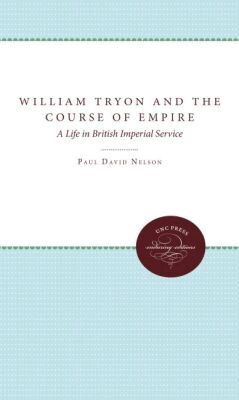
William Tryon's role in the affairs of British America during the last years of the empire, and his inability to stem the collapse of that empire, makes for a fascinating story. Royal governor of North Carolina from 1765 to 1771 and then of New York from 1771 to 1780, Tryon became a general in the British army attempting to quell the American rebellion. This biography covers his life in service to the Crown through the end of the American Revolution.Paul Nelson argues that Tryon was a talented colonial administrator and a successful, even popular, governor largely because he understood American thinking on such basic constitutional issues as taxation, finance, and trade policy. British home authorities failed to follow Tryon's sage counsel regarding the governance of the colonies, advice that might have forestalled the Revolution. In particular, Tryon, like Edmund Burke and others in Parliament, could not convince British ministers that Americans would never accept internal taxes imposed upon them by London.Once the war broke out and Tryon's role changed from governing to leading Loyalist American troops, he was an advocate of harsh, retributive warfare against his former charges. Nelson follows Tryon's military career, especially his debates with colleagues such as Sir Henry Clinton on the wisdom of hard-line versus conciliatory approach to the fighting. And after the war, Nelson shows, Tryon's connections with those unfortunate Americans who came out on the losing side of the great imperial struggle retained an important place in his life. An exciting drama in its own right, Tryon's story also serves to illuminate a number of issues important to historians of the Revolutionary War. Played out on two continents and in two important American colonies, amid the stirring events that resulted in the formation of the United States of America, Tryon's life is significant for understanding many aspects of politics and society in the Anglo-American world of the eighteenth century.A UNC Press Enduring Edition -- UNC Press Enduring Editions use the latest in digital technology to make available again books from our distinguished backlist that were previously out of print. These editions are published unaltered from the original, and are presented in affordable paperback formats, bringing readers both historical and cultural value.
629 kr
Skickas inom 10-15 vardagar
Though Major General James Grant's name appears in many early histories of Florida, he has been remembered primarily for one speech he delivered in Parliament in 1775 that disparaged American military might. In this biography, Nelson aims to establish Grant as an intelligent participant in the political and military events of his age. As the first royal governor of British colonial Florida (1763-73), Grant practically created the colony once it was secured from Spain at the end of the Seven Years' War. His deliberate cultivation of friendships in the neighbouring colonies of Georgia and South Carolina is part of the annals of royal administration, and he left behind a record of balanced, careful leadership. Even after he returned to Great Britain, where he represented Scottish constituencies in Parliament, he maintained an interest in Florida's fate, not least because he held tracts of land in East Florida that yielded profits from indigo. Using previously neglected Grant papers at Ballindalloch Castle in Scotland, as well as better-known materials, Nelson documents the roots of Grant's personality and ambitions, aiming to produce a work of interest for scholars of the American revolution and of military history, as well as early Florida and 18th century British history.
Francis Rawdon-Hastings Marguess of Hastings
Soldier, Peer of the Realm, Governor-General of India
Inbunden, Engelska, 2005
1 156 kr
Skickas inom 7-10 vardagar
Considering the importance of Francis Rawdon-Hastings, 1st Marquess of Hastings and 2nd Earl of Moira, it is surprising that no full-length biography has been written about him. The only significant studies of his career have been analysis of his role as governor-general of India in the early nineteenth century. Paul David Nelson's study rectifies this situation by providing a well-crafted scholarly analysis of the life of Lord Hastings. He covers in depth all aspects of the man's multifaceted career as a professional soldier, peer in the House of Lords, and governor-general of India. He also provides a character study of this intelligent, affable man, pointing out his strengths as a father, husband, and friend. In the process, Nelson does not lose sight of Hastings's personal ineptitude. He shows how the marquess ran up debts of nearly 1,000,000 by the time of his death and left his family almost penniless.The most important role that Hastings played was as a soldier in the British army. He was a young officer during the American war, fighting at Bunker Hill in 1775 as a lieutenant in the grenadier company of the 5th Regiment. Distinguishing himself, he was promoted captain and appointed aide-de-camp to General Henry Clinton. He went on to lead the Volunteers of Ireland, serve as adjutant general under Clinton, and to command an independent army in South Carolina in 1780-81. As governor-general of India from 1813 to 1823, he successfully led campaigns against the Nepalese, Pindaris, and Marathas. Hastings's second most important role was as an administrator in India. Although supported by able civilian subordinates, he sometimes made poor choices in his own appointments and became mired in the cloudy dealings of the Palmer Company. He was not guilty of any chicanery, but his reputation was marred by his defense of some questionable company activities.Hastings's third role was as a politician in the House of Lords. Here he was least successful, partly because he was not ruthless enough to rise to the