Paul Goren - Böcker
Visar alla böcker från författaren Paul Goren. Handla med fri frakt och snabb leverans.
5 produkter
5 produkter
1 098 kr
Skickas inom 5-8 vardagar
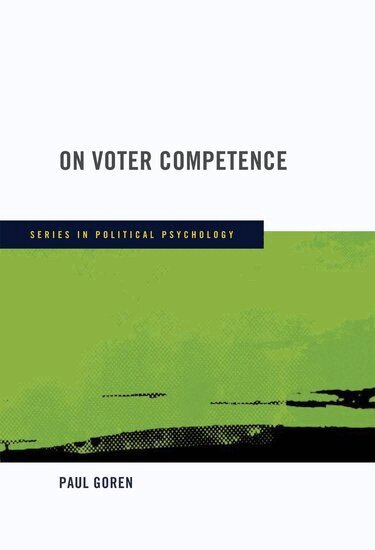
A half century of research shows that most citizens are shockingly uninformed about public affairs, liberal-conservative ideologies, and the issues of the day. This has led most scholars to condemn typical American voters as politically brainless and to conclude that policy voting lies beyond their reach. On Voter Competence breaks sharply from this view. According to Paul Goren, people vote based on abstract policy principles, a practice that has escaped scholars because they have searched for evidence of policy voting in the wrong places. Once we turn away from liberal-conservative predispositions and issue preferences, we find that nearly everyone holds genuine policy principles and uses these to guide their votes on election day. Three key principles divide the Democratic and Republican parties: limited government, traditional morality, and military strength. Deftly integrating research in social and political history, social and political psychology, and electoral behavior, Goren argues that nearly all citizens keep these principles in mind. The principles function as central heuristics in their belief systems, are rooted deeply in basic human values, and guide presidential choice to a similar degree for voters across the sophistication spectrum. Goren's comprehensive analysis of opinion data from the past six presidential elections and several new national surveys yields unequivocal support for these claims. Contrary to the indictment leveled by most of the scholarly community and political pundits more generally, ordinary citizens who are neither deeply knowledgeable nor engaged with the world of public affairs prove as adept as their more sophisticated counterparts in grounding presidential votes in abstract views about public policy. Insofar as citizen competence can be equated with the development and use of bedrock principles, the American voter performs far better than has been recognized in the past.
Moral Issues
How Public Opinion on Abortion and Gay Rights Affects American Religion and Politics
Inbunden, Engelska, 2024
912 kr
Skickas inom 7-10 vardagar
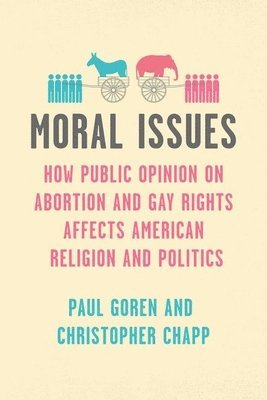
A new perspective on how beliefs about abortion and gay rights reshaped American politics.Many believe that religious and partisan identities undergird American public opinion. However, when it comes to abortion and gay rights, the reverse may be closer to the truth. Drawing on wide-ranging evidence, Paul Goren and Christopher Chapp show that views on abortion and gay rights are just as durable and politically impactful—and often more so—than political and religious identities. Goren and Chapp locate the lasting strength of stances on abortion and gay rights in the automatic, visceral emotions that the media has primed since the late 1980s. Moral Issues examines how attitudes toward these moralized issues affect, and can sometimes even disrupt, religious and partisan identities. Indeed, over the last thirty years, these attitudes have accelerated the rise of the religious “nones,” who have no religious affiliation, and promoted moral sorting into the Democratic and Republican parties.
Moral Issues
How Public Opinion on Abortion and Gay Rights Affects American Religion and Politics
Häftad, Engelska, 2024
263 kr
Skickas inom 7-10 vardagar
A new perspective on how beliefs about abortion and gay rights reshaped American politics.Many believe that religious and partisan identities undergird American public opinion. However, when it comes to abortion and gay rights, the reverse may be closer to the truth. Drawing on wide-ranging evidence, Paul Goren and Christopher Chapp show that views on abortion and gay rights are just as durable and politically impactful—and often more so—than political and religious identities. Goren and Chapp locate the lasting strength of stances on abortion and gay rights in the automatic, visceral emotions that the media has primed since the late 1980s. Moral Issues examines how attitudes toward these moralized issues affect, and can sometimes even disrupt, religious and partisan identities. Indeed, over the last thirty years, these attitudes have accelerated the rise of the religious “nones,” who have no religious affiliation, and promoted moral sorting into the Democratic and Republican parties.
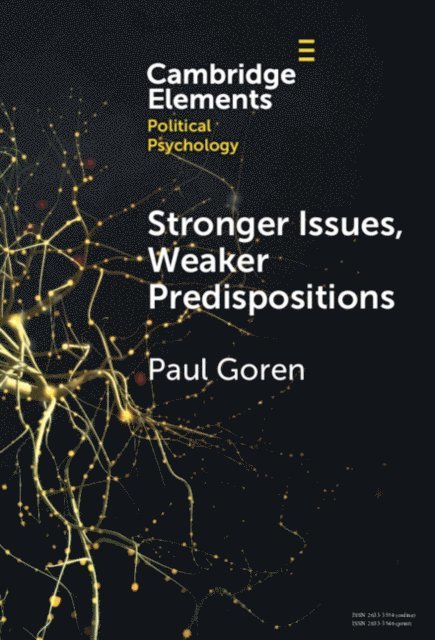
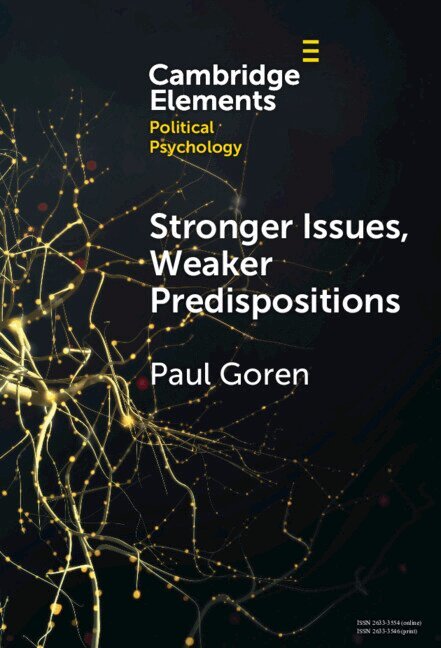
Stronger Issues, Weaker Predispositions
Abortion, Gay Rights, and Authoritarianism
Inbunden, Engelska, 2025
753 kr
Skickas inom 7-10 vardagar
Political psychologists have long theorized that authoritarianism structures the positions people take on cultural issues and their party ties. Authoritarianism is durable; it resists the influence of other political judgments; and it is very impactful-in a word, it is strong. By contrast, researchers characterize the attitudes most people hold on most issues as unstable and ineffectual-in a word, weak. But what is true of most issues is not true of the issues that have driven America's long running culture war-abortion and gay rights. This Element demonstrates that moral issue attitudes are stronger than authoritarianism. With data from multiple sources over the period 1992-2020, it shows that (1) moral issue attitudes endure longer than authoritarianism; (2) moral issues predict change in authoritarianism; (3) authoritarianism does not systematically predict change in moral issues; and (4) moral issues have always played a much greater role structuring party ties than authoritarianism.
Stronger Issues, Weaker Predispositions
Abortion, Gay Rights, and Authoritarianism
Häftad, Engelska, 2025
234 kr
Skickas inom 7-10 vardagar
Political psychologists have long theorized that authoritarianism structures the positions people take on cultural issues and their party ties. Authoritarianism is durable; it resists the influence of other political judgments; and it is very impactful-in a word, it is strong. By contrast, researchers characterize the attitudes most people hold on most issues as unstable and ineffectual-in a word, weak. But what is true of most issues is not true of the issues that have driven America's long running culture war-abortion and gay rights. This Element demonstrates that moral issue attitudes are stronger than authoritarianism. With data from multiple sources over the period 1992-2020, it shows that (1) moral issue attitudes endure longer than authoritarianism; (2) moral issues predict change in authoritarianism; (3) authoritarianism does not systematically predict change in moral issues; and (4) moral issues have always played a much greater role structuring party ties than authoritarianism.