Paul J Lavrakas – författare
2 193 kr
Skickas inom 10-15 vardagar
599 kr
Skickas inom 10-15 vardagar
1 518 kr
Läs direkt efter köp
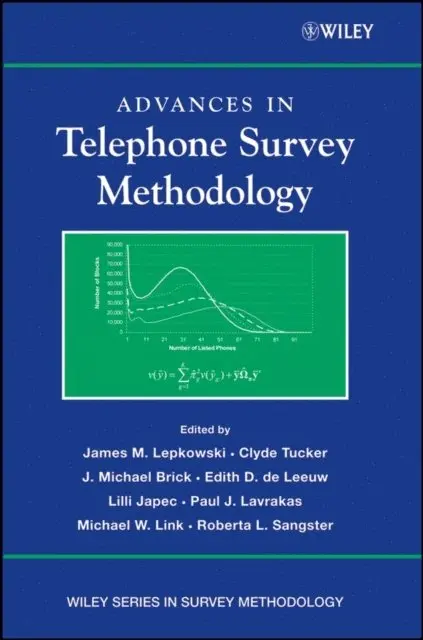
Over the past fifteen years, advances in technology have transformed the field of survey methodology, from how interviews are conducted to the management and analysis of compiled data. Advances in Telephone Survey Methodology is an all—encompassing and authoritative resource that presents a theoretical, methodological, and statistical treatment of current practices while also establishing a discussion on how state—of—the—art developments in telecommunications have and will continue to revolutionize the telephone survey process.
Seventy—five prominent international researchers and practitioners from government, academic, and private sectors have collaborated on this pioneering volume to discuss basic survey techniques and introduce the future directions of the telephone survey. Concepts and findings are organized in four parts—sampling and estimation, data collection, operations, and nonresponse—equipping the reader with the needed practical applications to approach issues such as choice of target population, sample design, questionnaire construction, interviewing training, and measurement error. The book also introduces important topics that have been overlooked in previous literature, including:
The impact of mobile telephones on telephone surveys and the rising presence of mobile—only households worldwide
The design and construction of questionnaires using Computer Assisted Telephone Interviewing (CATI) software
The emerging use of wireless communication and Voice over Internet Protocol (VoIP) versus the telephone
Methods for measuring and improving interviewer performance and productivity
Privacy, confidentiality, and respondent burden as main factors in telephone survey nonresponse
Procedures for the adjustment of nonresponse in telephone surveys
In—depth reviews of the literature presented along with a full bibliography, assembled from references throughout the world
Advances in Telephone Survey Methodology is an indispensable reference for survey researchers and practitioners in almost any discipline involving research methods such as sociology, social psychology, survey methodology, and statistics. This book also serves as an excellent text for courses and seminars on survey methods at the undergraduate and graduate levels.
Advances in Telephone Survey Methodology
1 530 kr
Skickas inom 3-6 vardagar
Telephone Survey Methods
Sampling, Selection, and Supervision
1 777 kr
Skickas inom 3-6 vardagar
2 759 kr
Skickas inom 3-6 vardagar
1 692 kr
Skickas inom 3-6 vardagar
706 kr
Läs direkt efter köp
706 kr
Läs direkt efter köp
1 053 kr
Läs direkt efter köp
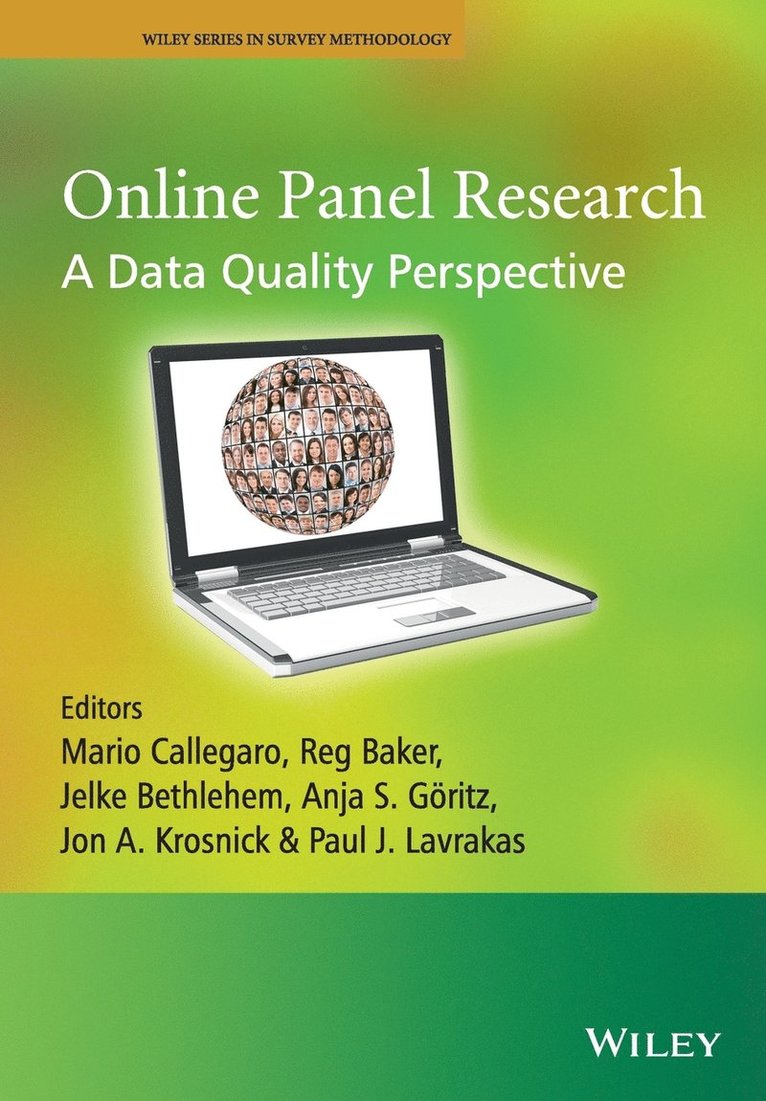
Over the last decade, there has been a major global shift in survey and market research towards data collection, using samples selected from online panels. Yet despite their widespread use, remarkably little is known about the quality of the resulting data.
This edited volume is one of the first attempts to carefully examine the quality of the survey data being generated by online samples. It describes some of the best empirically-based research on what has become a very important yet controversial method of collecting data. Online Panel Research presents 19 chapters of previously unpublished work addressing a wide range of topics, including coverage bias, nonresponse, measurement error, adjustment techniques, the relationship between nonresponse and measurement error, impact of smartphone adoption on data collection, Internet rating panels, and operational issues.
The datasets used to prepare the analyses reported in the chapters are available on the accompanying website: www.wiley.com/go/online_panel
Covers controversial topics such as professional respondents, speeders, and respondent validation. Addresses cutting-edge topics such as the challenge of smartphone survey completion, software to manage online panels, and Internet and mobile ratings panels. Discusses and provides examples of comparison studies between online panels and other surveys or benchmarks. Describes adjustment techniques to improve sample representativeness. Addresses coverage, nonresponse, attrition, and the relationship between nonresponse and measurement error with examples using data from the United States and Europe. Addresses practical questions such as motivations for joining an online panel and best practices for managing communications with panelists. Presents a meta-analysis of determinants of response quantity. Features contributions from 50 international authors with a wide variety of backgrounds and expertise.This book will be an invaluable resource for opinion and market researchers, academic researchers relying on web-based data collection, governmental researchers, statisticians, psychologists, sociologists, and other research practitioners.
1 053 kr
Läs direkt efter köp
Over the last decade, there has been a major global shift in survey and market research towards data collection, using samples selected from online panels. Yet despite their widespread use, remarkably little is known about the quality of the resulting data.
This edited volume is one of the first attempts to carefully examine the quality of the survey data being generated by online samples. It describes some of the best empirically-based research on what has become a very important yet controversial method of collecting data. Online Panel Research presents 19 chapters of previously unpublished work addressing a wide range of topics, including coverage bias, nonresponse, measurement error, adjustment techniques, the relationship between nonresponse and measurement error, impact of smartphone adoption on data collection, Internet rating panels, and operational issues.
The datasets used to prepare the analyses reported in the chapters are available on the accompanying website: www.wiley.com/go/online_panel
Covers controversial topics such as professional respondents, speeders, and respondent validation. Addresses cutting-edge topics such as the challenge of smartphone survey completion, software to manage online panels, and Internet and mobile ratings panels. Discusses and provides examples of comparison studies between online panels and other surveys or benchmarks. Describes adjustment techniques to improve sample representativeness. Addresses coverage, nonresponse, attrition, and the relationship between nonresponse and measurement error with examples using data from the United States and Europe. Addresses practical questions such as motivations for joining an online panel and best practices for managing communications with panelists. Presents a meta-analysis of determinants of response quantity. Features contributions from 50 international authors with a wide variety of backgrounds and expertise.This book will be an invaluable resource for opinion and market researchers, academic researchers relying on web-based data collection, governmental researchers, statisticians, psychologists, sociologists, and other research practitioners.
1 306 kr
Skickas inom 5-8 vardagar
1 503 kr
Läs direkt efter köp
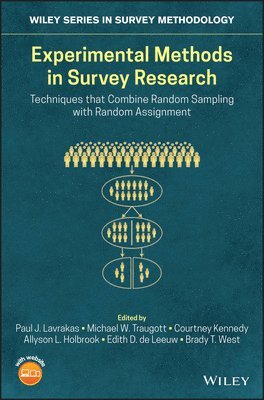
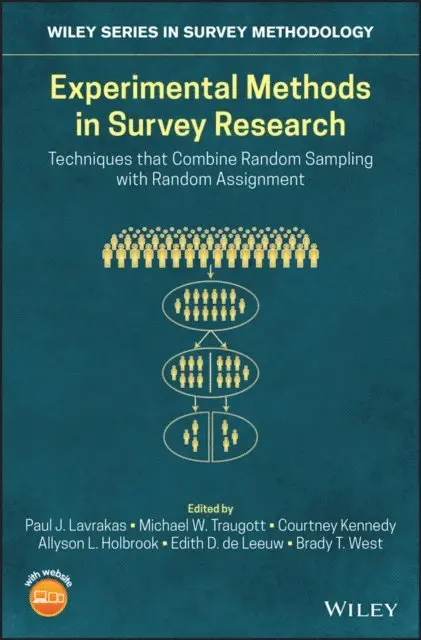
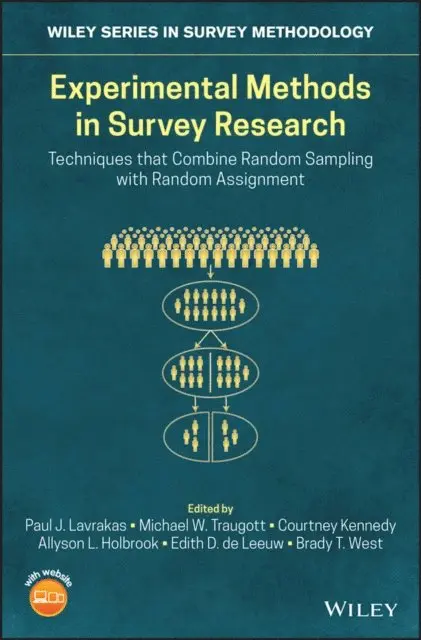
A thorough and comprehensive guide to the theoretical, practical, and methodological approaches used in survey experiments across disciplines such as political science, health sciences, sociology, economics, psychology, and marketing
This book explores and explains the broad range of experimental designs embedded in surveys that use both probability and non-probability samples. It approaches the usage of survey-based experiments with a Total Survey Error (TSE) perspective, which provides insight on the strengths and weaknesses of the techniques used.
Experimental Methods in Survey Research: Techniques that Combine Random Sampling with Random Assignment addresses experiments on within-unit coverage, reducing nonresponse, question and questionnaire design, minimizing interview measurement bias, using adaptive design, trend data, vignettes, the analysis of data from survey experiments, and other topics, across social, behavioral, and marketing science domains.
Each chapter begins with a description of the experimental method or application and its importance, followed by reference to relevant literature. At least one detailed original experimental case study then follows to illustrate the experimental method’s deployment, implementation, and analysis from a TSE perspective. The chapters conclude with theoretical and practical implications on the usage of the experimental method addressed. In summary, this book:
Fills a gap in the current literature by successfully combining the subjects of survey methodology and experimental methodology in an effort to maximize both internal validity and external validity Offers a wide range of types of experimentation in survey research with in-depth attention to their various methodologies and applications Is edited by internationally recognized experts in the field of survey research/methodology and in the usage of survey-based experimentation —featuring contributions from across a variety of disciplines in the social and behavioral sciences Presents advances in the field of survey experiments, as well as relevant references in each chapter for further study Includes more than 20 types of original experiments carried out within probability sample surveys Addresses myriad practical and operational aspects for designing, implementing, and analyzing survey-based experiments by using a Total Survey Error perspective to address the strengths and weaknesses of each experimental technique and methodExperimental Methods in Survey Research: Techniques that Combine Random Sampling with Random Assignment is an ideal reference for survey researchers and practitioners in areas such political science, health sciences, sociology, economics, psychology, public policy, data collection, data science, and marketing. It is also a very useful textbook for graduate-level courses on survey experiments and survey methodology.

1 463 kr
Läs direkt efter köp
A thorough and comprehensive guide to the theoretical, practical, and methodological approaches used in survey experiments across disciplines such as political science, health sciences, sociology, economics, psychology, and marketing
This book explores and explains the broad range of experimental designs embedded in surveys that use both probability and non-probability samples. It approaches the usage of survey-based experiments with a Total Survey Error (TSE) perspective, which provides insight on the strengths and weaknesses of the techniques used.
Experimental Methods in Survey Research: Techniques that Combine Random Sampling with Random Assignment addresses experiments on within-unit coverage, reducing nonresponse, question and questionnaire design, minimizing interview measurement bias, using adaptive design, trend data, vignettes, the analysis of data from survey experiments, and other topics, across social, behavioral, and marketing science domains.
Each chapter begins with a description of the experimental method or application and its importance, followed by reference to relevant literature. At least one detailed original experimental case study then follows to illustrate the experimental method’s deployment, implementation, and analysis from a TSE perspective. The chapters conclude with theoretical and practical implications on the usage of the experimental method addressed. In summary, this book:
Fills a gap in the current literature by successfully combining the subjects of survey methodology and experimental methodology in an effort to maximize both internal validity and external validity Offers a wide range of types of experimentation in survey research with in-depth attention to their various methodologies and applications Is edited by internationally recognized experts in the field of survey research/methodology and in the usage of survey-based experimentation —featuring contributions from across a variety of disciplines in the social and behavioral sciences Presents advances in the field of survey experiments, as well as relevant references in each chapter for further study Includes more than 20 types of original experiments carried out within probability sample surveys Addresses myriad practical and operational aspects for designing, implementing, and analyzing survey-based experiments by using a Total Survey Error perspective to address the strengths and weaknesses of each experimental technique and methodExperimental Methods in Survey Research: Techniques that Combine Random Sampling with Random Assignment is an ideal reference for survey researchers and practitioners in areas such political science, health sciences, sociology, economics, psychology, public policy, data collection, data science, and marketing. It is also a very useful textbook for graduate-level courses on survey experiments and survey methodology.
896 kr
Skickas inom 5-8 vardagar
785 kr
Skickas inom 10-15 vardagar
1 471 kr
Skickas inom 3-6 vardagar
915 kr
Läs direkt efter köp
915 kr
Läs direkt efter köp
485 kr
Skickas inom 5-8 vardagar
226 kr
Skickas inom 5-8 vardagar
1 048 kr
Skickas inom 10-15 vardagar
451 kr
Skickas inom 10-15 vardagar
484 kr
Läs direkt efter köp
5 769 kr
Tillfälligt slut