Paul J. Quirk - Böcker
Visar alla böcker från författaren Paul J. Quirk. Handla med fri frakt och snabb leverans.
8 produkter
8 produkter
1 252 kr
Skickas inom 5-8 vardagar
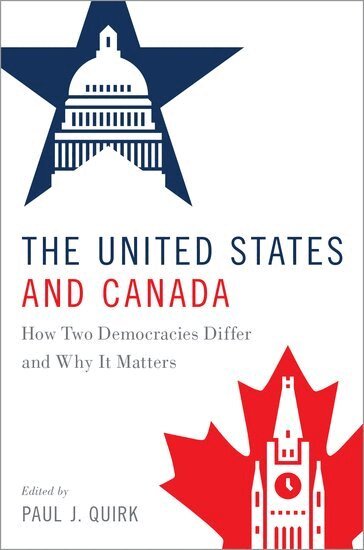
The United States and Canada share the longest border in the world, maintain one of the closest alliances, and are notably similar in many ways. Yet the two countries also have important differences, including sharply contrasting political institutions. In The United States and Canada, Paul J. Quirk has gathered a distinguished cast of contributors to present an integrated comparative examination of the political systems of the United States and Canada-with special attention to the effects of political institutions and their interaction with political values, geographic and demographic factors, and other influences. The volume explores the differences between the American presidential (or separation-of-powers) system and the Canadian parliamentary system-focusing on electoral and party systems, executive leadership and the legislative process, bureaucratic influence, and federalism. It proceeds to examine patterns of governance in a wide range of issue areas: economic policy; climate-change policy; healthcare policy; civil rights/integration and immigration; and abortion and gay rights. A sweeping comparative account, this volume serves as an authoritative guide for anyone interested in why the two countries differ and where they might be headed.
712 kr
Skickas inom 5-8 vardagar
The United States and Canada share the longest border in the world, maintain one of the closest alliances, and are notably similar in many ways. Yet the two countries also have important differences, including sharply contrasting political institutions. In The United States and Canada, Paul J. Quirk has gathered a distinguished cast of contributors to present an integrated comparative examination of the political systems of the United States and Canada-with special attention to the effects of political institutions and their interaction with political values, geographic and demographic factors, and other influences. The volume explores the differences between the American presidential (or separation-of-powers) system and the Canadian parliamentary system-focusing on electoral and party systems, executive leadership and the legislative process, bureaucratic influence, and federalism. It proceeds to examine patterns of governance in a wide range of issue areas: economic policy; climate-change policy; healthcare policy; civil rights/integration and immigration; and abortion and gay rights. A sweeping comparative account, this volume serves as an authoritative guide for anyone interested in why the two countries differ and where they might be headed.
973 kr
Skickas inom 5-8 vardagar
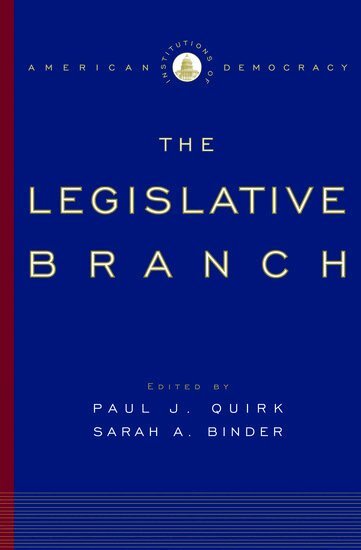
The checks and balances provided by the three branches of federal government are essential to nurturing and maintaining American democracy. With the guidance of coeditors Paul J. Quirk and Sarah A. Binder, this collection of essays examines the role of the Legislature in American democracy and the dynamic between the other branches of government, and discusses possible measures for reform.The volume addresses questions such as: How does Congress serve the values of democracy and American constitutional principles? Which conceptions of those values does it implement, and which does it overlook or fail to realize? What are Congress's strengths and weaknesses in performing the tasks of democratic governance? What reforms, if any, are necessary to ensure the health and success of Congress as an institution of democracy in the future?
417 kr
Skickas inom 5-8 vardagar
The checks and balances provided by the three branches of federal government are essential to nurturing and maintaining American democracy. With the guidance of coeditors Paul J. Quirk and Sarah A. Binder, this collection of essays examines the role of the Legislature in American democracy and the dynamic between the other branches of government, and discusses possible measures for reform.The volume addresses questions such as: How does Congress serve the values of democracy and American constitutional principles? Which conceptions of those values does it implement, and which does it overlook or fail to realize? What are Congress's strengths and weaknesses in performing the tasks of democratic governance? What reforms, if any, are necessary to ensure the health and success of Congress as an institution of democracy in the future?
799 kr
Skickas inom 7-10 vardagar
The task of deliberating public policy falls preeminently to Congress. But decisions on matters ranging from budget deficits to the war with Iraq, among others, raise serious doubts about its performance. In "Deliberative Choices", Gary Mucciaroni and Paul J. Quirk assess congressional deliberation by analyzing debate on the House and Senate floors. Does debate genuinely inform members of Congress and the public? Or does it mostly mislead and manipulate them? Mucciaroni and Quirk argue that in fashioning the claims they use in debate, legislators make a strategic trade-off between boosting their rhetorical force and ensuring their ability to withstand scrutiny. Using three case studies - welfare reform, repeal of the estate tax, and telecommunications deregulation - the authors show how legislators' varying responses to such a trade-off shape the issues they focus on, the claims they make, and the information they provide in support of those claims. Mucciaroni and Quirk conclude that congressional debate generally is only moderately realistic and informed. It often trades in half-truths, omissions, and sometimes even outright falsehoods. Yet some debates are highly informative.Moreover, the authors believe it's possible to improve congressional deliberation, and they recommend reforms designed to do so.
817 kr
Skickas inom 3-6 vardagar
Federal regulatory agencies are often assumed to be excessively responsive to and influenced by the corporate interests they are supposed to regulate. On the basis of direct empirical examination, Paul Quirk challenges this assumption as it relates to four United States federal regulatory agencies. Through a series of interviews with high-level officials of the Federal Trade Commission, the Civil Aeronautics Board, the Food and Drug Administration, and the National Highway Traffic Safety Administration, he determines whether and what kinds of incentives exist to adopt policies favorable to industry. Originally published in 1981. The Princeton Legacy Library uses the latest print-on-demand technology to again make available previously out-of-print books from the distinguished backlist of Princeton University Press. These editions preserve the original texts of these important books while presenting them in durable paperback and hardcover editions. The goal of the Princeton Legacy Library is to vastly increase access to the rich scholarly heritage found in the thousands of books published by Princeton University Press since its founding in 1905.
1 817 kr
Skickas inom 3-6 vardagar
Federal regulatory agencies are often assumed to be excessively responsive to and influenced by the corporate interests they are supposed to regulate. On the basis of direct empirical examination, Paul Quirk challenges this assumption as it relates to four United States federal regulatory agencies. Through a series of interviews with high-level officials of the Federal Trade Commission, the Civil Aeronautics Board, the Food and Drug Administration, and the National Highway Traffic Safety Administration, he determines whether and what kinds of incentives exist to adopt policies favorable to industry. Originally published in 1981. The Princeton Legacy Library uses the latest print-on-demand technology to again make available previously out-of-print books from the distinguished backlist of Princeton University Press. These editions preserve the original texts of these important books while presenting them in durable paperback and hardcover editions. The goal of the Princeton Legacy Library is to vastly increase access to the rich scholarly heritage found in the thousands of books published by Princeton University Press since its founding in 1905.
287 kr
Skickas inom 10-15 vardagar
The standard wisdom among political scientists has been that ""iron triangles"" operated among regulatory agencies, the regulated industries, and members of Congress, all presumably with a stake in preserving regulation that protected the industries from competition. Despite almost unanimous agreement among economists that such regulation was inefficient, it seemed highly unlikely that deregulation could occur. Yet between 1975 and 1980 major deregulatory changes that strongly favored competition did take place in a wide range of industries. The results are familiar to airline passengers, users of telephone service, and trucking freight shippers, among others. Martha Derthick and Paul J. Quirk ask why this deregulation happened. How did a diffuse public interest prevail over the powerful industry and union interests that sought to preserve regulation? Why did the regulatory commissions, which were expected to be a major obstacle to deregulation, instead take the initiative on behalf of it? And why did influential members of Congress push for even greater deregulation? The authors concentrate on three cases: airlines, trucking, and telecommunications. They find important similarities among the cases and discuss the implications of these findings for two broader topics: the role that economic analysis has played in policy change, and the capacity of the American political system for transcending narrow interests.