Paul Knottnerus - Böcker
Visar alla böcker från författaren Paul Knottnerus. Handla med fri frakt och snabb leverans.
3 produkter
3 produkter
1 059 kr
Skickas inom 10-15 vardagar
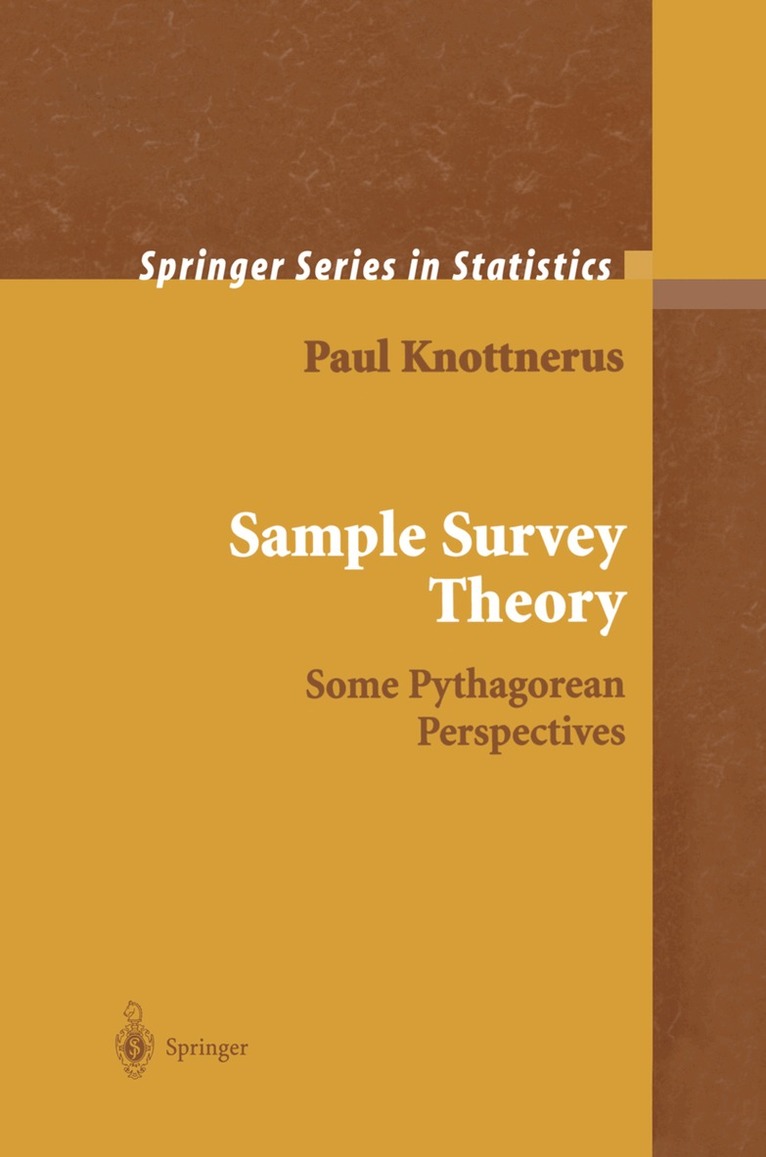
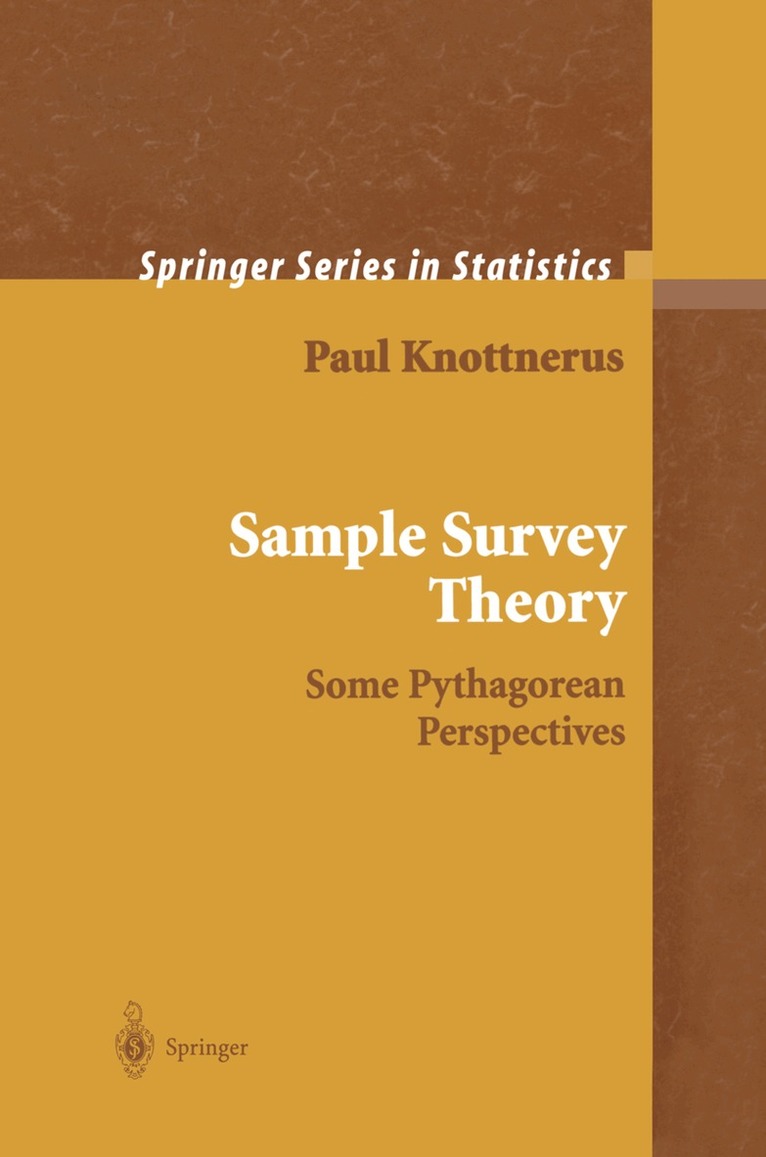
This book describes a novel approach to the theory of sampling from finite populations. The new unifying approach is based on the sampling autocorrelation coefficient. The author derives a general set of sampling equations that describe the estimators, their variances as well as the corresponding variance estimators. These equations are applicable for a family of different sampling designs, varying from simple surveys to complex surveys based on multistage sampling without replacement and unequal probabilities. The book also considers constrained estimation problems that may occur when linear or nonlinear economic restrictions are imposed on the population parameters to be estimated and the observations stem from different surveys. This volume also offers a guide to little-known connections between design-based survey sampling and other areas of statistics. The common underlying principles in the distinct fields are explained by an extensive use of the geometry of the ancient Pythagorean theorem.
1 059 kr
Skickas inom 10-15 vardagar
This volume deals primarily with the classical question of how to draw conclusions about the population mean of a variable, given a sample with observations on that variable. Another classical question is how to use prior knowledge of an economic or definitional relationship between the popu lation means of several variables, provided that the variables are observed in a sample. The present volume is a compilation of two discussion papers and some additional notes on these two basic questions. The discussion papers and notes were prepared for a 15-hour course at Statistics Nether lands in Voorburg in February 2000. The first discussion paper is entitled "A Memoir on Sampling and Rho, the Generalized Intrasample Correlation Coefficient" (1999). It describes a new approach to the problem of unequal probability sampling. The second discussion paper "The General Restric tion Estimator" (2000), deals with the problem of how to find constrained estimators that obey a given set of restrictions imposed on the parameters to be estimated. Parts I and II of the volume provide a novel and systematic treatment of sampling theory considered from the angle of the sampling autocorrelation coefficient p (rho). The same concept plays an important role in the analysis of time series. Although this concept is also well known in sampling theory, for instance in cluster sampling and systematic sampling, generalizations of p for an arbitrary sampling design are to my knowledge not readily found in the literature.
Del 358 - Lecture Notes in Economics and Mathematical Systems
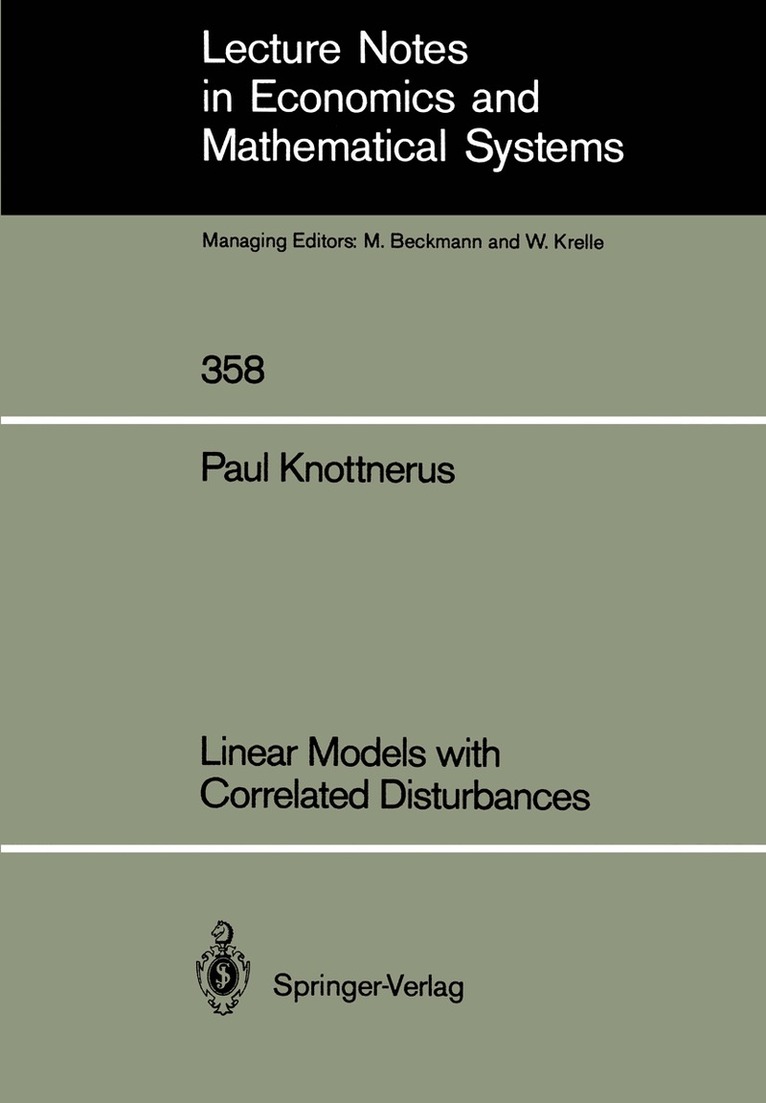
Linear Models with Correlated Disturbances
Häftad, Engelska, 1991
1 091 kr
Skickas inom 10-15 vardagar
The main aim of this volume is to give a survey of new and old estimation techniques for regression models with correlated disturbances, especially with autoregressive-moving average disturbances. In nearly all chapters the usefulness of the simple geometric interpretation of the classical ordinary Least Squares method is demonstrated. It emerges that both well-known and new results can be derived in a simple geometric manner, e.g., the conditional normal distribution, the Kalman filter equations and the Cramer-Rao inequality. The same geometric interpretation also shows that disturbances which follow an arbitrary correlation process can easily be transformed into a white noise sequence. This is of special interest for Maximum Likelihood estimation. Attention is paid to the appropriate estimation method for the specific situation that observations are missing. Maximum Likelihood estimation of dynamic models is also considered. The final chapter is concerned with several test strategies for detecting the genuine correlation structure among the disturbances.The geometric approach throughout the book provides a coherent insight in apparently different subjects in the econometric field of time series analysis.