Paul W. Franks - Böcker
Visar alla böcker från författaren Paul W. Franks. Handla med fri frakt och snabb leverans.
2 produkter
2 produkter
2 292 kr
Kommande
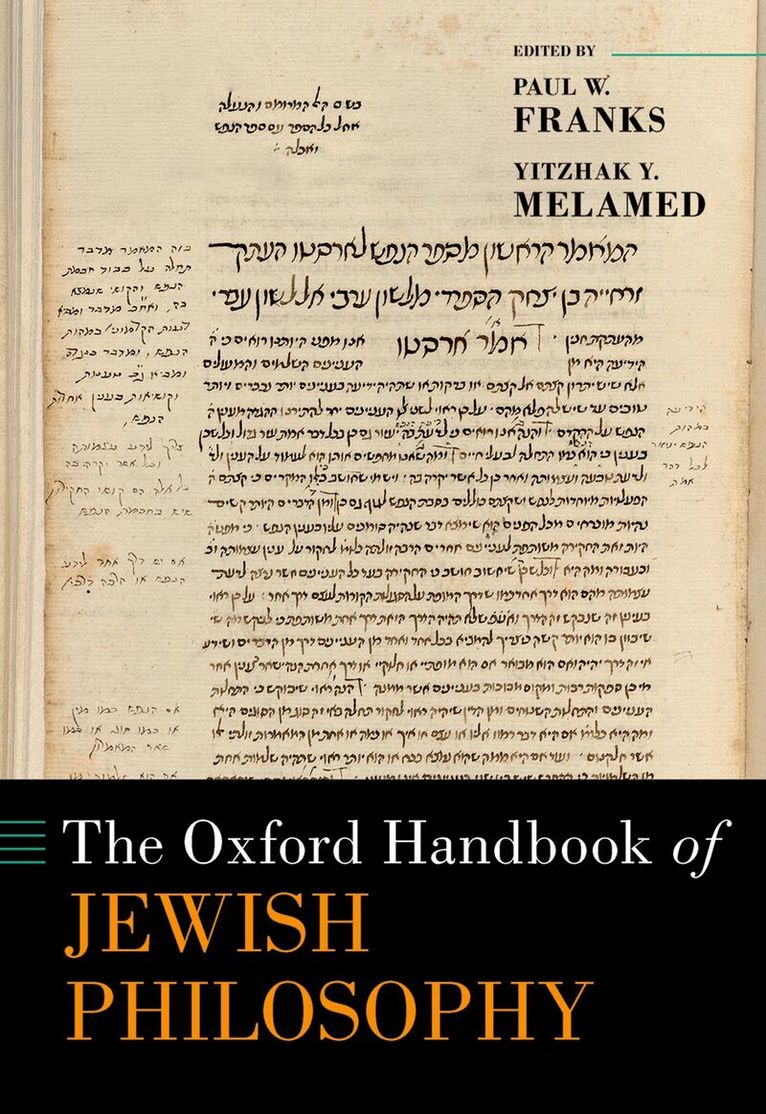
This Handbook provides an examined and nuanced overview of the history and devlopment of Jewish philosophy, from antiquity up to current trends in the field. Editors Paul W. Franks and Yitzhak Y. Melamed have brought together an international team of philosophers and scholars to tackle a complex and multi-layered literary corpus that stretches over two millennia. This volume is comprised of six divisions, each telling the story of Jewish philosophy from a distinctive vantage point: an introductory section addressing the place and historiography of Jewish philosophy within broader academia; the history of Jewish philosophy with an eye towards major schools and periods; interactions between Jewish philosophy and other branches of the Jewish literarary tradition; interactions with non-Jewish philosophy; key topics in Jewish philosophy; and new directions in the field. The result is a uniquely comprehensive and multi-layered survey of this incredibly important intellectual tradition. Drawing from thinkers at the top of their field and edited by two of the most important philosophers working today, this Handbook is the authoritative guide to the history, development, and trajectory of Jewish philosophy.
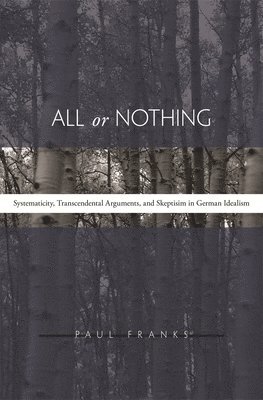
All or Nothing
Systematicity, Transcendental Arguments, and Skepticism in German Idealism
Inbunden, Engelska, 2005
772 kr
Skickas inom 10-15 vardagar
Interest in German Idealism--not just Kant, but Fichte and Hegel as well--has recently developed within analytic philosophy, which traditionally defined itself in opposition to the Idealist tradition. Yet one obstacle remains especially intractable: the Idealists' longstanding claim that philosophy must be systematic. In this work, the first overview of the German Idealism that is both conceptual and methodological, Paul W. Franks offers a philosophical reconstruction that is true to the movement's own times and resources and, at the same time, deeply relevant to contemporary thought. At the center of the book are some neglected but critical questions about German Idealism: Why do Fichte, Schelling, and Hegel think that philosophy's main task is the construction of a system? Why do they think that every part of this system must derive from a single, immanent and absolute principle? Why, in short, must it be all or nothing? Through close examination of the major Idealists as well as the overlooked figures who influenced their reading of Kant, Franks explores the common ground and divergences between the philosophical problems that motivated Kant and those that, in turn, motivated the Idealists. The result is a characterization of German Idealism that reveals its sources as well as its pertinence--and its challenge--to contemporary philosophical naturalism.