Paul W. Schroeder - Böcker
Visar alla böcker från författaren Paul W. Schroeder. Handla med fri frakt och snabb leverans.
6 produkter
6 produkter
4 314 kr
Skickas inom 7-10 vardagar
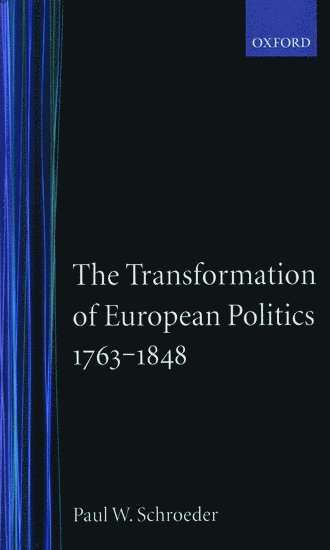
This is the only modern study of European politics to cover the entire timespan from the end of the Seven Years' War in 1763 to the revolutionary year of 1848. Paul Schroeder's comprehensive and authoritative volume charts the course of international history over this turbulent period, in which the map of Europe was redrawn time and again. Professor Schroeder examines the wars, political crises, and diplomatic opportunities of the age, many of which - the Revolutionary and Napoleonic Wars, the Congress of Vienna and its aftermath - had far-reaching consequences for modern Europe.Professor Schroeder provides a new account of the course of international politics over these years and a major reinterpretation of the structure and operation of the international system. He shows how the practice of international politics was transformed in revolutionary ways, with far-reaching and beneficial effects. The Vienna Settlement established peace by abandoning the competitive balance-of-power politics of the eighteenth century, and devising a new political equilibrium. It created a European consensus on a new political balance with new rules to maintain it, ushering in a uniquely peaceful, progessive period in European international politics.
Metternich's Diplomacy at Its Zenith, 1820-1823
Austria and the Congresses of Troppau, Laibach, and Verona
Häftad, Engelska, 1962
325 kr
Skickas inom 10-15 vardagar
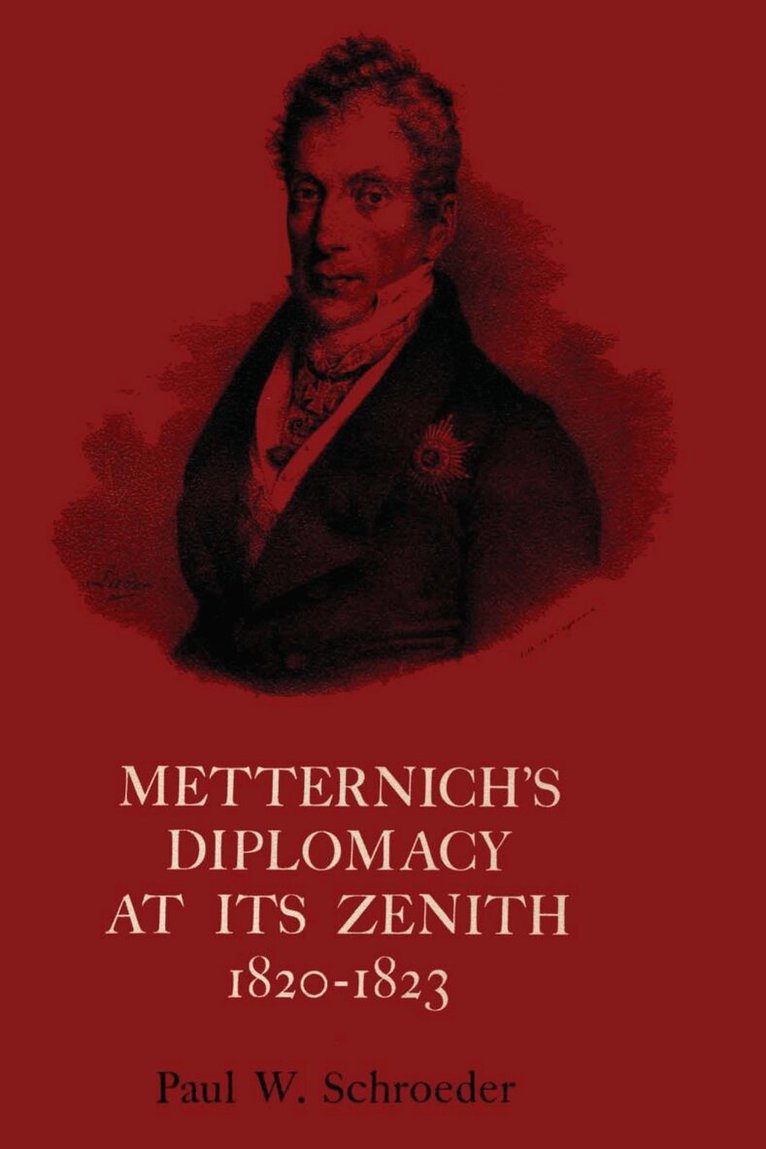
What Metiernich wanted at the peak of his career, why he wanted it, and the methods by which he achieved his goals are questions brilliantly answered in this survey and analysis of the Austrian chancellor's diplomacy during the period when he was the pre-eminent figure in European politics. Metternich's single-minded objective during 1820–1823 was to preserve the Austrian hegemony he had gained in Central Europe after long wars, enormous effort, and great sacrifice. If the internal security and international-power position secured by Austria at the Congress of Vienna were to be defended against the impact of widespread revolution in Europe, it was imperative that peace in Europe and the status quo be maintained. This required an unyielding opposition to all political movements that might disturb the equilibrium, especially French chauvinism and the spread of French constitutional ideas. A one-man distillate of the doctrine of absolute monarchy, Metternich was the relentless foe of any cause, just or unjust, that threatened European repose. Hence, when the revolution in Naples seriously menaced Austrian hegemony in Italy, Metternich determined that the constitutional regime in Naples must be overthrown by an Austrian armed force, an absolute monarchy restored, and an Austrian army of occupation kept there. Nor did he scruple to use duplicity, secret negotiation, trickery, or deceit against ally and adversary alike in his effort to enlist them in the common cause of all thrones. At the Congress of Troppau, Metternich succeeded not only in defeating Russian ideas for peaceful intervention and a moderate constitution at Naples, but also in converting Tsar Alexander to thoroughly conservative views, thereby making Russia a powerful supporter of Austrian policies and knowingly alienating England, formerly Austria's closest ally. Paul W. Schroeder brings to this bookexceptional scholarship and an objectivity hard to attain when dealing with a personality. Although Metternich, as Schroeder sees him, doubtless helped to maintain European peace and order, his real greatness consisted not in his European principles, but in his ability to defend Austrian interests under the guise of European principles. The evidence, gathered from documentary material in the Haus Hof- und Staatsarchiv in Vienna, has forced the author to the conclusion that Metternich was no real statesman. The very qualities that distinguished him as a brilliant diplomat-keen vision, cogent analysis, fertility of expedients, farsightedness, flexibility, and firmness of purpose-were converted into those of blindness to reality, superficial analysis, sterility of expedients, dogmatism, and failure of will when confronted with fundamental problems of state and society.
288 kr
Skickas inom 7-10 vardagar
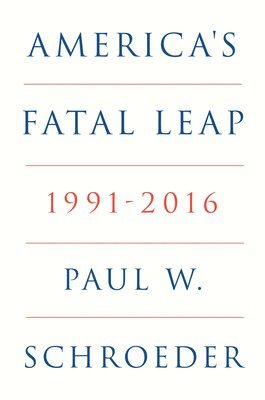
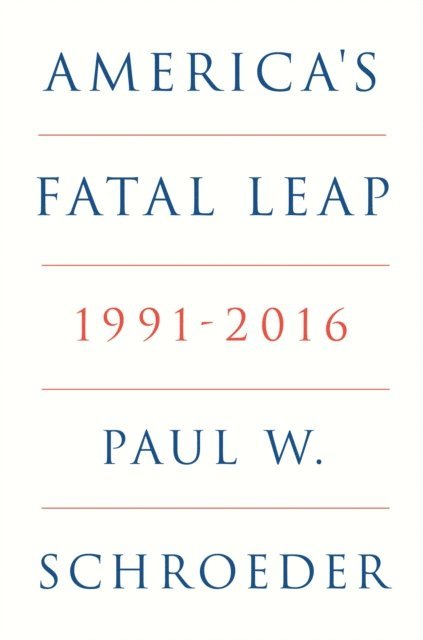
America's Fatal Leap deconstructs US geopolitics after the end of the Cold War, informed by its author's unsurpassed command of modern history. Paul W. Schroeder, an acclaimed historian of international diplomacy, was a conservative and a natural supporter of American leadership in the world. But he wrote scathing op-eds for the National Interest and the American Conservative about the hubris and moral failings of the War on Terror, warning of damaging long-range effects on the international system. Schroeder compared 9/11 to the assassination in Sarajevo that sparked the First World War, insisting that a great power should never give terrorists a war they wanted. He wrote with extraordinary prescience - months before the US launched its attack on the Taliban - of the 'risks of victory' in Afghanistan, characterised the war in Iraq as a failed bid for informal empire, and called for 'disimperialism' in the Middle East.America's Fatal Leap collects Schroeder's remarkable interventions on America's adventurism in the Middle East, from the 1991 Gulf War to the Surge of 2007. It includes an Introduction by Perry Anderson, author of US Foreign Policy and Its Thinkers and Ever Closer Union?
Stealing Horses to Great Applause
The Origins of the First World War Reconsidered
Inbunden, Engelska, 2025
409 kr
Skickas
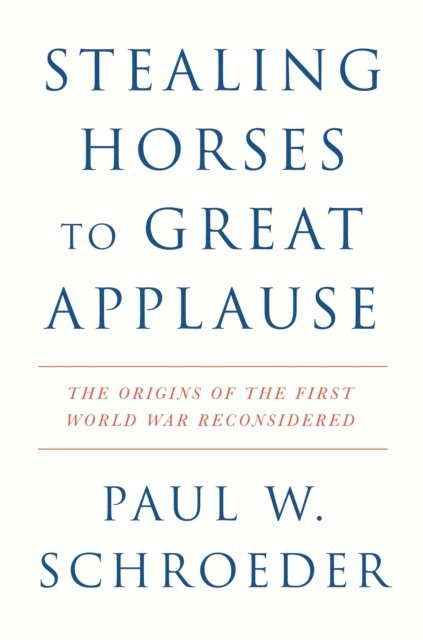
Stealing Horses presents arguably the finest considerations yet of the origins of the First World War. Breaking with accounts which focus on the actions of a single state or the final countdown to hostilities, Paul W. Schroeder describes the systemic crisis engulfing the Great Powers. They were more interested in colonial plunder overseas ('stealing horses to great applause', in the old Spanish adage) than the traditional statecraft of European peace-making. Preserving the balance of power required preserving all the essential actors in it, including a tottering Austria-Hungary. This the British in particular failed to recognise. The Central Powers may have started the War but that does not mean they in any real sense caused it. In the end Schroeder recalls the verdict of Shakespeare's Romeo and Juliet: 'All are punished'.Stealing Horses includes appraisals of Niall Ferguson and A. J. P. Taylor, and an extensive unpublished final paper re-thinking the First World War as 'the last 18th-century war'.With an Introduction by Perry Anderson.
198 kr
Kommande
America's Fatal Leap deconstructs US geopolitics after the end of the Cold War, informed by its author's unsurpassed command of modern history. Paul W. Schroeder, an acclaimed historian of international diplomacy, was a conservative and a natural supporter of American leadership in the world. But he wrote scathing op-eds for the National Interest and the American Conservative about the hubris and moral failings of the War on Terror, warning of damaging long-range effects on the international system. Schroeder compared 9/11 to the assassination in Sarajevo that sparked the First World War, insisting that a great power should never give terrorists a war they wanted. He wrote with extraordinary prescience - months before the US launched its attack on the Taliban - of the 'risks of victory' in Afghanistan, characterised the war in Iraq as a failed bid for informal empire, and called for 'disimperialism' in the Middle East.America's Fatal Leap collects Schroeder's remarkable interventions on America's adventurism in the Middle East, from the 1991 Gulf War to the Surge of 2007. It includes an Introduction by Perry Anderson, author of US Foreign Policy and Its Thinkers and Ever Closer Union?
Stealing Horses to Great Applause
The Origins of the First World War Reconsidered
Häftad, Engelska, 2026
235 kr
Kommande
Stealing Horses to Great Applause is arguably the finest consideration yet of the origins of the First World War. Breaking with accounts focusing on the actions of a single state or the final countdown to hostilities, Paul W. Schroeder analyzes the systemic crisis that engulfed the Great Powers in 1914. Increasingly, they had become more interested in colonial expansion abroad ('stealing horses to great applause', in the old Spanish adage) than in the traditional conventions of European peacemaking. They forgot the rule that a balance of power required the preservation of all its essential actors, including the weakest of them, Austria-Hungary. This the British too failed to heed. The Central Powers may have started the war, but that does not mean they in any real sense caused it.Stealing Horses includes appraisals of Niall Ferguson and A. J. P. Taylor as well as an extensive unpublished final work rethinking the First World War as 'the last eighteenth-century war'.With an introduction by Perry Anderson.