Pavel B. Brazdil - Böcker
Visar alla böcker från författaren Pavel B. Brazdil. Handla med fri frakt och snabb leverans.
3 produkter
3 produkter
1 640 kr
Skickas inom 10-15 vardagar
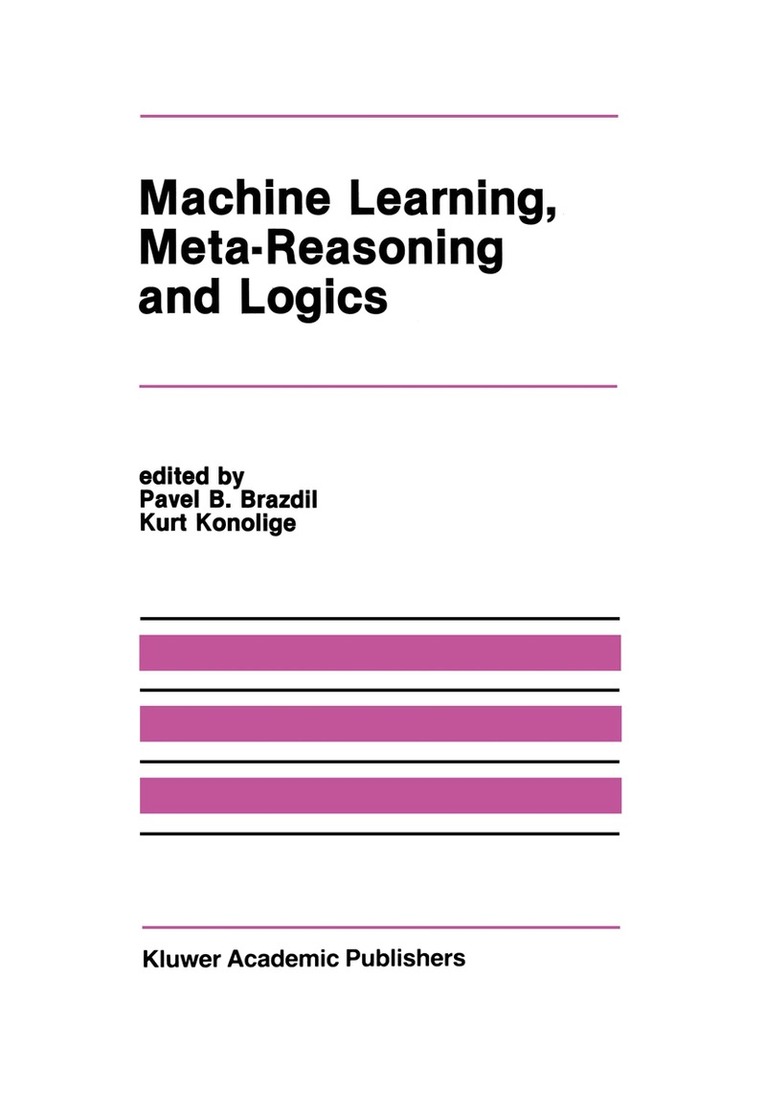
This book contains a selection of papers presented at the International Workshop Machine Learning, Meta-Reasoning and Logics held in Hotel de Mar in Sesimbra, Portugal, 15-17 February 1988. All the papers were edited afterwards. The Workshop encompassed several fields of Artificial Intelligence: Machine Learning, Belief Revision, Meta-Reasoning and Logics. The objective of this Workshop was not only to address the common issues in these areas, but also to examine how to elaborate cognitive architectures for systems capable of learning from experience, revising their beliefs and reasoning about what they know. Acknowledgements The editing of this book has been supported by COST-13 Project Machine Learning and Knowledge Acquisition funded by the Commission o/the European Communities which has covered a substantial part of the costs. Other sponsors who have supported this work were Junta Nacional de lnvestiga~ao Cientlfica (JNICT), lnstituto Nacional de lnvestiga~ao Cientlfica (INIC), Funda~ao Calouste Gulbenkian. I wish to express my gratitude to all these institutions. Finally my special thanks to Paula Pereira and AnaN ogueira for their help in preparing this volume. This work included retyping all the texts and preparing the camera-ready copy. Introduction 1 1. Meta-Reasoning and Machine Learning The first chapter is concerned with the role meta-reasoning plays in intelligent systems capable of learning. As we can see from the papers that appear in this chapter, there are basically two different schools of thought.
1 640 kr
Skickas inom 10-15 vardagar
This book contains a selection of papers presented at the International Workshop Machine Learning, Meta-Reasoning and Logics held in Hotel de Mar in Sesimbra, Portugal, 15-17 February 1988. All the papers were edited afterwards. The Workshop encompassed several fields of Artificial Intelligence: Machine Learning, Belief Revision, Meta-Reasoning and Logics. The objective of this Workshop was not only to address the common issues in these areas, but also to examine how to elaborate cognitive architectures for systems capable of learning from experience, revising their beliefs and reasoning about what they know. Acknowledgements The editing of this book has been supported by COST-13 Project Machine Learning and Knowledge Acquisition funded by the Commission o/the European Communities which has covered a substantial part of the costs. Other sponsors who have supported this work were Junta Nacional de lnvestiga~ao Cientlfica (JNICT), lnstituto Nacional de lnvestiga~ao Cientlfica (INIC), Funda~ao Calouste Gulbenkian. I wish to express my gratitude to all these institutions. Finally my special thanks to Paula Pereira and AnaN ogueira for their help in preparing this volume. This work included retyping all the texts and preparing the camera-ready copy. Introduction 1 1. Meta-Reasoning and Machine Learning The first chapter is concerned with the role meta-reasoning plays in intelligent systems capable of learning. As we can see from the papers that appear in this chapter, there are basically two different schools of thought.
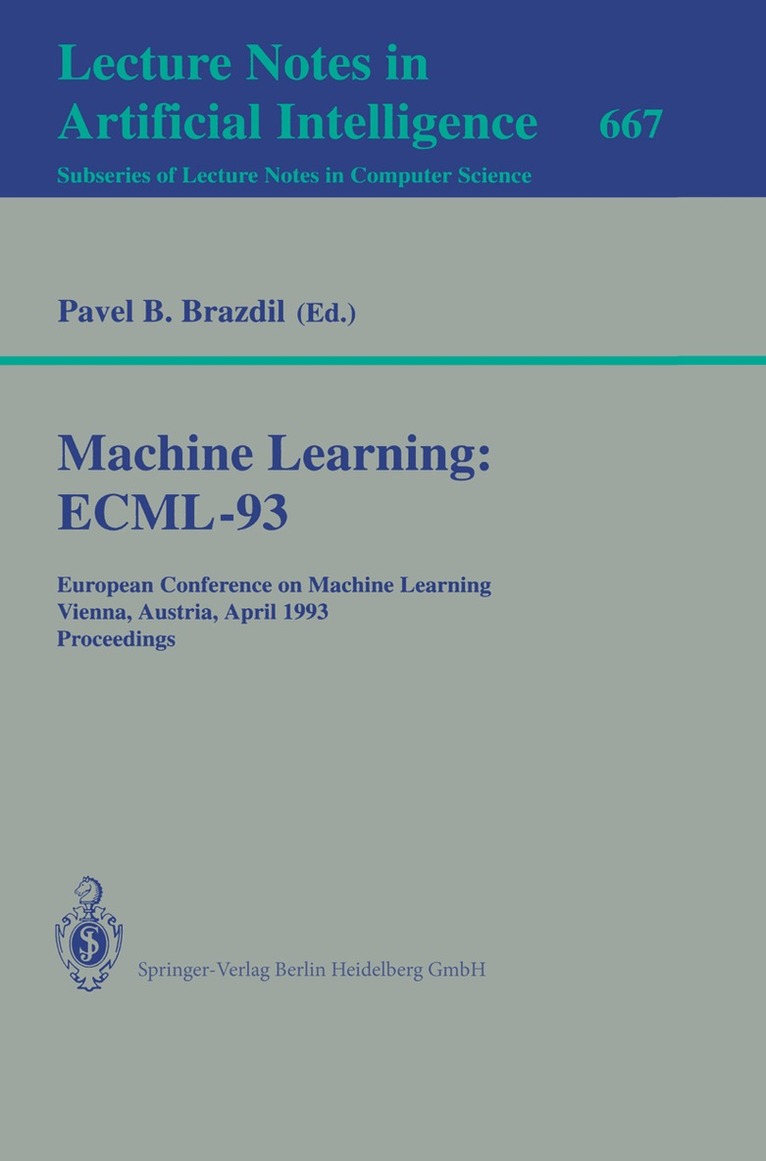
Machine Learning: ECML-93
European Conference on Machine Learning, Vienna, Austria, April 5-7, 1993. Proceedings
Häftad, Engelska, 1993
552 kr
Skickas inom 10-15 vardagar
This volume contains the proceedings of the EurpoeanConference on Machine Learning (ECML-93), continuing thetradition of the five earlier EWSLs (European WorkingSessions on Learning). The aim of these conferences is toprovide a platform for presenting the latest results in thearea of machine learning. The ECML-93 programme included invited talks, selectedpapers, and the presentation of ongoing work in postersessions. The programme was completed by several workshopson specific topics. The volume contains papers relatedto all these activities. The first chapter of the proceedings contains two invitedpapers, one by Ross Quinlan and one by Stephen Muggleton oninductive logic programming. The second chapter contains 18scientific papers accepted for the main sessions of theconference. The third chapter contains 18 shorter positionpapers. The final chapter includes three overview papersrelated to the ECML-93 workshops.