Pavlo Kravchuk – författare
Visar alla böcker från författaren Pavlo Kravchuk. Handla med fri frakt och snabb leverans.
2 produkter
2 produkter
797 kr
Kommande
Situated on an ancient trading route on the banks of the River Dnipro, Zaporizhzhia was a small provincial town until the construction of its railway station in 1873 put it on the map as an industrial centre. The Dnipro Hydroelectric Station (1932) turned it into an important hub for the metallurgical industry and eventually into one of the largest cities in Ukraine.This guide, written by two local architectural historians and preservation activists, focuses on Sobornyi Avenue, the 11-kilometre-long axis which threads the parts of Zaporizhzhia into a harmonious whole. One of the finest examples of Soviet ensemble architecture, the avenue is a catalogue of architectural styles: early-20th-century Style Moderne, the Constructivism and Rationalism of the 1920s and 1930s, the grand Neoclassical architecture and ensemble-based urban planning of the Stalinist period, and post-war Second Socialist Modernism with its clean lines and well laid-out ‘microdistricts’. Parts of Sobornyi Avenue resemble Berlin’s former Stalinallee or Leningrad’s Moskovsky prospekt.Architectural Guide Zaporizhzhia is a unique opportunity to approach this war-threatened city and hold it in one’s hand. To peruse the pages of this guide is to wander the city’s streets and squares and breathe again the air of a more peaceful, more purposeful age.This architectural guide is part of the Histories of Ukrainian Architecture programme initiated by Berlin-based DOM publishers in response to Russia’s attack on Ukraine’s sovereignty on 24 February 2022.
Del 164 - Grundlagen / Basics
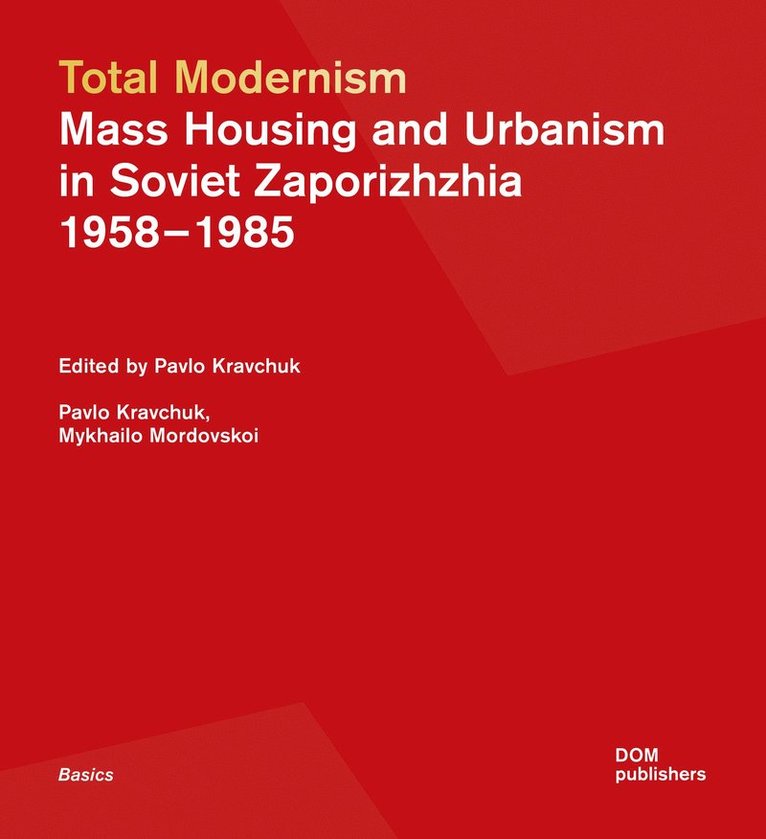
Total Modernism. Mass Housing and Urbanism in Soviet Zaporizhzhia
19581985
Häftad, Engelska, 2024
409 kr
Skickas inom 3-6 vardagar
A quiet rural town until World War I, Zaporizhzhia exploded into a major industrial centre in the 1920s following con¬struction of the Dnipro Hydroelectric Station. This book looks at a later period in the history of what is now one of the largest cities in Ukraine, the 1950s to 1980s, when the focus in Soviet policy shifted from industrialisation to welfare and from production to consumption. In this respect Zaporizhzhia may be seen as ‘a local model of the birth of a modern society’ – Soviet consumer society. Historian Pavlo Kravchuk and historian and graphic designer Mykhailo Mordovskoi skilfully combine text and images to show how this shift played out in urban planning, architecture, and, more importantly, the lives of ordinary Soviet citizens. Prefabricated construction techniques enabled the rapid erection of districts of mass housing, giving ordinary people a small apartment of their own for the first time. With this came a need for consumer goods. At the same time, sitting in their new kitchens, people gained a modicum of privacy and a space in which to meet and discuss, away from the controlling eye of the state. The new Soviet apartment was ‘a place of leisure’, but also of dissidence – the beginning of the end of the regime.