Peter A. Swenson - Böcker
Visar alla böcker från författaren Peter A. Swenson. Handla med fri frakt och snabb leverans.
5 produkter
5 produkter
Capitalists against Markets
The Making of Labor Markets and Welfare States in the United States and Sweden
Inbunden, Engelska, 2002
1 165 kr
Skickas inom 5-8 vardagar
Conventional wisdom argues that welfare state builders in the US and Sweden in the 1930s took their cues from labor and labor movements. Capitalists Against Markets makes the startling argument that pragmatic social reformers looked for support not only from below but also from above, taking into account capitalist interests and preferences. Juxtaposing two widely recognized extremes of welfare, the US and Sweden, Peter Swenson shows that employer interests played a role in welfare state development in both countries. This broad-ranging comparative analysis begins with theory about employer interests under varying economic and institutional conditions, especially in labor markets shape to a considerable degree by employers themselves. It then moves on to in-depth historical evidence starting from very early in the 1900s. The historical narrative reveals striking variations within and across the behavior of their capitalist classes. It gives reason to believe that capitalists were among essential allies of the American welfare state in the 1930s and beyond, not just forces for containing its expansion. It also shows tjhat Social Democrats in Sweden were kicking in capitalists' open doors as they installed and expanded the various pieces of their world-renowned welfare state through the 1960s. A concludin chapter surveys labor market and social policy changes in both countries since the 1970s in light of the theory and historical analysis of cross-class alliance politics. Provocative in its challenge to conventional thinking and theory, Capitalists Against Markets illuminates the political conditions for greater economic and social security in capitalist societies.
Capitalists against Markets
The Making of Labor Markets and Welfare States in the United States and Sweden
Häftad, Engelska, 2002
651 kr
Skickas inom 5-8 vardagar
Conventional wisdom argues that welfare state builders in the US and Sweden in the 1930s took their cues from labor and labor movements. Capitalists Against Markets makes the startling argument that pragmatic social reformers looked for support not only from below but also from above, taking into account capitalist interests and preferences. Juxtaposing two widely recognized extremes of welfare, the US and Sweden, Peter Swenson shows that employer interests played a role in welfare state development in both countries. This broad-ranging comparative analysis begins with theory about employer interests under varying economic and institutional conditions, especially in labor markets shaped to a considerable degree by employers themselves. It then moves on to in-depth historical evidence starting from very early in the 1900s. The historical narrative reveals striking variations within and across the behavior of their capitalist classes. It gives reason to believe that capitalists were among essential allies of the American welfare state in the 1930s and beyond, not just forces for containing its expansion. It also shows tjhat Social Democrats in Sweden were kicking in capitalists' open doors as they installed and expanded the various pieces of their world-renowned welfare state through the 1960s. A concluding chapter surveys labor market and social policy changes in both countries since the 1970s in light of the theory and historical analysis of cross-class alliance politics. Provocative in its challenge to conventional thinking and theory, Capitalists Against Markets illuminates the political conditions for greater economic and social security in capitalist societies.
1 074 kr
Skickas inom 10-15 vardagar
Conflict between labor and capital reflects the competitive and conflict-laden relations within the working class itself, Peter Swenson maintains. Fair Shares examines the internal conflicts of organized labor regarding distribution of wages in order to explain both union leaders' market-structuring objectives in the "political economy", and their imperative to shape and fulfill workers' notions of pay fairness in the "moral economy". Swenson develops an innovative theoretical approach to labor politics through a detailed comparative analysis of union centralization and collective bargaining in Sweden and Germany since the turn of the century.To create solidarity and overcome workers' opposition to centralized control of the labor movement, Swenson argues, union leaders depend heavily on moral appeals concerning fair pair distribution and on success in fulfilling workers' expectation of fairness. Swenson interprets union politics as the attempt to overcome what he calls the "wage policy trilemma"
1 149 kr
Skickas inom 10-15 vardagar
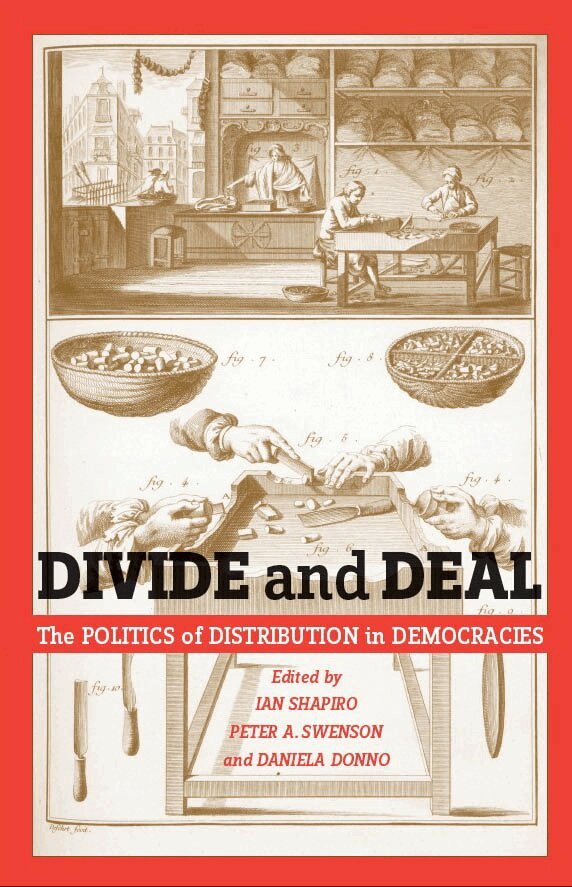
Why are democracies so unequal? Despite the widespread expectation that democracy, via expansion of the franchise, would lead to redistribution in favor of the masses, in reality majorities regularly lose out in democracies. Taking a broad view of inequality as encompassing the distribution of wealth, risk, status, and well-being, this volume explores how institutions, individuals, and coalitions contribute to the often surprising twists and turns of distributive politics.The contributors hail from a range of disciplines and employ an array of methodologies to illuminate the central questions of democratic distributive politics: What explains the variety of welfare state systems, and what are their prospects for survival and change? How do religious beliefs influence people's demand for redistribution? When does redistributive politics reflect public opinion? How can different and seemingly opposed groups successfully coalesce to push through policy changes that produce new winners and losers?The authors identify a variety of psychological and institutional factors that influence distributive outcomes. Taken together, the chapters highlight a common theme: politics matters. In seeking to understand the often puzzling contours of distribution and redistribution, we cannot ignore the processes of competition, bargaining, building, and destroying the political alliances that serve as bridges between individual preferences, institutions, and policy outcomes.
400 kr
Skickas inom 7-10 vardagar
Why are democracies so unequal? Despite the widespread expectation that democracy, via expansion of the franchise, would lead to redistribution in favor of the masses, in reality majorities regularly lose out in democracies. Taking a broad view of inequality as encompassing the distribution of wealth, risk, status, and well-being, this volume explores how institutions, individuals, and coalitions contribute to the often surprising twists and turns of distributive politics.The contributors hail from a range of disciplines and employ an array of methodologies to illuminate the central questions of democratic distributive politics: What explains the variety of welfare state systems, and what are their prospects for survival and change? How do religious beliefs influence people's demand for redistribution? When does redistributive politics reflect public opinion? How can different and seemingly opposed groups successfully coalesce to push through policy changes that produce new winners and losers?The authors identify a variety of psychological and institutional factors that influence distributive outcomes. Taken together, the chapters highlight a common theme: politics matters. In seeking to understand the often puzzling contours of distribution and redistribution, we cannot ignore the processes of competition, bargaining, building, and destroying the political alliances that serve as bridges between individual preferences, institutions, and policy outcomes.