Peter Achinstein - Böcker
Visar alla böcker från författaren Peter Achinstein. Handla med fri frakt och snabb leverans.
9 produkter
9 produkter
398 kr
Skickas inom 5-8 vardagar
Newton urged scientists never to speculate, only to prove by establishing experimental facts. By contrast, Einstein urged scientists to speculate freely, since only daring speculations, not experimental facts, can advance science. Who, if either, is right? Is speculation a legitimate part of science, even in the absence of testing? If so, can speculations be evaluated without testing? How? To answer these questions it must first be determined what counts as a speculation, a task not usually investigated by those who express strong views about speculation. In Speculation, Peter Achinstein develops the basic idea that speculating involves introducing assumptions, under certain "theorizing" conditions, without knowing that there is evidence for those assumptions. This idea is made precise by utilizing a concept of "evidence" Achinstein has introduced in previous writings and also explains here. With this concept, Achinstein defends a view according to which, by contrast with Newton, speculations are crucial in science, and by contrast with Einstein, they are subject to constraints. The latter include pragmatic ones, reflecting the particular aims of the scientist in speculating, and epistemic ones that are subject to a different standard then "evidence sufficient for belief." This viewpoint is illustrated and evaluated by critically examining historical and contemporary speculations in fundamental physics as well as more general speculations within or about science, including these: nature is simple, and simplicity is a sign of truth (Newton, Einstein); a theory can only be tested "holistically" (Duhem and Quine); and there is, and must be, a "Theory of Everything" (string theorists and reductionists).
929 kr
Skickas inom 5-8 vardagar
Offering a new approach to scientific explanation, this book focuses initially on the explaining act itself. From that act, a "product" emerges: an explanation. To understand what that product is, as well as how it can be evaluated in the sciences, reference must be made to the concept of the explaining act. Following an account of the explaining act, its product, and the evaluation of explanations, the theory is brought to bear on these issues: Why have thestandard models of scientific explanation been unsuccessful, and can there be a model of the type sought? What is causal explanation, and must explanation in the sciences be causal? What is a functionalexplanation? The "illocutionary" theory of explanation developed at the outset is used in discussing these issues, and contrasting philosophical viewpoints are assessed.
665 kr
Skickas inom 5-8 vardagar
What is required for something to be evidence for a hypothesis? In this fascinating, elegantly written work, distinguished philosopher of science Peter Achinstein explores this question, rejecting typical philosophical and statistical theories of evidence. He claims these theories are much too weak to give scientists what they want--a good reason to believe--and, in some cases, they furnish concepts that mistakenly make all evidential claims a priori. Achinstein introduces four concepts of evidence, defines three of them by reference to "potential" evidence, and characterizes the latter using a novel epistemic interpretation of probability. The resulting theory is then applied to philosophical and historical issues. Solutions are provided to the "grue," "ravens," "lottery," and "old-evidence" paradoxes, and to a series of questions. These include whether explanations or predictions furnish more evidential weight, whether individual hypotheses or entire theoretical systems can receive evidential support, what counts as a scientific discovery, and what sort of evidence is required for it. The historical questions include whether Jean Perrin had non-circular evidence for the existence of molecules, what type of evidence J. J. Thomson offered for the existence of the electron, and whether, as is usually supposed, he really discovered the electron. Achinstein proposes answers in terms of the concepts of evidence introduced. As the premier book in the fabulous new series Oxford Studies in Philosophy of Science, this volume is essential for philosophers of science and historians of science, as well as for statisticians, scientists with philosophical interests, and anyone curious about scientific reasoning.
790 kr
Skickas inom 5-8 vardagar
The essays in this volume address three fundamental questions in the philosophy of science: What is required for some fact to be evidence for a scientific hypothesis? What does it mean to say that a scientist or a theory explains a phenomenon? Should scientific theories that postulate "unobservable " entities such as electrons be construed realistically as aiming to correctly describe a world underlying what is directly observable, or should such theories be understood as aiming to correctly describe only the observable world? Distinguished philosopher of science Peter Achinstein provides answers to each of these questions in essays written over a period of more than 40 years. The present volume brings together his important previously published essays, allowing the reader to confront some of the most basic and challenging issues in the philosophy of science, and to consider Achinstein's many influential contributions to the solution of these issues.He presents a theory of evidence that relates this concept to probability and explanation; a theory of explanation that relates this concept to an explaining act as well as to the different ways in which explanations are to be evaluated; and an empirical defense of scientific realism that invokes both the concept of evidence and that of explanation.
Evidence and Method
Scientific Strategies of Isaac Newton and James Clerk Maxwell
Inbunden, Engelska, 2013
424 kr
Skickas inom 5-8 vardagar
What is meant by scientific evidence, and how can a definition of this concept be applied in the sciences to determine whether observed facts constitute evidence that a given theory is true?In this book, Peter Achinstein proposes and defends several objective concepts of evidence. He then explores the question of whether a scientific method, such as that represented in the four "Rules for the Study of Natural Philosophy" that Isaac Newton invoked in proving his law of gravity, can be employed in demonstrating how the proposed definitions of evidence are to be applied to real scientific cases. In answering this question, he offers a new interpretation of Newton's controversial rules. Contrary to what many methodologists assume, whether the rules, so interpreted, can be used to determine whether observed phenomena provide evidence for a theory is an empirical question, not an a priori one. Finally, in order to deal with numerous cases in which evidence is insufficient to establish a theory, or where no theory is even available, Achinstein describes and defends three scientific methods proposed by the 19th century theoretical physicist James Clerk Maxwell, in the course of developing his electrical and molecular theories.
433 kr
Skickas inom 5-8 vardagar
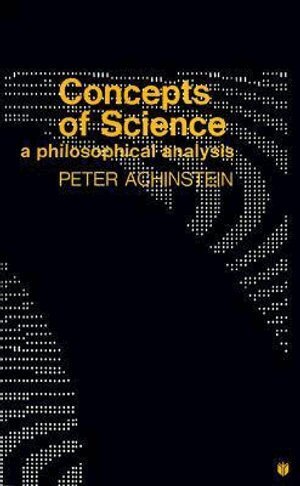
While the scientist works essentially with what he observes, with the measurable properties of nature, the philosopher of science is concerned to formulate the conceptual foundations of the scientific method. In this systematic study, Professor Achinstein analyzes such concepts as definitions, theories, and models, and contrasts his view with currently held positions that he finds inadequate.
783 kr
Tillfälligt slut
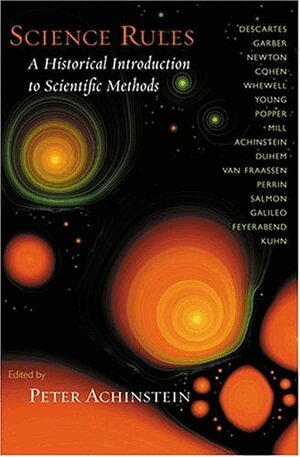
Is there a universal set of rules for discovering and testing scientific hypotheses? Since the birth of modern science, philosophers, scientists, and other thinkers have wrestled with this fundamental question of scientific practice. Efforts to devise rigorous methods for obtaining scientific knowledge include the twenty-one rules Descartes proposed in his Rules for the Direction of the Mind and the four rules of reasoning that begin the third book of Newton's Principia, and continue today in debates over the very possibility of such rules. Bringing together key primary sources spanning almost four centuries, Science Rules introduces readers to scientific methods that have played a prominent role in the history of scientific practice. Editor Peter Achinstein includes works by scientists and philosophers of science to offer a new perspective on the nature of scientific reasoning. For each of the methods discussed, he presents the original formulation of the method; selections written by a proponent of the method together with an application to a particular scientific example; and a critical analysis of the method that draws on historical and contemporary sources.The methods included in this volume are Cartesian rationalism with an application to Descartes' laws of motion; Newton's inductivism and the law of gravity; two versions of hypothetico-deductivism-those of William Whewell and Karl Popper-and the nineteenth-century wave theory of light; Paul Feyerabend's principle of proliferation and Thomas Kuhn's views on scientific values, both of which deny that there are universal rules of method, with an application to Galileo's tower argument. Included also is a famous nineteenth-century debate about scientific reasoning between the hypothetico-deductivist William Whewell and the inductivist John Stuart Mill; and an account of the realism-antirealism dispute about unobservables in science, with a consideration of Perrin's argument for the existence of molecules in the early twentieth century.
534 kr
Tillfälligt slut
Is there a universal set of rules for discovering and testing scientific hypotheses? Since the birth of modern science, philosophers, scientists, and other thinkers have wrestled with this fundamental question of scientific practice. Efforts to devise rigorous methods for obtaining scientific knowledge include the twenty-one rules Descartes proposed in his Rules for the Direction of the Mind and the four rules of reasoning that begin the third book of Newton's Principia, and continue today in debates over the very possibility of such rules. Bringing together key primary sources spanning almost four centuries, Science Rules introduces readers to scientific methods that have played a prominent role in the history of scientific practice. Editor Peter Achinstein includes works by scientists and philosophers of science to offer a new perspective on the nature of scientific reasoning. For each of the methods discussed, he presents the original formulation of the method; selections written by a proponent of the method together with an application to a particular scientific example; and a critical analysis of the method that draws on historical and contemporary sources.The methods included in this volume are Cartesian rationalism with an application to Descartes' laws of motion; Newton's inductivism and the law of gravity; two versions of hypothetico-deductivism-those of William Whewell and Karl Popper-and the nineteenth-century wave theory of light; Paul Feyerabend's principle of proliferation and Thomas Kuhn's views on scientific values, both of which deny that there are universal rules of method, with an application to Galileo's tower argument. Included also is a famous nineteenth-century debate about scientific reasoning between the hypothetico-deductivist William Whewell and the inductivist John Stuart Mill; and an account of the realism-antirealism dispute about unobservables in science, with a consideration of Perrin's argument for the existence of molecules in the early twentieth century.
567 kr
Tillfälligt slut
Physicists think they have discovered the top quark. Biologists believe in evolution. But what precisely constitutes evidence for such claims, and why? Scientists often disagree with one another over whether or to what extent some evidence counts in favor of a theory because they are operating with different concepts of scientific evidence. These concepts need to be critically explored. Peter Achinstein has gathered some prominent philosophers and historians of science for critical and lively discussions of both general questions about the meaning of evidence and specific ones about evidence for particular scientific theories. Contributors: Peter Achinstein, The Johns Hopkins University; Steven Gimbel, Gettysburg College; Gary Hatfield, University of Pennsylvania; Frederick M. Kronz, University of Texas-Austin; Helen Longino, University of Minnesota; Deborah G. Mayo, Virginia Tech; Amy L. McLaughlin, Florida Atlantic University; John Norton, University of Pittsburgh; Lawrence M. Principe, The Johns Hopkins University; Richard Richards, University of Alabama; Alex Rosenberg, Duke University; Sherrilyn Roush, Rice University; Laura J. Snyder, St. Johns University; Kent Staley, St.Louis University.