Peter Damian - Böcker
Visar alla böcker från författaren Peter Damian. Handla med fri frakt och snabb leverans.
10 produkter
10 produkter
475 kr
Skickas inom 10-15 vardagar
This volume concludes the series of Peter Damian's Letters in English translation. Among Letters 151-180 readers will find some of Damian's most passionate exhortations on behalf of eremitic ideals. These include Letter 152, in which Damian defends as consistent with the spirit and the letter of Benedict's Rule his practice of receiving into the eremitic life monks who had abandoned their cenobitic communities. In Letter 153 Damian encourages monks at Pomposa to pass beyond the minimum standards established in the Rule of St. Benedict for the higher and more demanding eremitic vocation. In Letter 165, addressed to a hermit, Albizo, and a monk, Peter, Damian reveals as well the importance of monastic life to the world: because the integrity of the monastic profession has weakened, the world has fallen even deeper into an abyss of sin and corruption and is rushing headlong to destruction. Let monks and hermits take refuge within the walls of the monastery, he urges, while outside the advent of Antichrist seems imminent. Only from within their walls can they project proper examples of piety and sanctity that may transform the world as a whole.Damian was equally concerned to address the moral condition of the larger Church. Letter 162 represents the last of Damian's four tracts condemning clerical marriage (Nicolaitism). Damian's condemnation of Nicolaitism also informed his rejection of Cadalus, the antipope Honorius II (see Letters 154 and 156), who was said to support clerical marriage, and therefore cast him into the center of a storm of ecclesiastical (and imperial) politics from which Damian never completely extricated himself.
488 kr
Skickas inom 10-15 vardagar
Peter Damian (1007-1072), an eleventh-century monk and man of letters, left a large and significant body of correspondence. Over one hundred and eighty letters have been preserved, principally from Damian's own monastery of Fonte Avellana. Ranging in length from short memoranda to longer monographs, the letters provide a contemporary account of many of the controversies of the eleventh century: purgatory, the Eucharist, clerical marriage and celibacy, immorality, and others. Peter Damian, or ""Peter the Sinner"" as he often referred to himself, was one of the most learned men of his day, and his letters are filled with both erudition and zeal for reform.This first volume contains the first thirty letters, and covers the period before 1049. Here we see Peter Damian as an untiring preacher and uncompromising reformer, both of the monastic world and of the church at large. He attacks clerical laxity and monastic decadence in letter after letter. The first letter in the collection is of particular interest, containing a theological consideration of the Christian position against the Jews. Other important letters in this first volume are Damian's allegorical interpretation of the Divine Office, his letters on the Last Days and the Judgment, on canonical and legal points (such as the prohibited degrees of consanguinity in marriage), and on liturgical matters (particularly in monastic observance).
488 kr
Skickas inom 10-15 vardagar
This second volumes of the Mediaeval Continuation contains Letters 31-60 of Peter Damian. While his epistolary style is varied--exhortatory, occasional, pastoral, reforming--his message is singular and simple in urging strict adherence to the canons of the Church.Letters 31 and 40 are long treatises, each published separately in critical editions. Letter 31, also known as the Book of Gomorrah, deplores the degradation of the priesthood through the vice of sodomy and appeals to Pope Leo IX to educate and purge the clergy. Letter 40, perhaps his most celebrated work, is also called the Liber gratissimus. In it Peter Damian opposes the reordination of those ordained simonists but writes that simonists are ""worthy of the supreme punishment that befits the incorrigible."" The very early reference to the ""heart of Jesus"" which is found in this letter was anticipated only by the Venerable Bede.Among the more personal letters are 55 and 57. In the former he writes of a long, debilitating illness, so serious that funeral preparations had been made, and of his immediate recovery when his brethren gave food to one hundred poor people. In the latter, he begs to be relieved of the administration of the diocese of Gubbio because of ill health, so that he may return to Fonte Avellana and his ""beloved solitude."" He also makes many references to folkloric tales and, perhaps, the earliest reference to the game of chess in Western literature.Letter 58 to Henry the archbishop of Ravenna in 1058 is the best example in the collection of Peter Damian's political and ecclesiastical influence. In it he gives his opinion of Benedict X and Nicholas II, the two candidates for the Apostolic See. He makes no effort to conceal his strong opinions but rather requests that this letter be made public so that all may learn what he has thought about the subject. This is perhaps, after all, what he would have hoped for the entire collection.
488 kr
Skickas inom 10-15 vardagar
Peter Damian (1007-1072), an eleventh-century monk and man of letters, left a large and significant body of correspondence. Over one hundred and eighty letters have been preserved, principally from Damian's own monastery of Fonte Avellana. Ranging in length from short memoranda to longer monographs, the letters provide a contemporary account of many of the controversies of the eleventh century: purgatory, the Eucharist, clerical marriage and celibacy, immorality, and others. Peter Damian, or ""Peter the Sinner"" as he often referred to himself, was one of the most learned men of his day, and his letters are filled with both erudition and zeal for reform.This third volume of The Letters of Peter Damian is a careful, fluent, and annotated translation of Letters 61-90. These letters reveal the author's concern with the contemporary need for reforms, centering on clerical, especially episcopal, celibacy and on the ""heresy"" of simony which involved the purchase of ecclesiastical offices. In Letter 89, for example, Damian addresses the Selvismatic attempt of antipope Honorius II (Cadalus of Parma) to circumvent the election of Alexander II by the newly organized college of cardinal bishops. Also, among the letters here presented are several of a highly spiritual, even mystical content. These letters demonstrate that this active reformer was at heart a solitary soul who, when away from home, longed for his ""beloved solitude,"" where he could practice the contemplative life. Eventually, Damian grew weary of his efforts at reform and asked to be retired from his office of cardinal bishop of Ostia.Because Damian's Latin was a living language that surpasses the ability of classical Latin lexicography to cope with it, all disciplines that make use of medieval thought will welcome this English translation. Owen J. Blum's thorough notes to each letter indicate the vocabulary problems he encountered and how they were resolved. This third volume, like its companions, uses Damian's thought to understand an important and gripping period in the history of church and state. With these intimate revelations into his character and motivation, readers may more readily appreciate Damian's total dedication to his mission.
488 kr
Skickas inom 10-15 vardagar
This fourth volume of the Mediaeval Continuation is the fourth of the letters of Peter Damian, an eleventh-century monk and man of letters. Written during the years 1062-1066, these letters deal with a wide variety of subjects. Some letters are of historical interest, others approach the size and scope of philosophical or theological treatises. Damian's correspondents range from simple hermits in his community to abbots, bishops, cardinals, and even to Pope Alexander II. Among these letters are to be found one addressed to the patriarch of Constantinopole, two to Damian's sisters, one to the Empress Agnes, and even a few to such distant personages as the young King Henry IV and the Archbishop Anno of Cologne.Like its companions, this volume uses Damian's thought to understand an important and gripping period in the history of church and state. Clearly, the most significant letter in this collection is Letter 119, written in 1063 to Abbot Desiderius of Monte Cassino and his monks, on the omnipotence of God. Translated here for the first time into English, Damian's treatise on Divine Omnipotence demonstrates his control of both theological and philosophical methodology. His opponents are contemporary rhetoricians whose denial of God's total potency in dealing with his creatures' contingencies in time past, present, and future opens them to the charge of heresy.Though Damian's vocabulary frequently challenges the combined dictionary resources of classical, patristic, and mediaeval Latin, Owen J. Blum's careful translation will guarantee the transmission of Damian's thought to all levels of readers throughout the world.
488 kr
Skickas inom 10-15 vardagar
This volume, the fifth in the series of volumes containing the one hundred and eighty letters written by the eleventh-century monk Peter Damian, contains careful and annotated translations of Damian's Letters 121-150. Written during the years 1062-66, the letters deal with a wide variety of subjects and provide a contemporary account of many of the controversies of the gripping period in the history of church and state.While previous volumes have included Damian's correspondence to a range of people from simple hermits in his community to abbots, bishops, cardinals, Pope Alexander II, and young King Henry IV, this collection of letters includes several addressed to kinsmen. Letter 123 is Damian's rather lengthy exhortation to his nephew Damianus encouraging him to seek a pure and virtuous monastic life. Letter 132, written to his nephew Marinus, contains a comprehensive discussion of the virtues proper to the monastic life. And Letter 126 to Alberic of Monte Cassino, presents a good example of Damian's principles of biblical exegesis.The remaining letters (151-180) are currently being translated and will be published in the sixth and final volume in Spring 2005.
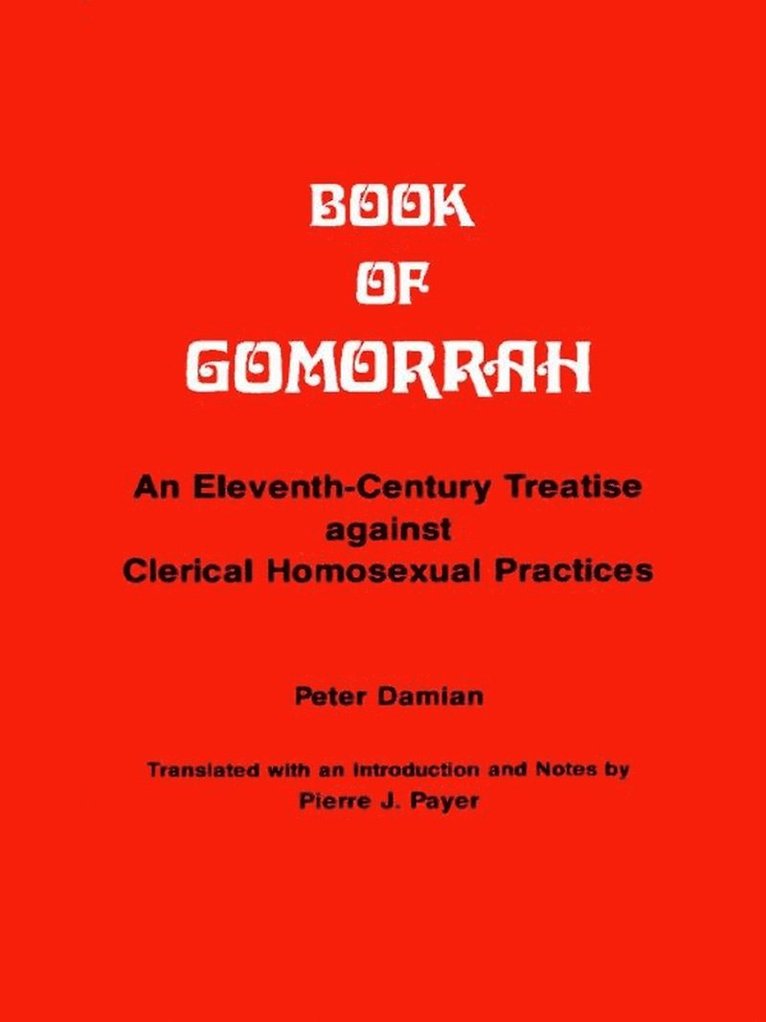
Book of Gomorrah
An Eleventh-Century Treatise Against Clerical Homosexual Practices
Häftad, Engelska, 1982
435 kr
Skickas inom 10-15 vardagar
Some of the roots of the characteristic negative attitude to homosexuality can be found in Peter Damian's appeal to Pope Leo IX. Though written 900 years ago by an Italian monk in a remote corner of Italy, The Book of Gomorrah is relevant to contemporary discussion of homosexuality. The Book of Gomorrah asks the Pope to take steps to halt the spread of homosexual practices among the clergy. The first part outlines the various forms of homosexual practice, the specific abuses, and the inadequacy of traditional penitential penances, and demands that offenders be removed form their ecclesiastical positions. The second part is an impassioned plea to the offenders to repent of their ways, accept due penance, and cease from homosexual activity. Payer's is the first translation of the full tract into any language from the original Latin. In his introduction to the tract Payer places The Book of Gomorrah in its context as the first major systematic treatise in the medieval West against various homosexual acts, provides a critique of Peter Damian's arguments, and outlines his life. The annotated translation is followed by a translation of the letter of Pope Leo IX in reply to Damian's Treatise, an extensive bibliography, and indexes. The book will be of interest to students of medieval history and religion, to ethicists and students of social mores, and to persons generally concerned with the historical roots of present-day attitudes to homosexuality.
Aromaterapia: El olor y la psique
Utilización de los aceites esenciales para el bienestar físico y emocional
Häftad, Spanska, 1997
138 kr
Tillfälligt slut
Durante miles de años se han utilizado los aceites aromáticos no sólo por su fragancia sino también con propósitos culinarios, terapéuticos y espirituales. Peter y Kate Samian revelan la forma de mejorar cas todos los aspectos de la vida mediante masajes aromáticos de lavanda y baños de aceite de té de árbol para el tratamiento de la presión alta o de ylang ylang contra la depresión. Al ser el único sentido que se extiende hasta el cerebro, el olfato es un componente primordial del estado de ánimo, la memoria y el apetito, y la clave para comprender la compatibilidad sexual y el instinto de protección maternal de un recién nacido. Pero, ¿qué armas en particular son eficaces en el tratamiento terapéutico o en los rituales? ¿Qué relación existe entre las esencias de las plantas y el aura humana? Junto a una amplia exposición de la historia de la aromaterapia de la antigua China, la India, Persia y Egipto, y a los conocimientos científicos actuales de la psicología del aroma, Aromaterapia: El olor y la psique es la guía perfecta para dominar el uso de los aceites esenciales. Se incluyen esquemas explicativos acerca de los cuarenta y cuarto aceites esenciales, además de instrucciones específicas para crear mezclas de los mismos.
208 kr
Tillfälligt slut
Aromatic oils have been used for thousands of years not only for their fragrance but for culinary, therapeutic, ritual, and spiritual purposes. More than a fashionable trend, aromatherapy is coming into its own as a body of knowledge and practice with specific applications that have a solid scientific base. Drawing on research and clinical studies, Peter and Kate Damian look at many applications from treating viral infections with garlic or black pepper oil to using rose oil to relax patients undergoing chemotherapy; from aromatic massage to the andquot;environmental fragrancingandquot; of subways and supermarkets." Explores: •How scent interacts with emotion, memory, mental acuity, and sleep •Why specific scents are so effective in therapeutic and ritual settings •Antiseptic and antimicrobial properties of essential oils How men and women differ in their responses to odors •Provides a thorough exposition of the ancient practice of aromatics in China, India, Persia, and Egypt •Details our modern scientific understanding of the physiology and psychology of scent." •Includes annotated profiles for forty-four essential oils and specific instructions for creating essential oil blends."
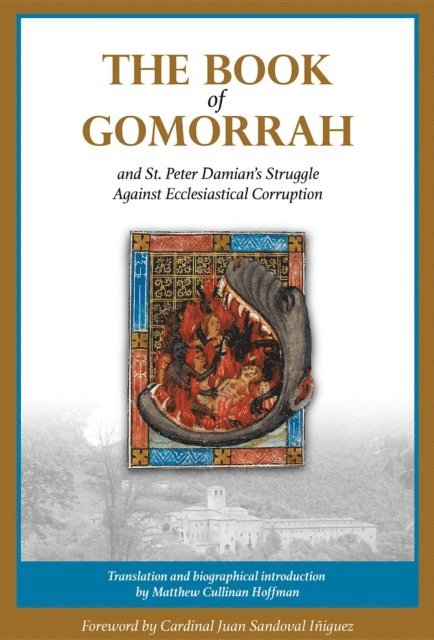
Book of Gomorrah and St. Peter Damian's Struggle Against Ecclesiastical Corruption
Häftad, Engelska, 2015
274 kr
Skickas inom 3-6 vardagar