
Peter Hinchliff – författare
Visar alla böcker från författaren Peter Hinchliff. Handla med fri frakt och snabb leverans.
3 produkter
3 produkter
2 874 kr
Skickas inom 5-8 vardagar
It is well known that the scientific discoveries of the nineteenth century posed problems for Christian theology. Less well known is the fact that the new understanding of history, developed in the same period, also created a number of difficulties. The realization that Christianity possessed a history of its own, and had changed and developed, raised numerous important questions for theologians and Christians alike.Newman's revised Essay on the Development of Doctrine provides the starting-point for this new and comprehensive survey, in which Peter Hinchliff discusses the ideas of a wide range of theologians from the full spectrum of British Christianity - from Roman Catholics through to theologians from the Churches of England and Scotland, and the Free Church - and their attempts to tackle these questions in the period leading up to the Great War. He proves that this hitherto little studied period in the development of theology is in fact an area of considerable interest and pertinence to historians as much as theologians.
1 284 kr
Skickas inom 3-6 vardagar
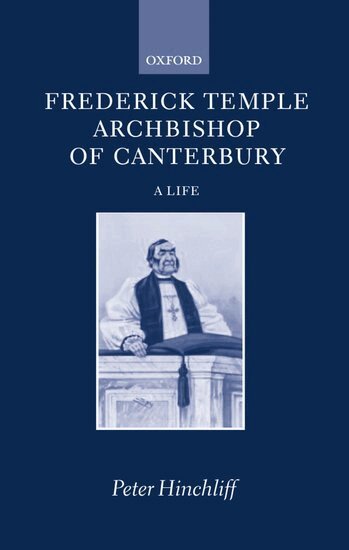
This is the first full-length, serious biography of Frederick Temple, an eminent, nineteenth-century figure and father of William Temple who was Archbishop of Canterbury during the Second World War. Born on a Greek island, of middle-class but impoverished parents, he was educated at Balliol College on a scholarship, became principal of a college which trained teachers for pauper children, then headmaster of Rugby, and Bishop successively of Exeter and London before finally becoming Archbishop of Canterbury at the age of 76 in 1897. In the realm of education he could be considered the real designer of the Oxford and Cambridge Examination Board in the 1850s; was a contributor to the first of the `scandalous' volumes of liberal theology, Essays and Reviews in 1860; was secretary of the Taunton Commission on grammar school education in 1868; and gave the Bampton lectures of 1884 on science and religion which made the theory of evolution respectable. As Bishop of London he attempted to mediate in the London dock strike of 1889; was responsible for the final form of the Archbishops' reply to the Pope's encyclical on Anglican orders; presided over the `Archbishops' Headings' on certain ritual practices in the `Church Crisis' at the end of the century; was much involved in Queen Victoria's Diamond Jubilee celebrations; and crowned Edward VII. He collapsed in the House of Lords after speaking in the debate on the education bill of 1902 and died soon afterwards.To gather the material for this fluent and attractive biography, the author has made use of the Temple family papers, most of which have been hitherto unpublished, as well as the more than 100 volumes of the Archbishop's official papers at Lambeth Palace.
1 748 kr
Skickas inom 5-8 vardagar
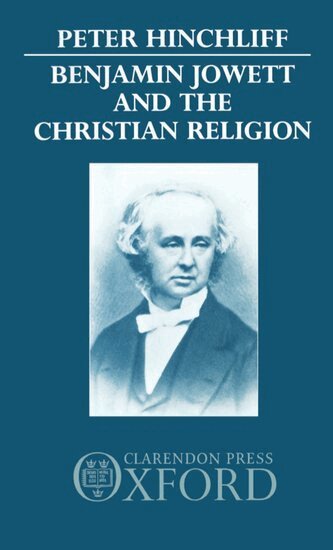
The conventional picture of Benjamin Jowett (1817-93) is of the outstanding educator, the famous master of Balliol College, Oxford, whose pupils were extremely influential in the public life of Britain in the second half of the nineteenth century. However, he is also recognized as a theologian since he contributed an essay 'On the Interpretation of Scripture' to Essays and Reviews, a collection published in 1860; the book's liberalism aroused great controversy, and it was eventually synodically condemned in 1864. It has been thought that having got into trouble over his essay, Jowett abandoned theology and became a purely secular figure.This book attempts to identify the ideas which caused Jowett to develop his theology, the thinkers who influenced him and how his own religious ideas evolved. It argues that, after the Essays and Reviews controversy, he deliberately chose to disseminate those ideas through the college of which he became master. It also shows how he influenced other religious thinkers and theologians of the late nineteenth and early twentieth centuries, arguing that he was more important in the history of English theology than is usually recognized.