Peter M. Allen - Böcker
Visar alla böcker från författaren Peter M. Allen. Handla med fri frakt och snabb leverans.
10 produkter
10 produkter
2 106 kr
Skickas inom 5-8 vardagar
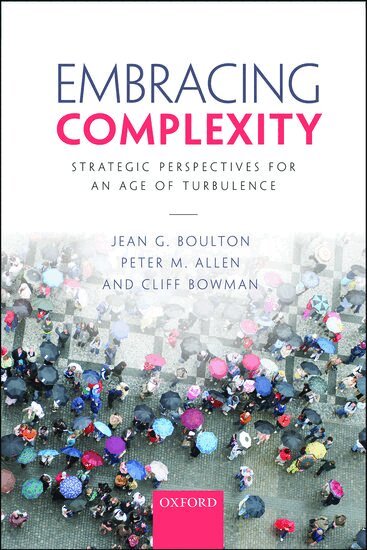
The book describes what it means to say the world is complex and explores what that means for managers, policy makers and individuals.The first part of the book is about the theory and ideas of complexity. This is explained in a way that is thorough but not mathematical. It compares differing approaches, and also provides a historical perspective, showing how such thinking has been around since the beginning of civilisation. It emphasises the difference between a complexity worldview and the dominant mechanical worldview that underpins much of current management practice. It defines the complexity worldview as recognising the world is interconnected, shaped by history and the particularities of context. The comparison of the differing approaches to modelling complexity is unique in its depth and accessibility. The second part of the book uses this lens of complexity to explore issues in the fields of management, strategy, economics, and international development. It also explores how to facilitate others to recognise the implications of adopting a complex rather than a mechanical worldview and suggests methods of research to explore systemic, path-dependent emergent aspects of situations. The authors of this book span both science and management, academia and practice, thus the explanations of science are authoritative and yet the examples of changing how you live and work in the world are real and accessible. The aim of the book is to bring alive what complexity is all about and to illustrate the importance of loosening the grip of a modernist worldview with its hope for prediction, certainty and control.
650 kr
Skickas
The book describes what it means to say the world is complex and explores what that means for managers, policy makers and individuals.The first part of the book is about the theory and ideas of complexity. This is explained in a way that is thorough but not mathematical. It compares differing approaches, and also provides a historical perspective, showing how such thinking has been around since the beginning of civilisation. It emphasises the difference between a complexity worldview and the dominant mechanical worldview that underpins much of current management practice. It defines the complexity worldview as recognising the world is interconnected, shaped by history and the particularities of context. The comparison of the differing approaches to modelling complexity is unique in its depth and accessibility. The second part of the book uses this lens of complexity to explore issues in the fields of management, strategy, economics, and international development. It also explores how to facilitate others to recognise the implications of adopting a complex rather than a mechanical worldview and suggests methods of research to explore systemic, path-dependent emergent aspects of situations. The authors of this book span both science and management, academia and practice, thus the explanations of science are authoritative and yet the examples of changing how you live and work in the world are real and accessible. The aim of the book is to bring alive what complexity is all about and to illustrate the importance of loosening the grip of a modernist worldview with its hope for prediction, certainty and control.
Self-Organization and Dissipative Structures
Applications in the Physical and Social Sciences
Häftad, Engelska, 1982
370 kr
Skickas inom 10-15 vardagar
The contributions to this volume attempt to apply different aspects of Ilya Prigogine's Nobel-prize-winning work on dissipative structures to nonchemical systems as a way of linking the natural and social sciences. They address both the mathematical methods for description of pattern and form as they evolve in biological systems and the mechanisms of the evolution of social systems, containing many variables responding to subjective, qualitative stimuli. The mathematical modeling of human systems, especially those far from thermodynamic equilibrium, must involve both chance and determinism, aspects both quantitative and qualitative. Such systems (and the physical states of matter which they resemble) are referred to as self-organized or dissipative structures in order to emphasize their dependence on the flows of matter and energy to and from their surroundings. Some such systems evolve along lines of inevitable change, but there occur instances of choice, or bifurcation, when chance is an important factor in the qualitative modification of structure. Such systems suggest that evolution is not a system moving toward equilibrium but instead is one which most aptly evokes the patterns of the living world. The volume is truly interdisciplinary and should appeal to researchers in both the physical and social sciences. Based on a workshop on dissipative structures held in 1978 at the University of Texas, contributors include Prigogine, A. G. Wilson, Andre de Palma, D. Kahn, J. L. Deneubourgh, J. W. Stucki, Richard N. Adams, and Erick Jantsch. The papers presented include Allen, "Self-Organization in the Urban System"; Robert Herman, "Remarks on Traffic Flow Theories and the Characterization of Traffic in Cities"; W. H. Zurek and Schieve, "Nucleation Paradigm: Survival Threshold in Population Dynamics"; De Palma et al., "Boolean Equations with Temporal Delays"; Nicholas Georgescu-Roegin, "Energy Analysis and Technology Assessment"; Magoroh Maruyama, "Four Different Causal Meta-types in Biological and Social Sciences"; and Jantsch, "From Self-Reference to Self-Transcendence: The Evolution of Self-Organization Dynamics."
1 078 kr
Skickas inom 5-8 vardagar
944 kr
Skickas inom 5-8 vardagar
944 kr
Skickas inom 5-8 vardagar
1 059 kr
Skickas inom 5-8 vardagar
Productivity, Competitiveness and Incomes in Asia
An Evolutionary Theory of International Trade
Inbunden, Engelska, 2005
1 675 kr
Skickas inom 7-10 vardagar
The authors of this book link productivity change, trade competitiveness, networks of interaction and cooperation and income growth in developing Asian countries with the complex evolutionary processes of economic development and international trade. They take an innovative approach to simulating the complex micro-dynamics of competitiveness in order to distinguish those trade-related microeconomic dynamics and institutional reforms vital to leading countries out of institutional and poverty traps.Real competitiveness changes in six countries (Bangladesh, India, Indonesia, Nepal, Pakistan and Thailand) are measured from 1991 to 2000 with detailed international export unit value comparisons, to detect structural changes towards technology and knowledge intensive goods in trade patterns. No significant structural change was detected in the six countries during that period. Evolutionary trade theory is presented in two models and is calibrated with transaction and trade data from West Bengal and Nepal. These reveal that lower transport costs - resulting from investment in transport and institutional reforms related to the investment and trade environment - result initially in small productivity differences that can be amplified in a non-linear evolutionary system and eventually lead to a spatial restructuring of the system, and to a structural change in the trade patterns. The models in this path-breaking book can be used to explore the impact of a variety of interventions and policies.Productivity, Competitiveness and Incomes in Asia will be of interest to academics and researchers in Asian Studies, industrial economics, evolutionary economics and international business development. The book will also appeal to policy makers responsible for economic growth.
1 059 kr
Skickas inom 5-8 vardagar
812 kr
Skickas inom 10-15 vardagar
A clear methodological and philosophical introduction to complexity theory as applied to urban and regional systems is given, together with a detailed series of modelling case studies compiled over the last couple of decades. Based on the new complex systems thinking, mathematical models are developed which attempt to simulate the evolution of towns, cities, and regions and the complicated co-evolutionary interaction there is both between and within them. The aim of these models is to help policy analysis and decision-making in urban and regional planning, energy policy, transport policy, and many other areas of service provision, infrastructure planning, and investment that are necessary for a successful society.