Peter Mackridge - Böcker
Visar alla böcker från författaren Peter Mackridge. Handla med fri frakt och snabb leverans.
13 produkter
13 produkter
1 801 kr
Skickas inom 5-8 vardagar
This is a history of the great language controversy that has occupied and impassioned Greeks - sometimes with fatal results - for over two hundred years. It begins in the late eighteenth century when a group of Greek intellectuals sought to develop a new, Hellenic, national identity alongside the traditional identity supplied by Orthodox Christianity. The ensuing controversy focused on the language, fuelled on the one hand by a desire to develop a form of Greek that expressed the Greeks' relationship to the ancients, and on the other by the different groups' contrasting notions of what the national image so embodied should be. The purists wanted a written language close to the ancient. The vernacularists - later known as demoticists - sought to match written language to spoken, claiming the latter to be the product of the unbroken development of Greek since the time of Homer. Peter Mackridge explores the political, social, and linguistic causes and effects of the controversy in its many manifestations. Drawing on a wide range of evidence from literature, language, history, and anthropology, he traces its effects on spoken and written varieties of Greek and shows its impact on those in use today. He describes the efforts of linguistic elites and the state to achieve language standardization and independence from languages such as Turkish, Albanian, Vlach, and Slavonic. This is a timely book. The sense of national and linguistic identity that has been inculcated into generations of Greeks since the start of the War of Independence in 1821 has, in the last 25 years, received blows from which it may not recover. Immigration from Eastern Europe and elsewhere has introduced new populations whose religions, languages, and cultures are transforming Greece into a country quite different from what it has been and from what it once aspired to be.
589 kr
Skickas inom 7-10 vardagar
This is a history of the great language controversy that has occupied and empassioned Greeks - sometimes with fatal results - for over two hundred years. It begins in the late eighteenth-century when a group of Greek intellectuals sought to develop a new, Hellenic, national identity alongside the traditional identity supplied by Orthodox Christianity. The ensuing controversy focused on the language, fuelled on the one hand by a desire to develop a form of Greek that expressed the Greeks' relationship to the ancients, and on the other by the different groups' contrasting notions of what the national image so embodied should be. The purists wanted a written language close to the ancient. The vernacularists - later known as demoticists - sought to match written language to spoken, claiming the latter to be the product of the unbroken development of Greek since the time of Homer. Peter Mackridge explores the political, social, and linguistic causes and effects of the controversy in its many manifestations. Drawing on a wide range of evidence from literature, language, history, and anthropology, he traces its effects on spoken and written varieties of Greek and shows its impact on those in use today. He describes the efforts of linguistic elites and the state to achieve language standardization and independence from languages such as Turkish, Albanian, Vlach, and Slavonic. This is a timely book. The sense of national and linguistic identity that has been inculcated into generations of Greeks since the start of the War of Independence in 1821 has, in the last 25 years, received blows from which it may not recover. Immigration from Eastern Europe and elsewhere has introduced new populations whose religions, languages, and cultures are transforming Greece into a country quite different from what it has been and to what it once aspired to be.
730 kr
Skickas inom 10-15 vardagar
In the immediate aftermath of the Second World War, and with British political influence over Greece soon to be ceded to the United States, there was a considerable degree of cultural interaction between Greek and British literati. Sponsored or assisted by the British Council, this interaction was notable for its diversity and quality alike. Indeed, the British Council in Greece made a more significant contribution to local culture in that period than at any other time, and perhaps in any other country. Many of the participants – among them Patrick Leigh Fermor, Steven Runciman, and Louis MacNeice – are well known, while others deserve to be better known than they are today. But what has been less fully discussed, and what the volume sets out to do, is to explore the two-way relations between Greek and British literary production in which the British Council played a particularly important role until the outbreak of armed conflict in Cyprus in 1955, which rendered further contacts of this kind difficult. Close attention is paid to the variety of ways – marked by personal affinities and allegiances, but also by political tensions – in which the British Council functioned as an agent of interaction in a climate where a complex blend of traditional Anglophilia or Philhellenism found itself encountering a new post-war and Cold War environment. What is distinctive about the volume, beyond the inclusion of much recent archival research, is its attention to the British Council as part of the story of Greek letters, and not just as a place in which various British men and women of letters worked. The British Council found itself, sometimes more through improvisation and personal affinities than through careful planning, at the heart of some key developments, notably in terms of important periodical publications which had a lasting influence on Greek letters. Though in the cultural forum that influence was arguably to be less pervasive than that of France, with its more ambitious cultural outreach, or than that of the USA in later decades, the role of the British Council in Greece in this crucial period of Greek (and indeed European) post-war history continues to make a rich case study in cultural politics. This volume thus fills a gap in the rich bibliography on Anglo-Greek relations and contributes to a wider scholarly and public discussion about cultural politics.
1 033 kr
Skickas inom 10-15 vardagar
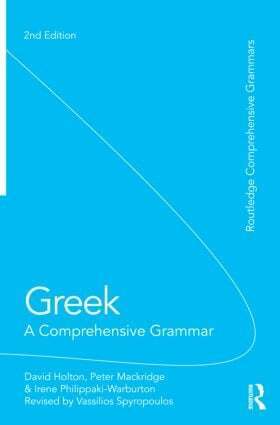
Greek: A Comprehensive Grammar of the Modern Language has become firmly established as the leading reference guide to modern Greek grammar. With its detailed treatment of all grammatical structures, its analysis of the complexities of the language and its particular attention to areas of confusion and difficulty, it is the first truly comprehensive grammar of the language to be produced. It provides a study of the real patterns of use in contemporary GreekThis second edition continues to focus on the Greek spoken and written by native speakers today. Taking account of recent changes to the Greek language, this new edition features: Significantly expanded material on many areas, including syntax and phonology A new chapter on derivational morphology and other word formation processes including compounding and acronym formation Examples drawn from everyday spoken usage as well as official, journalistic and online discourse, such as newspapers, blogs and discussion groups A significantly expanded index of English terms and Greek words and a revised glossary of termsThe Grammar will be an essential reference source for the adult learner and user of Greek. It is ideal for independent study and for use in schools, colleges, universities and adult classes, up to an advanced level.
2 166 kr
Skickas inom 10-15 vardagar
Greek: A Comprehensive Grammar of the Modern Language has become firmly established as the leading reference guide to modern Greek grammar. With its detailed treatment of all grammatical structures, its analysis of the complexities of the language and its particular attention to areas of confusion and difficulty, it is the first truly comprehensive grammar of the language to be produced. It provides a study of the real patterns of use in contemporary GreekThis second edition continues to focus on the Greek spoken and written by native speakers today. Taking account of recent changes to the Greek language, this new edition features: Significantly expanded material on many areas, including syntax and phonology A new chapter on derivational morphology and other word formation processes including compounding and acronym formation Examples drawn from everyday spoken usage as well as official, journalistic and online discourse, such as newspapers, blogs and discussion groups A significantly expanded index of English terms and Greek words and a revised glossary of termsThe Grammar will be an essential reference source for the adult learner and user of Greek. It is ideal for independent study and for use in schools, colleges, universities and adult classes, up to an advanced level.
1 499 kr
Skickas inom 10-15 vardagar
Originally published in 1996, this volume contains essays by scholars, critics and translators and includes themes such as the myth in the Cretan Renaissance and the use of ancient myth by 19th and 20th Century poets. Some essays deal with individual mythical figures such as Odysseus, Orpheus, Prometheus and Aphrodite, while others deal with the problematic issue of the use of myth by Greek women poets. The discussion is completed by comparing attitudes to the ancient Greeks as embodied in English and modern Greek poetry.
479 kr
Skickas inom 10-15 vardagar
Originally published in 1996, this volume contains essays by scholars, critics and translators and includes themes such as the myth in the Cretan Renaissance and the use of ancient myth by 19th and 20th Century poets. Some essays deal with individual mythical figures such as Odysseus, Orpheus, Prometheus and Aphrodite, while others deal with the problematic issue of the use of myth by Greek women poets. The discussion is completed by comparing attitudes to the ancient Greeks as embodied in English and modern Greek poetry.
2 305 kr
Skickas inom 10-15 vardagar
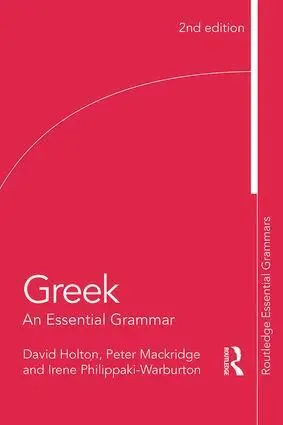
Greek: An Essential Grammar is a concise and user-friendly reference guide to modern Greek. It presents a fresh and accessible description of the language in short, readable sections. Explanations are clear and supported by examples throughout. This new edition has been revised and updated to present an accurate and accessible description of the most important aspects of modern Greek.Features include: clear and up-to-date examples special attention to those points which often cause problems to English-speaking learners Greek/English comparisons and contrasts highlighted throughout. Greek: An Essential Grammar is ideal for learners involved in independent study and for students in schools, colleges, universities and adult classes of all types. Levels CEFR scale A1-B2 and ACTFL level Low-Intermediate to Advanced.
794 kr
Skickas inom 10-15 vardagar
Greek: An Essential Grammar is a concise and user-friendly reference guide to modern Greek. It presents a fresh and accessible description of the language in short, readable sections. Explanations are clear and supported by examples throughout. This new edition has been revised and updated to present an accurate and accessible description of the most important aspects of modern Greek.Features include: clear and up-to-date examples special attention to those points which often cause problems to English-speaking learners Greek/English comparisons and contrasts highlighted throughout. Greek: An Essential Grammar is ideal for learners involved in independent study and for students in schools, colleges, universities and adult classes of all types. Levels CEFR scale A1-B2 and ACTFL level Low-Intermediate to Advanced.
2 418 kr
Skickas inom 10-15 vardagar
In the immediate aftermath of the Second World War, and with British political influence over Greece soon to be ceded to the United States, there was a considerable degree of cultural interaction between Greek and British literati. Sponsored or assisted by the British Council, this interaction was notable for its diversity and quality alike. Indeed, the British Council in Greece made a more significant contribution to local culture in that period than at any other time, and perhaps in any other country. Many of the participants – among them Patrick Leigh Fermor, Steven Runciman, and Louis MacNeice – are well known, while others deserve to be better known than they are today. But what has been less fully discussed, and what the volume sets out to do, is to explore the two-way relations between Greek and British literary production in which the British Council played a particularly important role until the outbreak of armed conflict in Cyprus in 1955, which rendered further contacts of this kind difficult. Close attention is paid to the variety of ways – marked by personal affinities and allegiances, but also by political tensions – in which the British Council functioned as an agent of interaction in a climate where a complex blend of traditional Anglophilia or Philhellenism found itself encountering a new post-war and Cold War environment. What is distinctive about the volume, beyond the inclusion of much recent archival research, is its attention to the British Council as part of the story of Greek letters, and not just as a place in which various British men and women of letters worked. The British Council found itself, sometimes more through improvisation and personal affinities than through careful planning, at the heart of some key developments, notably in terms of important periodical publications which had a lasting influence on Greek letters. Though in the cultural forum that influence was arguably to be less pervasive than that of France, with its more ambitious cultural outreach, or than that of the USA in later decades, the role of the British Council in Greece in this crucial period of Greek (and indeed European) post-war history continues to make a rich case study in cultural politics. This volume thus fills a gap in the rich bibliography on Anglo-Greek relations and contributes to a wider scholarly and public discussion about cultural politics.
Ourselves and Others
The Development of a Greek Macedonian Cultural Identity since 1912
Inbunden, Engelska, 1997
1 754 kr
Skickas inom 10-15 vardagar
When it was incorporated into the Greek state in 1912, Greek Macedonia constituted a mosaic of populations who spoke different languages and shared different cultures and religions. The Greek state, the local authorities and the local intelligentsia strove to achieve the ethnic and cultural assimilation of all these populations -- in the end, with varying degrees of success. Long the site of fierce nationalist activity, Macedonia is a revealing microcosm of the ethnic divides that resist the homogenizing tendencies of nation-states throughout the world.This timely and interdisciplinary book brings together the work of specialists in various fields to spotlight the cultural processes of assimilation that have taken place in Greek Macedonia since 1912. It sheds new light on the old and complex socio-historical roots of this hotly contested area and of the Balkans in general, and will serve as a model for future studies on nationalism, ethnic identity and cultural heritage.
Ourselves and Others
The Development of a Greek Macedonian Cultural Identity since 1912
Häftad, Engelska, 1997
489 kr
Skickas inom 10-15 vardagar
When it was incorporated into the Greek state in 1912, Greek Macedonia constituted a mosaic of populations who spoke different languages and shared different cultures and religions. The Greek state, the local authorities and the local intelligentsia strove to achieve the ethnic and cultural assimilation of all these populations -- in the end, with varying degrees of success. Long the site of fierce nationalist activity, Macedonia is a revealing microcosm of the ethnic divides that resist the homogenizing tendencies of nation-states throughout the world.This timely and interdisciplinary book brings together the work of specialists in various fields to spotlight the cultural processes of assimilation that have taken place in Greek Macedonia since 1912. It sheds new light on the old and complex socio-historical roots of this hotly contested area and of the Balkans in general, and will serve as a model for future studies on nationalism, ethnic identity and cultural heritage.
Contemporary Greek Fiction in a United Europe
From Local History to the Global Individual
Häftad, Engelska, 2004
667 kr
Skickas inom 10-15 vardagar
After more than twenty years as a full member of the European Union, Greece has produced a literature with radically different thematic, ideological and linguistic orientations from previous periods, for both domestic and international reasons. Since literature is considered to constitute both the repository of culture and one of its several manifestations, any attempt to assess cultural convergence in a unified Europe necessitates an examination and evaluation of contemporary literary production in individual member states. The present volume - the collective work of academics, literary critics and fiction writers - investigates the dramatically new trends that have emerged in contemporary Greek fiction and places this local literature within an international context.