David Holton – författare
1 106 kr
Skickas inom 10-15 vardagar
860 kr
Skickas inom 10-15 vardagar
2 494 kr
Skickas inom 10-15 vardagar
720 kr
Skickas inom 7-10 vardagar
6 516 kr
Skickas inom 11-20 vardagar
1 106 kr
Skickas inom 7-10 vardagar
2 494 kr
Skickas inom 10-15 vardagar
701 kr
Skickas inom 10-15 vardagar
831 kr
Läs direkt efter köp
The Greek Language after Antiquity offers an in-depth look at the diachrony of the Greek language, focusing on a period relatively neglected by modern scholarship: the more than 1,000 years between the end of Antiquity and the early modern period. These studies, written by experts in the field, target different levels of analysis (phonology, morphology, semantics, lexicon, dialectology, sociolinguistics), combining substantial primary data with various theoretical approaches.
It begins with a radical proposal for a different approach to the historical linguistics of Greek, focused on the process of language diversification, as opposed to the traditional genetic approach to dialect emergence. Other topics include register variation in Byzantine literature, crucial for understanding the subsequent evolution of a written standard; morphological variation in conjunction with problems of textual transmission in medieval and early modern vernacular texts, with special focus on the notion of “philology”; evidence for language contact in the Late Medieval period; and the use of graphemic evidence, i.e. spelling, to detect changes in pronunciation over a long time span. Two chapters examine issues of word formation: one presents a new research project on diachronic derivational morphology; the other examines compound formation in the Cretan dialect. The final chapter examines theoretical and methodological issues in studying the historical semantics of Greek.
This book is essential reading for researchers in Greek historical linguistics and especially useful for students, teachers and researchers in Classics, Byzantine studies and general linguistics, with important connections to the historical linguistics and text-critical studies of other languages, particularly Romance and Turkish.
831 kr
Läs direkt efter köp
The Greek Language after Antiquity offers an in-depth look at the diachrony of the Greek language, focusing on a period relatively neglected by modern scholarship: the more than 1,000 years between the end of Antiquity and the early modern period. These studies, written by experts in the field, target different levels of analysis (phonology, morphology, semantics, lexicon, dialectology, sociolinguistics), combining substantial primary data with various theoretical approaches.
It begins with a radical proposal for a different approach to the historical linguistics of Greek, focused on the process of language diversification, as opposed to the traditional genetic approach to dialect emergence. Other topics include register variation in Byzantine literature, crucial for understanding the subsequent evolution of a written standard; morphological variation in conjunction with problems of textual transmission in medieval and early modern vernacular texts, with special focus on the notion of “philology”; evidence for language contact in the Late Medieval period; and the use of graphemic evidence, i.e. spelling, to detect changes in pronunciation over a long time span. Two chapters examine issues of word formation: one presents a new research project on diachronic derivational morphology; the other examines compound formation in the Cretan dialect. The final chapter examines theoretical and methodological issues in studying the historical semantics of Greek.
This book is essential reading for researchers in Greek historical linguistics and especially useful for students, teachers and researchers in Classics, Byzantine studies and general linguistics, with important connections to the historical linguistics and text-critical studies of other languages, particularly Romance and Turkish.
5 519 kr
Läs direkt efter köp
1 316 kr
Läs direkt efter köp
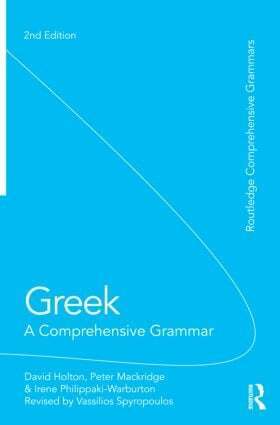
Greek: A Comprehensive Grammar of the Modern Language has become firmly established as the leading reference guide to modern Greek grammar. With its detailed treatment of all grammatical structures, its analysis of the complexities of the language and its particular attention to areas of confusion and difficulty, it is the first truly comprehensive grammar of the language to be produced. It provides a study of the real patterns of use in contemporary Greek
This second edition continues to focus on the Greek spoken and written by native speakers today. Taking account of recent changes to the Greek language, this new edition features:
Significantly expanded material on many areas, including syntax and phonology
A new chapter on derivational morphology and other word formation processes including compounding and acronym formation
Examples drawn from everyday spoken usage as well as official, journalistic and online discourse, such as newspapers, blogs and discussion groups
A significantly expanded index of English terms and Greek words and a revised glossary of terms
The Grammar will be an essential reference source for the adult learner and user of Greek. It is ideal for independent study and for use in schools, colleges, universities and adult classes, up to an advanced level.
2 494 kr
Skickas inom 10-15 vardagar
1 022 kr
Läs direkt efter köp
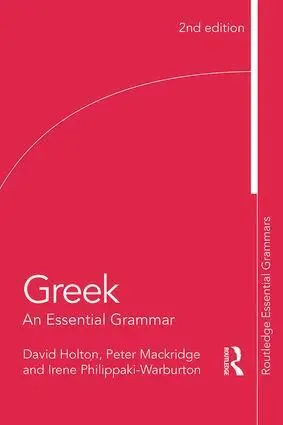
Greek: An Essential Grammar is a concise and user-friendly reference guide to modern Greek. It presents a fresh and accessible description of the language in short, readable sections. Explanations are clear and supported by examples throughout.
This new edition has been revised and updated to present an accurate and accessible description of the most important aspects of modern Greek.
Features include:
clear and up-to-date examples
special attention to those points which often cause problems to English-speaking learners
Greek/English comparisons and contrasts highlighted throughout.
Greek: An Essential Grammar is ideal for learners involved in independent study and for students in schools, colleges, universities and adult classes of all types.
Levels CEFR scale A1-B2 and ACTFL level Low-Intermediate to Advanced.
1 022 kr
Läs direkt efter köp
Greek: An Essential Grammar is a concise and user-friendly reference guide to modern Greek. It presents a fresh and accessible description of the language in short, readable sections. Explanations are clear and supported by examples throughout.
This new edition has been revised and updated to present an accurate and accessible description of the most important aspects of modern Greek.
Features include:
clear and up-to-date examples
special attention to those points which often cause problems to English-speaking learners
Greek/English comparisons and contrasts highlighted throughout.
Greek: An Essential Grammar is ideal for learners involved in independent study and for students in schools, colleges, universities and adult classes of all types.
Levels CEFR scale A1-B2 and ACTFL level Low-Intermediate to Advanced.
Greece in British Women's Literary Imagination, 1913–2013
1 247 kr
Skickas inom 5-8 vardagar