Peter R. Kingstone - Böcker
Visar alla böcker från författaren Peter R. Kingstone. Handla med fri frakt och snabb leverans.
2 produkter
2 produkter
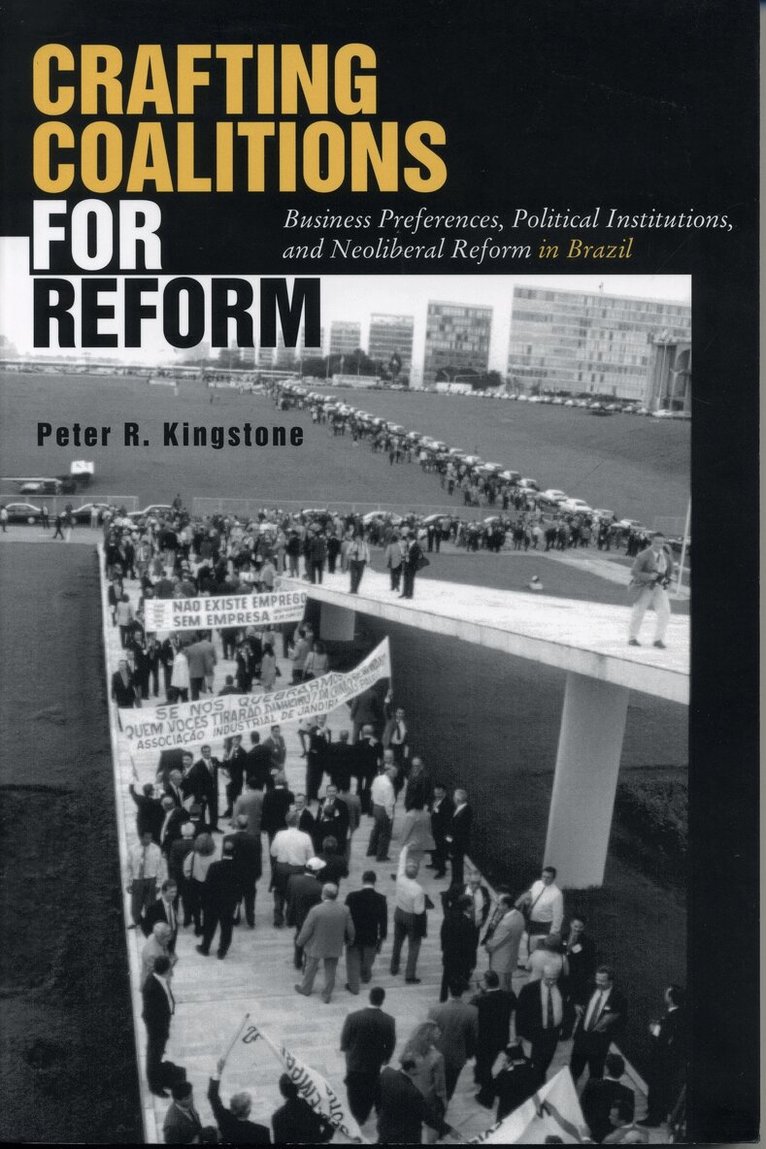
Crafting Coalitions for Reform
Business Preferences, Political Institutions, and Neoliberal Reform in Brazil
Häftad, Engelska, 1999
486 kr
Skickas inom 7-10 vardagar
The success of political efforts to create a more open economy in Brazil over the past decade has depended crucially on support from the industrial sector, which long enjoyed the benefits of protection by the state from economic competition. Why businesses previously so sheltered would back neoliberal reform, and why opposition arose at times from sectors least threatened by free trade, are the puzzles this book seeks to answer.Drawing on more than one hundred interviews with industrialists and business association representatives, as well as a wide range of other sources, Peter Kingstone argues that the key to understanding the behavior of industrialists lies in the impact of four factors on their preferences for reform: the effect of economic crisis on industrialists' perception of the viability of the earlier development model; the sectoral location of their firms in the economy and the advantages historically accruing therefrom; the adjustment options available to them given their position in the market; and the credibility of the government's promises about reform and its tactical choices for getting them implemented through the political system.The mix of these four factors, Kingstone shows, left business preferences relatively malleable and thus available for support of reform, even in the face of potentially high costs. Whether such support was forthcoming depended on industrialists' perceptions of the ability of government leaders to deliver on their promises. Widespread resistance to reform occurred when leaders lost their credibility. Under Fernando Collor's leadership, that credibility was never recovered; under Fernando Henrique Cardoso's, it was recovered through increasing concessions to industrialists on the character of the reform program.
705 kr
Skickas inom 7-10 vardagar
After 21 years of military rule, Brazil returned to democracy in 1985. Over the past decade and a half, Brazilians in the Nova Rep\u00fablica (New Republic) have struggled with a range of diverse challenges that have tested the durability and quality of the young democracy. How well have they succeeded? To what extent can we say that Brazilian democracy has consolidated? What actors, institutions, and processes have emerged as most salient over the past 15 years? Although Brazil is Latin America's largest country, the world's third largest democracy, and a country with a population and GNP larger than Yeltsin's Russia, more than a decade has passed since the last collaborative effort to examine regime change in Brazil, and no work in English has yet provided a comprehensive appraisal of Brazilian democracy in the period since 1985.Democratic Brazil analyzes Brazilian democracy in a comprehensive, systematic fashion, covering the full period of the New Republic from Presidents Sarney to Cardoso. Democratic Brazil brings together twelve top scholars, the \u201cnext generation of Brazilianists,\u201d with wide-ranging specialties including institutional analysis, state autonomy, federalism and decentralization, economic management and business-state relations, the military, the Catholic Church and the new religious pluralism, social movements, the left, regional integration, demographic change, and human rights and the rule of law. Each chapter focuses on a crucial process or actor in the New Republic, with emphasis on its relationship to democratic consolidation. The volume also contains a comprehensive bibliography on Brazilian politics and society since 1985. Prominent Brazilian historian Thomas Skidmore has contributed a foreword to the volume.Democratic Brazil speaks to a wide audience, including Brazilianists, Latin Americanists generally, students of comparative democratization, as well as specialists within the various thematic subfields represented by the contributors. Written in a clear, accessible style, the book is ideally suited for use in upper-level undergraduate courses and graduate seminars on Latin American politics and development.