Peter S. Maitland - Böcker
Visar alla böcker från författaren Peter S. Maitland. Handla med fri frakt och snabb leverans.
6 produkter
6 produkter
538 kr
Skickas inom 10-15 vardagar
Since this book was published in 1978 many advances have been made in our knowledge of the fresh waters of the world, especially in understanding many of the intricate processes involved in their functioning as systems and in countering the problems created by human activities. New problems, many of an international nature, have loomed during this period - of which the acidification of fresh waters in many parts of the world is a notable example. Much has been published concerning the aquatic flora, fauna and ecology of previously poorly known geographic areas, notably Australasia.
1 584 kr
Skickas inom 10-15 vardagar
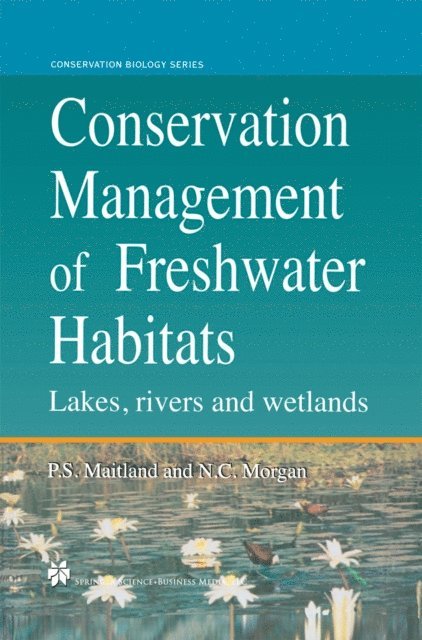
This text applies research knowledge to the solution of practical problems facing wildlife conservation in freshwater habitats. Subjects covered include: evaluation of the conservation interest of sites; practical protection and management of freshwater habitats; and species conservation. Using a large number of photographs and examples from freshwater habitats worldwide, this text brings together expertise and information to produce a practical and comprehensive account of freshwater conservation management.
268 kr
Skickas inom 5-8 vardagar
1 584 kr
Skickas inom 10-15 vardagar
Scotland is fortunate in being very richly endowed with natural fresh waters in the form of numerous lochs and rivers. These constitute on the one hand an attractive feature of the landscape and on the other a major resource for industry and recreation. Thus there are about 3800 lochs over4 ha in area and these form approximately 1.0% of the total surface area of Scotland. Com parable figures for England and Wales are 1700 lakes and 0.05% of the land surface, and in terms of volume. Loch Ness contains more water than all the lakes and reservoirs in England and Wales put together (Smith & Lyle 1979). Many of the Scottish lochs are large and clean and consequently are particularly valuable in resource terms. The decision as to which are actually the largest lochs is debatable, particularly when the main criteria of greatest surface area, length, volume and depth each gives a different water (Lochs Lomond. Awe, Ness and Morar respectively). These four then are certainly among the largest lochs in the country, but close to them in size come several other large waters, among which is Loch Shiel- which is exceeded in length only by Lochs Awe, Ness and Lomond. These five very large lochs (Frontis piece) form the group of waters selected for the comparative studies described in this volume.
1 584 kr
Skickas inom 10-15 vardagar
Scotland is fortunate in being very richly endowed with natural fresh waters in the form of numerous lochs and rivers. These constitute on the one hand an attractive feature of the landscape and on the other a major resource for industry and recreation. Thus there are about 3800 lochs over4 ha in area and these form approximately 1.0% of the total surface area of Scotland. Com parable figures for England and Wales are 1700 lakes and 0.05% of the land surface, and in terms of volume. Loch Ness contains more water than all the lakes and reservoirs in England and Wales put together (Smith & Lyle 1979). Many of the Scottish lochs are large and clean and consequently are particularly valuable in resource terms. The decision as to which are actually the largest lochs is debatable, particularly when the main criteria of greatest surface area, length, volume and depth each gives a different water (Lochs Lomond. Awe, Ness and Morar respectively). These four then are certainly among the largest lochs in the country, but close to them in size come several other large waters, among which is Loch Shiel- which is exceeded in length only by Lochs Awe, Ness and Lomond. These five very large lochs (Frontis piece) form the group of waters selected for the comparative studies described in this volume.
1 584 kr
Skickas inom 10-15 vardagar
In this book the authors have applied research knowledge to the solution of practical problems facing wildlife conservation in freshwater habitats. Subjects covered include: evaluation of the conservation interest of sites; practical protection and management of freshwater habitats; species conservation.