Peter Topping - Böcker
Visar alla böcker från författaren Peter Topping. Handla med fri frakt och snabb leverans.
10 produkter
10 produkter
210 kr
Skickas inom 5-8 vardagar
Del 325 - London Mathematical Society Lecture Note Series
Lectures on the Ricci Flow
Häftad, Engelska, 2006
797 kr
Skickas inom 7-10 vardagar
Hamilton's Ricci flow has attracted considerable attention since its introduction in 1982, owing partly to its promise in addressing the Poincaré conjecture and Thurston's geometrization conjecture. This book gives a concise introduction to the subject with the hindsight of Perelman's breakthroughs from 2002/2003. After describing the basic properties of, and intuition behind the Ricci flow, core elements of the theory are discussed such as consequences of various forms of maximum principle, issues related to existence theory, and basic properties of singularities in the flow. A detailed exposition of Perelman's entropy functionals is combined with a description of Cheeger-Gromov-Hamilton compactness of manifolds and flows to show how a 'tangent' flow can be extracted from a singular Ricci flow. Finally, all these threads are pulled together to give a modern proof of Hamilton's theorem that a closed three-dimensional manifold whichcarries a metric of positive Ricci curvature is a spherical space form.
1 222 kr
Skickas inom 5-8 vardagar
Del 403 - BAR International
Enclosures and Defences in the Neolithic of Western Europe, Part i
Häftad, Engelska, 1988
749 kr
Skickas inom 5-8 vardagar
Del 403 - BAR International
Enclosures and Defences in the Neolithic of Western Europe, Part ii
Häftad, Engelska, 1988
749 kr
Skickas inom 5-8 vardagar
178 kr
Skickas inom 11-20 vardagar
There have been some fine histories of Didsbury compiled over the last 150 years since the publication of A History of the Chapels of Didsbury & Chorlton by Revd John Booker in 1859. But now it is time for a new book, which does not attempt to revisit or repackage what already has been published but to do something different, viewing the history of Didsbury from another angle. Local painter and author Peter Topping and author and historian Andrew Simpson invite readers to dip into the pages of Didsbury Through Time to discover the changes that have occurred over the last century. Through a mix of old images paired with new, along with a selection of paintings by Peter himself, the lives of the people who lived behind the doors of Didsbury's fine buildings are uncovered.
704 kr
Tillfälligt slut
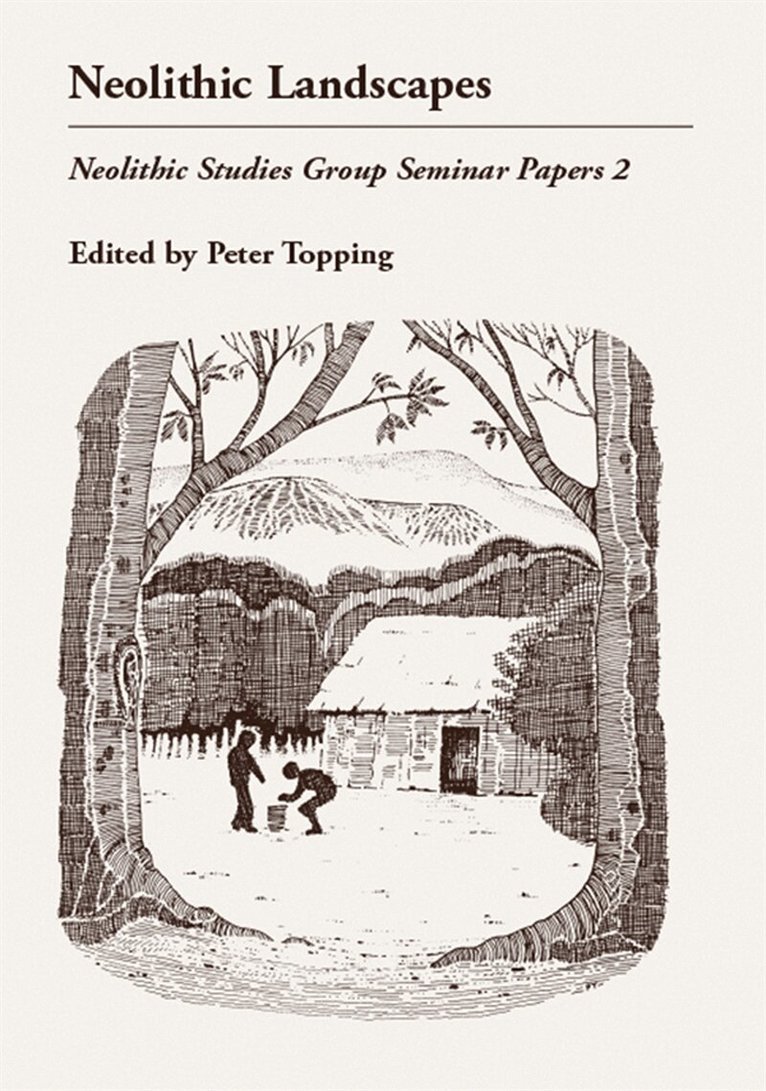
The social processes involved in acquiring flint and stone in the Neolithic began to be considered over thirty years ago, promoting a more dynamic view of past extraction processes. Whether by quarrying, mining or surface retrieval, the geographic source locations of raw materials and their resultant archaeological sites have been approached from different methodological and theoretical perspectives. In recent years this has included the exploration of previously undiscovered sites, refined radiocarbon dating, comparative ethnographic analysis and novel analytical approaches to stone tool manufacture and provenancing. The aim of this volume in the Neolithic Studies Group Papers is to explore these new findings on extraction sites and their products. How did the acquisition of raw materials fit into other aspects of Neolithic life and social networks? How did these activities merge in creating material items that underpinned cosmology, status and identity? What are the geographic similarities, constraints and variables between the various raw materials, and how does the practise of stone extraction in the UK relate to wider extractive traditions in northwestern Europe? Eight papers address these questions and act as a useful overview of the current state of research on the topic.
618 kr
Skickas
The Northumberland Archaeological Group’s (NAG) Wether Hill project spanned the years 1994–2015 and was located on the eponymous hilltop overlooking the mouth of the Breamish Valley in the Northumberland Cheviots. The project had been inspired by the RCHME’s ‘Southeast Cheviots Project’ that had discovered and recorded extensive prehistoric and later landscapes. The NAG project investigated several sites. Over the 11 seasons of excavation, NAG recorded evidence of residual Mesolithic activity (microliths), a burial cairn containing two Beakers in an oak coffin, which was superseded by a stone-built cist containing three Food Vessels, Iron Age cord rig cultivation and clearance cairns, a series of Middle/Late Iron Age timber-built palisaded enclosures, a cross-ridge dyke, which protected the southern approach to the Wether Hill fort, and sampled the multi-period bivallate hillfort. The hillfort sequence on Wether Hill began with a succession of palisaded enclosures, which were later replaced by bivallate earth and stone defenses; both phases appear to have been associated with timber-built houses. Eventually the fort was abandoned, and three stone-built roundhouses were constructed in the fort. The 18 radiocarbon dates obtained from various contexts in the hillfort makes this site one of the better dated forts in the Borders. The chronology of the Wether Hill fort spanned the Middle/Late Iron Age, which corresponds with dates from palisaded enclosures excavated elsewhere on the hilltop spur. Taken together, this evidence provides a snapshot of settlement hierarchies and agricultural practices during the later Iron Age in this part of the Northumberland Cheviots. The excavations also help contextualise some of the RCHME survey evidence, providing data to model chronology, potential prehistoric settlement density and land-use patterns at different time periods in the well-preserved archaeological landscapes of the Cheviots.
441 kr
Skickas
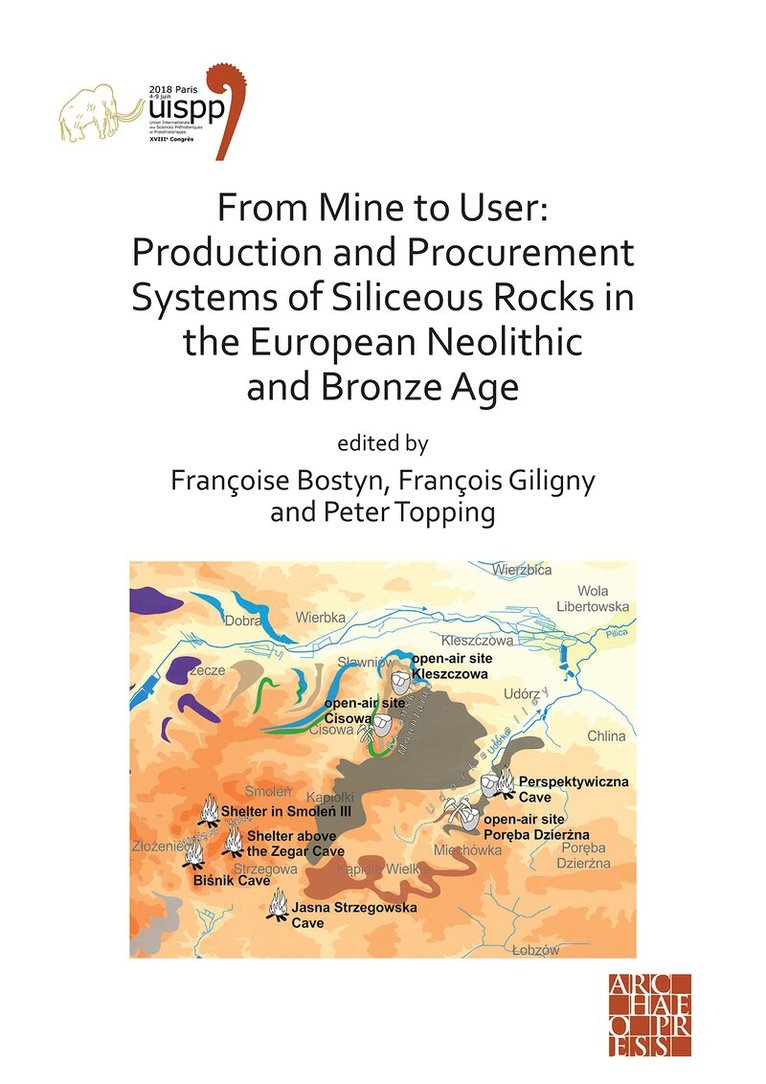
From Mine to User: Production and Procurement Systems of Siliceous Rocks in the European Neolithic and Bronze Age presents the papers from Session XXXIII of the 18th UISPP World Congress (Paris, June 2018). 23 authors contribute nine papers from Parts 1 and 2 of the Session. The first session ‘Siliceous rocks: procurement and distribution systems’ was aimed at analysing one of the central research issues related to mining, i.e. the production systems and the diffusion of mining products. The impact of extraction on the environment, group mobility and the numbers involved in the exploitation phase were considered; mining products were also examined with a view to identifying local and imported/exported products and the underlying social organization relating to the different fields of activity. The second session ‘Flint mines and chipping floors from prehistory to the beginning of the nineteenth century’ focused on knapping activities. The significance of the identification of knapping workshops in the immediate vicinity of mine shafts and of their presence in villages as well as in intermediary places between the two was considered in the analysis of chaîne opératoire sequences. The potential of product quality and artefact distribution to contribute to the understanding of the social organisation of the communities being studied was also examined.
474 kr
Skickas inom 7-10 vardagar
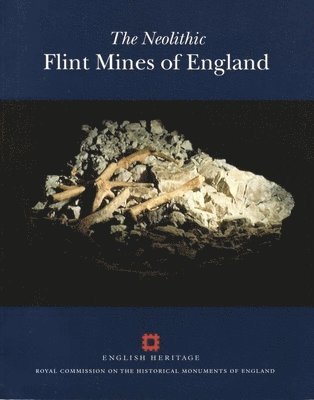
Only rarely in Europe do the surface remains of Neolithic flint mines remain so dramatically for all to see as those located along the South Downs and in the Breckland of England. Even within England they represent a diminishing resource and only ten sites have been recorded with any certainty. As examples of our earliest industrial heritage they represent archaeological sites of the first importance and have a special part to play in the history of technology.However, despite a lengthy history of archaeological investigation, they have rarely been considered nationally as a class of monument. Although some sites such as Grime's Graves are well known through excavation campaigns, others are known only through obscure articles and unpublished archival material. Many of those that survive as earthworks or cropmarks have never been surveyed previously or accurately planned.Consequently, English Heritage has compiled detailed plans of the surface areas of all of the known flint mines and investigated the sites of other potential examples. Using a combination of field survey, aerial photography and archival research, this volume looks at each site in its own right as a major and important complex and - for the first time - offers a synthesis of the evidence to date.