Philipp Frank – författare
Visar alla böcker från författaren Philipp Frank. Handla med fri frakt och snabb leverans.
15 produkter
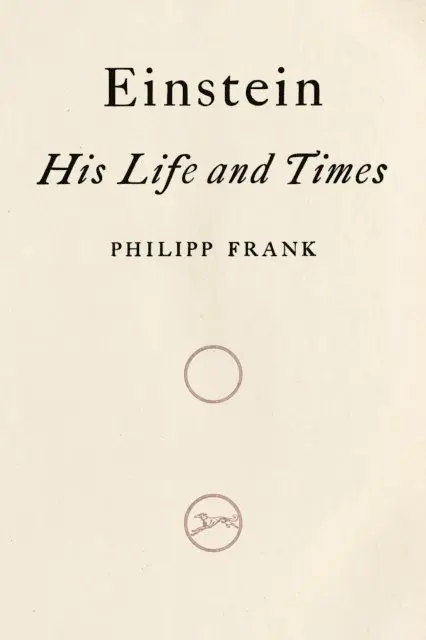
Einstein
His Life And Times
Häftad, 2002
227 kr
Lägg i varukorg
Much has been written about Albert Einstein, technical and biographical, but very little remains as valuable as this unique hybrid of a book written by Einstein's colleague and contemporary. Both rich in personal insights and grounded in a deep knowledge of twentieth-century science, Phillip …
Einstein
E-bok, 2013
236 kr
Lägg i varukorg
Much has been written about Albert Einstein, technical and biographical, but very little remains as valuable as this unique hybrid of a book written by Einstein’s colleague and contemporary. Both rich in personal insights and grounded in a deep knowledge of twentieth-century science, Phillip …
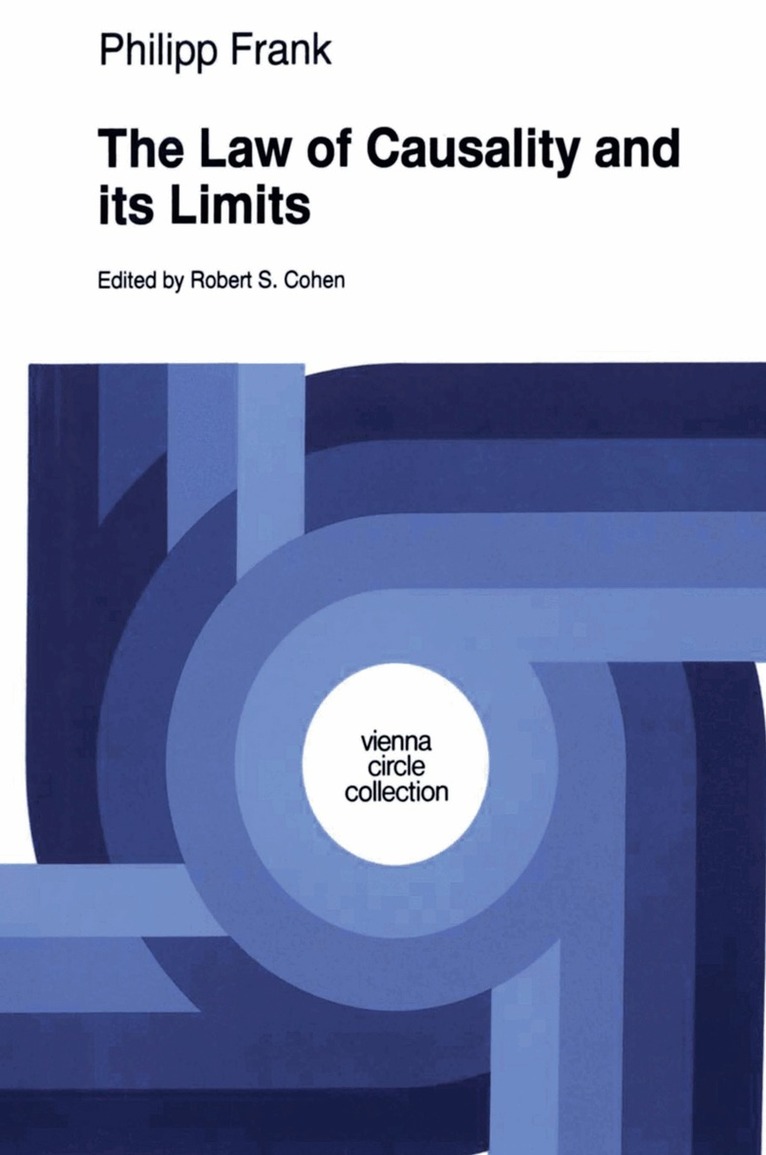
Law of Causality and Its Limits
Av Philipp Frank, Robert S. Cohen
Inbunden, 1997
1094 kr
Lägg i varukorg
The Law of Causality and its Limits was the principal philosophical work of the physicist turned philosopher, Philipp Frank. Born in Vienna on March 20, 1884, Frank died in Cambridge, Massachusetts on July 21, 1966. He received his doctorate in 1907 at the University of Vienna in theoretical …
Humanistic Background of Science
Av Philipp Frank, George A. Reisch m. fl.
Inbunden, 2021
1246 kr
Lägg i varukorg
The once-lost introduction to the philosophy of science by Philipp Frank (1884-1966), a leading member of the Vienna circle of philosophers and biographer of Albert Einstein.Philipp Frank (1884–1966) was an influential philosopher of science, public intellectual, and Harvard educator whose last …
Humanistic Background of Science
Av Philipp Frank, George A. Reisch m. fl.
Häftad, 2022
634 kr
Lägg i varukorg
The once-lost introduction to the philosophy of science by Philipp Frank (1884-1966), a leading member of the Vienna circle of philosophers and biographer of Albert Einstein.Philipp Frank (1884–1966) was an influential philosopher of science, public intellectual, and Harvard educator whose last …
Einstein
Sein Leben und seine Zeit
E-bok, 2013
629 kr
Lägg i varukorg
Das Manuskript zu diesem Buch ist unter merkwürdigen Um ständen entstanden. Ich begann die Niederschrift 1939 in New York, setzte sie 1940 in Chicago fort und beendete den größten Teil 1941 in Boston. Das Manuskript war in deutscher Sprache geschrieben, aber begreiflicherweise unter der damaligen …
Einstein
Sein Leben und seine Zeit
Häftad, 2012
654 kr
Lägg i varukorg
Das Manuskript zu diesem Buch ist unter merkwürdigen Um ständen entstanden. Ich begann die Niederschrift 1939 in New York, setzte sie 1940 in Chicago fort und beendete den größten Teil 1941 in Boston. Das Manuskript war in deutscher Sprache geschrieben, aber begreiflicherweise unter der damaligen …
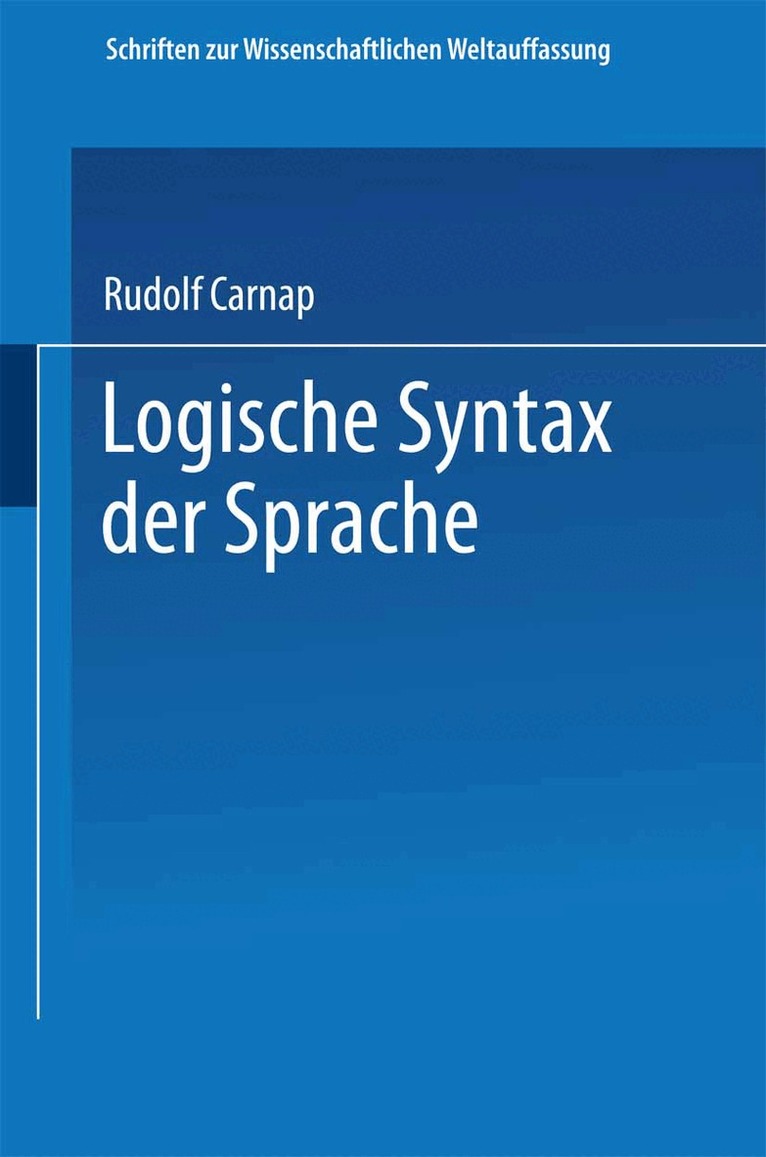
Logische Syntax der Sprache
Av Rudolf Carnap, Philipp Frank m. fl.
Häftad, 1934
566 kr
Lägg i varukorg
Dieser Buchtitel ist Teil des Digitalisierungsprojekts Springer Book Archives mit Publikationen, die seit den Anfängen des Verlags von 1842 erschienen sind. Der Verlag stellt mit diesem Archiv Quellen für die historische wie auch die disziplingeschichtliche Forschung zur Verfügung, die jeweils im …
Logische Syntax der Sprache
Av Moritz Schlick, Philipp Frank m. fl.
E-bok, 2013
462 kr
Lägg i varukorg
Dieser Buchtitel ist Teil des Digitalisierungsprojekts Springer Book Archives mit Publikationen, die seit den Anfängen des Verlags von 1842 erschienen sind. Der Verlag stellt mit diesem Archiv Quellen für die historische wie auch die disziplingeschichtliche Forschung zur Verfügung, die jeweils im …
Zur Biologie der Ethik
Psychopathologische Untersuchungen über Schuldgefühl und Moralische Idealbildung Zugleich ein Beitrag zum Wesen des Neurotischen Menschen
Av Otto Kant, Moritz Schlick m. fl.
E-bok, 2013
527 kr
Lägg i varukorg
Dieser Buchtitel ist Teil des Digitalisierungsprojekts Springer Book Archives mit Publikationen, die seit den Anfängen des Verlags von 1842 erschienen sind. Der Verlag stellt mit diesem Archiv Quellen für die historische wie auch die disziplingeschichtliche Forschung zur Verfügung, die jeweils im …
Law of Causality and Its Limits
Av Philipp Frank, Robert S. Cohen
Häftad, 2012
1126 kr
Lägg i varukorg
The Law of Causality and its Limits was the principal philosophical work of the physicist turned philosopher, Philipp Frank. Born in Vienna on March 20, 1884, Frank died in Cambridge, Massachusetts on July 21, 1966. He received his doctorate in 1907 at the University of Vienna in theoretical …
Law of Causality and Its Limits
Av Philipp Frank, Robert S. Cohen
E-bok, 2012
1455 kr
Lägg i varukorg
The Law of Causality and its Limits was the principal philosophical work of the physicist turned philosopher, Philipp Frank. Born in Vienna on March 20, 1884, Frank died in Cambridge, Massachusetts on July 21, 1966. He received his doctorate in 1907 at the University of Vienna in theoretical …