Philippa Glanville - Böcker
Visar alla böcker från författaren Philippa Glanville. Handla med fri frakt och snabb leverans.
4 produkter
4 produkter
2 773 kr
Skickas inom 10-15 vardagar
First Published in 2005. Silver is unique among the decorative arts in that its raw material is both inherently valuable and infinitely reusable. Its ownership has been a social bench-mark and its form has exercised the skills of sculptors, designers, chasers and engravers, but ultimately it could be, and normally was, melted down and refashioned quite without sentiment. Because of this constant recycling, the survival of any individual object is quite random and unrelated to its uniqueness or otherwise in its period. Hitherto plate historians have focused on individual objects almost to the exclusion of the context - social or economic - from which they came but now that context is seen as crucial in understanding historic plate. So in the first section of this book each chapter considers contemporary attitudes and usage.
691 kr
Skickas inom 10-15 vardagar
First Published in 2005. Silver is unique among the decorative arts in that its raw material is both inherently valuable and infinitely reusable. Its ownership has been a social bench-mark and its form has exercised the skills of sculptors, designers, chasers and engravers, but ultimately it could be, and normally was, melted down and refashioned quite without sentiment. Because of this constant recycling, the survival of any individual object is quite random and unrelated to its uniqueness or otherwise in its period. Hitherto plate historians have focused on individual objects almost to the exclusion of the context - social or economic - from which they came but now that context is seen as crucial in understanding historic plate. So in the first section of this book each chapter considers contemporary attitudes and usage.
186 kr
Skickas inom 11-20 vardagar
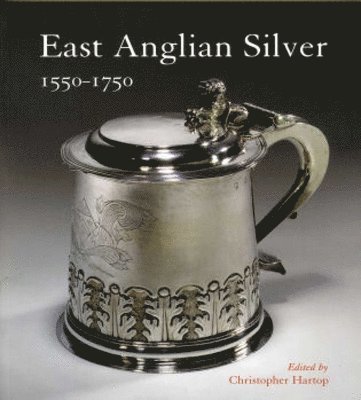
The beauty and stunning craftsmanship of silver made in East Anglia have long been celebrated by scholars and collectors. This book describes in depth a wealth of important silver articles made in the region which are now to be found in museums and private collections in Britain, America and Australia, as well as in churches in Norfolk, Suffolk and Essex. Many of the objects featured have never been published before, including a beaker in the Royal Collection by Elizabeth Haslewood, Norwich's only woman silversmith of the Stuart period, and a magnificent Charles II tankard from the Gregory Peck collection. The essays, the results of new research on many aspects of the economic and social history of the region, set the silver in its historical context. They present a fascinating perspective on everyday life for many East Anglians during the sixteenth and seventeenth centuries. Even modest households might have owned a few silver spoons at that time.The consumer demand from yeomen, merchants and others was filled by silversmiths working not only in Norwich, the second largest city in the kingdom, but also in smaller towns such as King's Lynn, Great Yarmouth, Beccles, Ipswich, Colchester and Cambridge. Norwich closely guarded its right to mark silverware made in the city with its civic arms. In the reign of Elizabeth, silversmiths there such as William Cobbold made objects to equal the finest creations of London, Antwerp and Amsterdam. European influences, especially from the Netherlands, were especially important in Norwich, which had a large community of immigrant craftsmen during the sixteenth and seventeenth centuries. Nearly a hundred photographs of marks used by silversmiths throughout East Anglia, many of them newly identified, make this book an essential tool for the collector as well as the local historian. '...a work of art in its own right.' Ian Collins in Eastern Daily Press
246 kr
Skickas
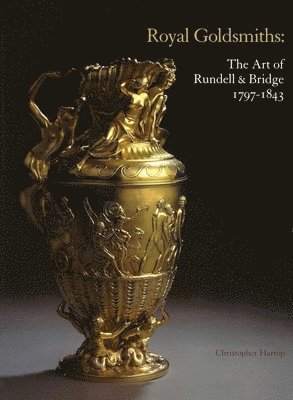
Artists such as John Flaxman, Thomas Stothard, Edward Hodges Baily were among the many who designed and modelled silverware for Rundell & Bridge, the Royal Goldsmiths who served two monarchs - George III and his son the Prince Regent (later George IV). It was a period of unparalleled prosperity in Britain during which patrons, led by the colourful Prince Regent, commissioned objects of silver, silver-gilt and even gold in the finest taste. Philip Rundell and John Bridge were well placed to respond to this new fashion for opulence. Directing their workshops from 1802 were the silversmith Benjamin Smith and the designer Digby Scott; and after Paul Storr, the most celebrated English silversmith of the period, took charge in 1807, the workshop grew until it employed the talents of several hundred gifted designers, modellers, chasers and engravers. It was a successful blending of art and industry that remains unsurpassed in the decorative arts. The firm Rundell & Bridge were appointed Royal Goldsmiths, Silversmiths, Jewellers and Medallists in 1797 and held the Royal Warrant until 1830. Yet Rundell & Bridge did more than promote innovative styles; they marketed new types of tableware.Despite the threat of invasion by Napoleon, the British enthusiastically embraced not only new designs from France, such as those inspired by the surge of Egyptomania, but new customs of the tabletop. Tying in with an exhibition at Koopman Rare Art, London, the first ever to be devoted to the firm's achievement, the book shows the importance of the Prince Regent as a patron of goldsmiths and presents a fascinating portrait of London against the backdrop of the Napoleonic Wars. It features a wealth of magnificent silver and gold objects, snuff boxes, jewellery, medals and bejewelled swords from museums and private collections in the United Kingdom, United States, Canada and Australia. With a foreword by His Royal Highness The Prince of Wales, the book will be a valuable addition not only to art historical studies but also to the social and economic history of the period. Net proceeds of the sale of the book will benefit the Prince's Trust.