Christopher Hartop - Böcker
Visar alla böcker från författaren Christopher Hartop. Handla med fri frakt och snabb leverans.
6 produkter
6 produkter
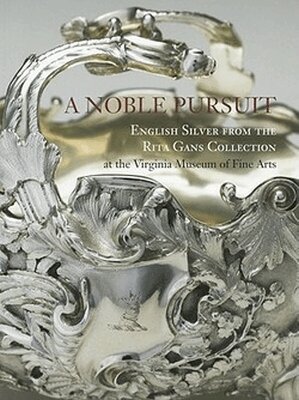
Noble Pursuit
English Silver from the Rita Gans Collection at the Virginia Museum of Fine Arts
Inbunden, Engelska, 2011
278 kr
Skickas inom 7-10 vardagar
186 kr
Skickas inom 11-20 vardagar
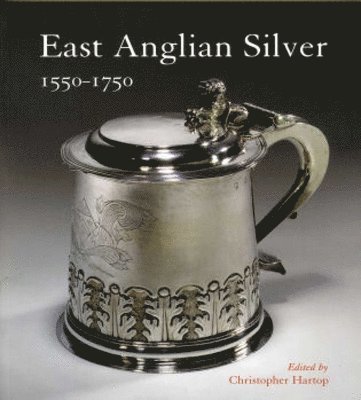
The beauty and stunning craftsmanship of silver made in East Anglia have long been celebrated by scholars and collectors. This book describes in depth a wealth of important silver articles made in the region which are now to be found in museums and private collections in Britain, America and Australia, as well as in churches in Norfolk, Suffolk and Essex. Many of the objects featured have never been published before, including a beaker in the Royal Collection by Elizabeth Haslewood, Norwich's only woman silversmith of the Stuart period, and a magnificent Charles II tankard from the Gregory Peck collection. The essays, the results of new research on many aspects of the economic and social history of the region, set the silver in its historical context. They present a fascinating perspective on everyday life for many East Anglians during the sixteenth and seventeenth centuries. Even modest households might have owned a few silver spoons at that time.The consumer demand from yeomen, merchants and others was filled by silversmiths working not only in Norwich, the second largest city in the kingdom, but also in smaller towns such as King's Lynn, Great Yarmouth, Beccles, Ipswich, Colchester and Cambridge. Norwich closely guarded its right to mark silverware made in the city with its civic arms. In the reign of Elizabeth, silversmiths there such as William Cobbold made objects to equal the finest creations of London, Antwerp and Amsterdam. European influences, especially from the Netherlands, were especially important in Norwich, which had a large community of immigrant craftsmen during the sixteenth and seventeenth centuries. Nearly a hundred photographs of marks used by silversmiths throughout East Anglia, many of them newly identified, make this book an essential tool for the collector as well as the local historian. '...a work of art in its own right.' Ian Collins in Eastern Daily Press
246 kr
Skickas
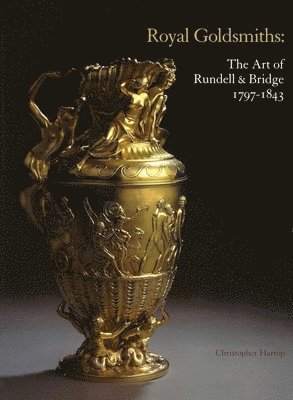
Artists such as John Flaxman, Thomas Stothard, Edward Hodges Baily were among the many who designed and modelled silverware for Rundell & Bridge, the Royal Goldsmiths who served two monarchs - George III and his son the Prince Regent (later George IV). It was a period of unparalleled prosperity in Britain during which patrons, led by the colourful Prince Regent, commissioned objects of silver, silver-gilt and even gold in the finest taste. Philip Rundell and John Bridge were well placed to respond to this new fashion for opulence. Directing their workshops from 1802 were the silversmith Benjamin Smith and the designer Digby Scott; and after Paul Storr, the most celebrated English silversmith of the period, took charge in 1807, the workshop grew until it employed the talents of several hundred gifted designers, modellers, chasers and engravers. It was a successful blending of art and industry that remains unsurpassed in the decorative arts. The firm Rundell & Bridge were appointed Royal Goldsmiths, Silversmiths, Jewellers and Medallists in 1797 and held the Royal Warrant until 1830. Yet Rundell & Bridge did more than promote innovative styles; they marketed new types of tableware.Despite the threat of invasion by Napoleon, the British enthusiastically embraced not only new designs from France, such as those inspired by the surge of Egyptomania, but new customs of the tabletop. Tying in with an exhibition at Koopman Rare Art, London, the first ever to be devoted to the firm's achievement, the book shows the importance of the Prince Regent as a patron of goldsmiths and presents a fascinating portrait of London against the backdrop of the Napoleonic Wars. It features a wealth of magnificent silver and gold objects, snuff boxes, jewellery, medals and bejewelled swords from museums and private collections in the United Kingdom, United States, Canada and Australia. With a foreword by His Royal Highness The Prince of Wales, the book will be a valuable addition not only to art historical studies but also to the social and economic history of the period. Net proceeds of the sale of the book will benefit the Prince's Trust.
306 kr
Skickas inom 11-20 vardagar
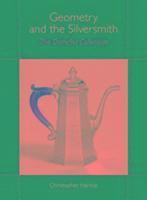
From the earliest times, learning how to construct simple and complex geometric shapes has been part of the training of a silversmith. Moreover, the educated patron of 300 years ago was also likely to be well versed in geometry and able to appreciate the subtleties of design of a seemingly simple cream jug or sugar bowl. Many functional objects in what became known as the 'Queen Anne' style rely for effect on polygons, multifoils, ellipses, and truncated pyramids and cones. Curiously, however, books on the history of European silver have been silent on the subject of geometry and the process by which design is transmitted via the workbench to a finished silver object has scarcely been explored. In his introductory essay, Christopher Hartop suggests that many of the geometric forms that became popular in the early eighteenth century were in fact modelled on imported Asian ceramics and lacquer, some of which in turn were copying much earlier Chinese metal wares. Yet a silversmith still needed a knowledge of geometrical constructions, whether he was copying an imported object, following a design on paper, or utilizing a template.Using the Domcha Collection of predominantly English seventeenth- to nineteenth-century silver as examples, this important new study examines the role of geometry in the design and manufacture of silverware. The coffee pot illustrated on the front cover is a truncated octagonal pyramid and the octofoil salver achieves its pleasing effect through the intersection of four ellipses with common centre. The Domcha Collection, formed during the last 25 years, shows the timeless beauty of plain silver forms, where the emphasis is on line rather than ornament. The collection includes works by such important masters as Paul de Lamerie, Paul Crespin, Frederick Kandler, and the Hennell family. Silver made in Ireland and Scotland is also featured, as is provincial English silver made in York, Sheffield and Newcastle.
247 kr
Skickas inom 11-20 vardagar
The second half of the eighteenth century saw an enthusiastic revival of the use of shapes and decoration from Greek and Roman architecture in the design of furniture, ceramics and silver. A reaction against the curving outlines and elaborate floral decoration of the rococo, neo-classicism was promoted as a return to the ideal proportions and balance of the ancient world. Ironically, however, it was also an evocation of lost civilizations and sowed the seeds of the romanticism of the succeeding century. The chief proponents of this new style were members of the emerging profession of architecture such as Sir William Chambers (1723-1796), architect to King George III, James Wyatt (1746-1813), James "Athenian" Stuart (1713-1788) and especially Robert Adam (1728-1792). All of them designed silver as well, and their contribution to the elegant forms and simple decoration of domestic silver of the period is assessed in this book, the first to be devoted to English neo-classical silver for over forty years.The part played by industrialization in the development of the style is also examined, as is the increasingly important role of opulent retailers such as Wakelin & Tayler, Thomas Heming, Joseph Creswell, Jeffries & Jones, and Rundell, Bridge & Rundell. At the beginning of the nineteenth century, Rundell's, with their own design studios and workshops staffed by such well-known names as Digby Scott (c. 1750-1816), Benjamin Smith (1764-after 1818) and Paul Storr (1771-1844), were at the forefront of the adoption of a new imperial style based no longer on classical architecture but on classical sculpture. This book will be a welcome addition to the bookshelf of the silver collector. It will also appeal to anyone interested in the history of design of the period.
168 kr
Skickas
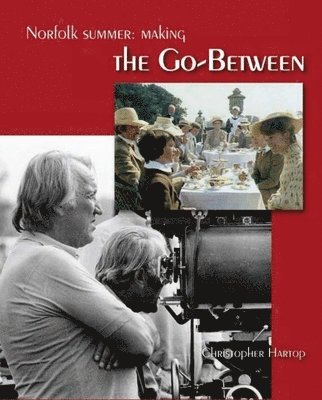
Norfolk Summer presents the story about the making of a film starring Julie Christie and Alan Bates Joseph Losey's award-winning movie The Go-Between was filmed entirely on location in Norfolk in 1970. The film charts the tragic story of a young boy's loss of innocence during a hot summer and stars Julie Christie and Alan Bates as a pair of lovers crossing class boundaries in late Victorian England. The production brought together the playwright Harold Pinter, who adapted L.P. Hartley's elegant novel for the screen, the acclaimed director Joseph Losey and a cast of international stars for ten weeks' filming in and around Melton Constable Hall in north Norfolk - a time of happy creativity, some tension and a good deal of comedy. But the idyllic summer only came about after years of bitter battling over the rights of the book, and it was to be followed by yet more intrigue and high drama, which culminated in the film's triumph at the 1971 Cannes Film Festival, where it won the prestigious Palme d'Or.