
Phillip Cox - Böcker
Visar alla böcker från författaren Phillip Cox. Handla med fri frakt och snabb leverans.
2 produkter
2 produkter
432 kr
Skickas inom 3-6 vardagar
Hoosier architect Evans Woollen (1927-2016) made a profound contribution to the built identity of Indianapolis, Indiana. Most recognized for introducing concrete Brutalism to the city, his practice was in fact surprisingly diverse, ranging from significant public buildings that are today some of the city's most iconic structures to humble churches, single-family homes, and historic renovations. Some loved his emphatic, proudly modern buildings, while others found them challenging, severe, or even ugly, but all agreed they were boundary pushing, the handiwork of an iconoclastic architect on the cutting edge of contemporary design. Surveying the full breadth of Woollen's six-decade career, What a Building Does tells the complete story of this essential Midwestern practitioner for the first time: from his early years as a student of Philip Johnson and Louis Kahn; to his decision to open his practice in Indianapolis; to his later professional successes across Indiana and beyond. With a focus on ten of Woollen's most important built works, this book explores the dynamic ideas which shaped his architecture and the complex relationship he held with Indianapolis, his hometown. Most significantly, it also discovers a multi-decade practice of empathetic, human-centered design conducted long before such ideas were mainstream. Featuring nearly 150 new full-color photos, never-before-seen archival material, and dozens of interviews with former colleagues, clients, and friends, What a Building Does expands the narrative of modern architecture and its legacy in the American Midwest.
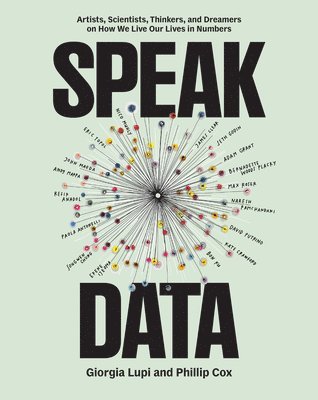
Speak Data
Artists, Scientists, Thinkers, and Dreamers on How We Live Our Lives in Numbers
Häftad, Engelska, 2025
389 kr
Skickas inom 3-6 vardagar
The first pop nonfiction book to explore the definition of data and how we can learn to speak that language features thought-provoking conversations with 17 extraordinary leaders in business, tech, medicine, psychology, health, art, and more who share new ideas about data, unpacking its powerful ability to reveal patterns, tell stories, stir emotion, and illuminate complexity.Data may be the most powerful force in society today. Data is everywhere, present in every moment, every event, every transaction, or interaction with someone else. Every time you send a text, call a friend, fill out a form, hail a taxi, stream a movie, surf the web, pay a bill, buy groceries, buy anything, take your temperature, count your steps, swipe right (or left), you generate data. There's data in the weather, in the air, in the ground, in outer space. If you own a smartwatch, you carry data on your body. If you have a cardiac pacemaker, you carry data in your body. So, what is data, really? It's a question that is surprisingly hard to answer. To some, data means numbers: figures on a screen, dots on a graph. It's also often (falsely) equated with facts, an invariable form of concrete knowledge that always tells the truth. But in reality, data is hardly so incontrovertible. Data is an abstraction of reality, a useful but imperfect representation of real life. Like life, it's full of nuance, imprecision, and ambivalence. It's quantitative and it's qualitative. And it's made by us—humans. These are some of the ideas that information designers Giorgia Lupi and Phillip Cox explore in their fascinating new book Speak Data: Artists, Scientists, Thinkers, and Dreamers on How We Live Our Lives in Numbers. Speak Data invites us to see data differently—not just as numbers on a chart, but as a way to understand and communicate who we are, how we connect, and how we make sense of the world. It's grounded in the principles of Data Humanism, a concept developed by coauthor and award-winning information designer Giorgia Lupi, which centers on people, rather than numbers, in its conception of data. In this beautifully illustrated book, the authors present data as a vocabulary that anyone can use, showing that when we truly learn to "speak data," we can open up new worlds of meaning about ourselves and everything around us.