P.N. Furbank - Böcker
Visar alla böcker från författaren P.N. Furbank. Handla med fri frakt och snabb leverans.
3 produkter
3 produkter
393 kr
Skickas
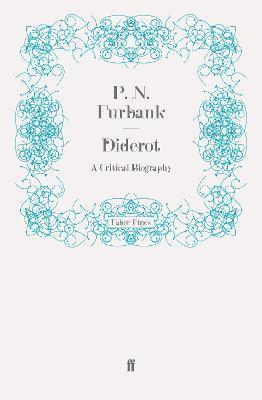
Author of that inexhaustibly strange masterpiece Rameau's Nephew, Denis Diderot (1713-84) was also a dramatist, a speculative philosopher, the founder of modern art criticism and a tireless correspondent; he has also been called the most talkative man of his generation. His genius was profoundly subversive, and he spent much of his working life under the threat of exile. The son of a cutler, Diderot had an empathy with trades, tools and machinery that flowered magnificently in some of his contributions to the great Encyclopédie, which he edited with d'Alembert and published over a period of some twenty years. Diderot's range of contacts was prodigious: a close friend of Rousseau, Grimm and d'Alembert, a familiar figure in the literary salons of Paris, he also met and corresponded with Hume, Garrick and Laurence Sterne. It was the support of Catherine the Great (as her agent, Diderot in effect laid the foundations of the Hermitage collection) that led to the most extraordinary episode in an astonishing life: at the age of sixty Diderot travelled to St Petersburg where he drew up outline plans for the conversion of Russia into an ideal republic.P. N. Furbank's sympathetic and probing analysis of Diderot's work and influence was first published in 1992 and won a Truman Capote Award for Literary Criticism.
393 kr
Skickas
Edward Morgan Forster died in 1970 at the age of 91, having achieved a world-wide reputation as an outstanding writer. Though best-known for his novels - Howard's End and A Passage to India are arguably the finest - he was also a brilliant critic and essayist and the author of some remarkable short stories.Forster was born into a mixed family background of bohemia and prim respectability. Indulged, cosseted, dressed up and shown off by his adored mother Lily, it was not surprising that he found public school life painfully harsh. Cambridge began the emancipation - intellectual, artistic, social, and sexual - which Forster's experiences abroad, his growing literary reputation, his deep friendships, and his love affairs were to extend.In his closing years Forster invited Furbank, a close friend, to write his biography. Based on the full range of private diaries, correspondence, and personal reminiscences, this book (first published in 1977) is the authorized and definitive 'life' of Forster. In the words of John Bayley, 'it is impossible to overpraise Furbank's style and sympathy as a biographer'; according to Noel Annan, 'he has done what Forster asked his biographer to do: he has told the truth'.
2 003 kr
Skickas inom 10-15 vardagar
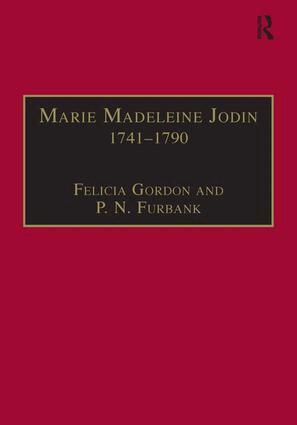
The life story of Marie-Madeleine Jodin opens an exciting new perspective on the world of 18th-century women, European court theatres, and, most strikingly, entails the remarkable discovery of a previously unknown French feminist. In 1790, Jodin, a protégée of Denis Diderot and a former actress, published a treatise entitled Vues législatives pour les femmes (Legislative Views for Women), which can lay claim to being the first signed, female-authored feminist manifesto of the French Revolutionary period, and which reveals Jodin's wide reading in women's history and feminist writing since ancient times. This new critical and contextual biography traces the turbulent life of an extraordinary woman, focusing particularly on her transformation from artisan's daughter, to tragic actress, to Enlightenment intellectual and feminist. The authors analyze the confrontations and scandals that beset her career, and read her feminist treatise-here reproduced, for the first time in English, in its entirety-as the summation of a chaotic but passionate existence. Also presented for the first time in English, fully set in their biographical and historical context, are the twenty-one letters that constitute Diderot's correspondence with Jodin. The varied and fascinating documentation concerning Jodin, which has only recently been discovered, provides a window on the world of 18th-century women. While memoirs and biographies of aristocratic women and upwardly mobile salonières such as Mme. Geoffrin and Mme. Roland are legion, chronicles of the lives of individual women lower down the social ladder are far fewer in number. A contemporary of Mary Wollstonecraft and Olympe de Gouges, Jodin argued for the social reform of working-class women, particularly prostitutes, to render them worthy to exercise the rights of citizenship.