Pramod N. Achar - Böcker
Visar alla böcker från författaren Pramod N. Achar. Handla med fri frakt och snabb leverans.
2 produkter
2 produkter
1 411 kr
Skickas inom 7-10 vardagar
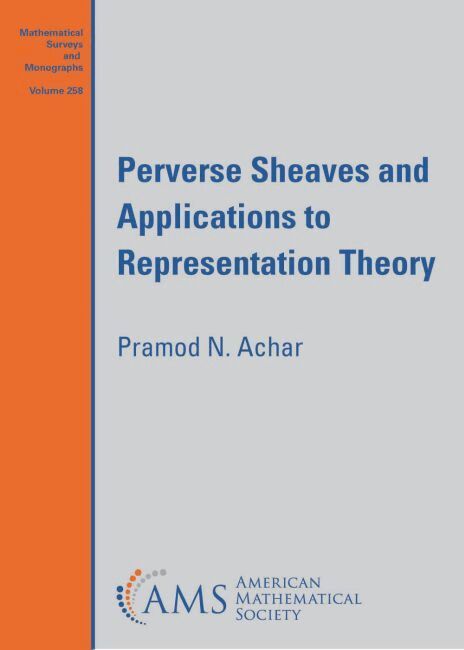
Since its inception around 1980, the theory of perverse sheaves has been a vital tool of fundamental importance in geometric representation theory. This book, which aims to make this theory accessible to students and researchers, is divided into two parts. The first six chapters give a comprehensive account of constructible and perverse sheaves on complex algebraic varieties, including such topics as Artin's vanishing theorem, smooth descent, and the nearby cycles functor. This part of the book also has a chapter on the equivariant derived category, and brief surveys of side topics including etale and $\ell$-adic sheaves, $\mathcal{D}$-modules, and algebraic stacks.The last four chapters of the book show how to put this machinery to work in the context of selected topics in geometric representation theory: Kazhdan-Lusztig theory; Springer theory; the geometric Satake equivalence; and canonical bases for quantum groups. Recent developments such as the $p$-canonical basis are also discussed.The book has more than 250 exercises, many of which focus on explicit calculations with concrete examples. It also features a 4-page ``Quick Reference'' that summarizes the most commonly used facts for computations, similar to a table of integrals in a calculus textbook.
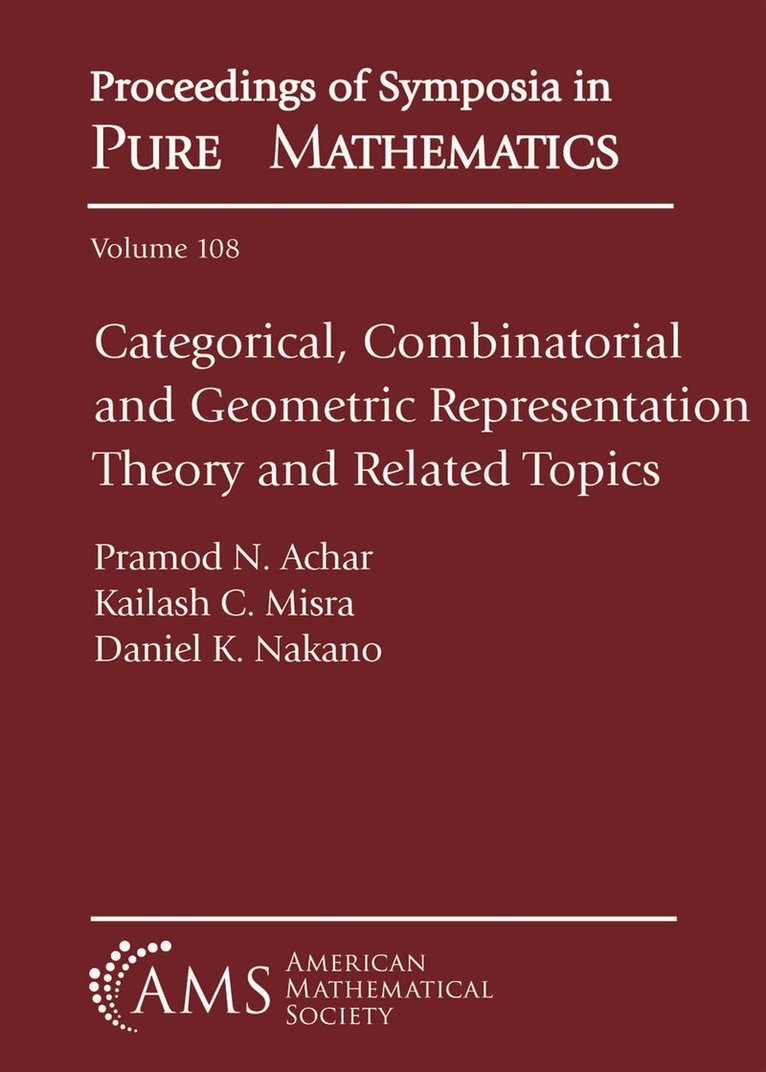
Categorical, Combinatorial and Geometric Representation Theory and Related Topics
Häftad, Engelska, 2024
1 568 kr
Skickas inom 7-10 vardagar
This book is the third Proceedings of the Southeastern Lie Theory Workshop Series covering years 2015-21. During this time five workshops on different aspects of Lie theory were held at North Carolina State University in October 2015; University of Virginia in May 2016; University of Georgia in June 2018; Louisiana State University in May 2019; and College of Charleston in October 2021.Some of the articles by experts in the field describe recent developments while others include new results in categorical, combinatorial, and geometric representation theory of algebraic groups, Lie (super) algebras, and quantum groups, as well as on some related topics. The survey articles will be beneficial to junior researchers. This book will be useful to any researcher working in Lie theory and related areas.