Prasannan Parthasarathi - Böcker
Visar alla böcker från författaren Prasannan Parthasarathi. Handla med fri frakt och snabb leverans.
5 produkter
5 produkter
Del 7 - Cambridge Studies in Indian History and Society
The Transition to a Colonial Economy
Weavers, Merchants and Kings in South India, 1720-1800
Häftad, Engelska, 2007
577 kr
Skickas inom 7-10 vardagar
According to widespread belief, poverty and low standards of living have been characteristic of India for centuries. Challenging this view, Prasannan Parthasarathi demonstrates that, until the late eighteenth century, labouring groups in South India, those at the bottom of the social order, were in a powerful position, receiving incomes well above subsistence. The decline in their economic fortunes, the author asserts, was a process initiated towards the end of that century, with the rise of colonial rule. Building on revisionist interpretations, he examines the transformation of Indian society and its economy under British rule through the prism of the labouring classes, arguing that their treatment by the early colonial state had no precedent in the pre-colonial past and that poverty and low wages were a product of colonial rule. The book promises to make an important contribution to the economic history of the region, and to the study of colonialism.
370 kr
Why Europe Grew Rich and Asia Did Not provides a striking new answer to the classic question of why Europe industrialised from the late eighteenth century and Asia did not. Drawing significantly from the case of India, Prasannan Parthasarathi shows that in the seventeenth and eighteenth centuries the advanced regions of Europe and Asia were more alike than different, both characterized by sophisticated and growing economies. Their subsequent divergence can be attributed to different competitive and ecological pressures that in turn produced varied state policies and economic outcomes. This account breaks with conventional views, which hold that divergence occurred because Europe possessed superior markets, rationality, science or institutions. It offers instead a groundbreaking rereading of global economic development that ranges from India, Japan and China to Britain, France and the Ottoman Empire and from the textile and coal industries to the roles of science, technology and the state.
Del 7 - Cambridge Studies in Indian History and Society
The Transition to a Colonial Economy
Weavers, Merchants and Kings in South India, 1720-1800
Inbunden, Engelska, 2001
1 241 kr
Skickas inom 7-10 vardagar
According to widespread belief, poverty and low standards of living have been characteristic of India for centuries. Challenging this view, Prasannan Parthasarathi demonstrates that, until the late eighteenth century, labouring groups in South India, those at the bottom of the social order, were in a powerful position, receiving incomes well above subsistence. The decline in their economic fortunes, the author asserts, was a process initiated towards the end of that century, with the rise of colonial rule. Building on revisionist interpretations, he examines the transformation of Indian society and its economy under British rule through the prism of the labouring classes, arguing that their treatment by the early colonial state had no precedent in the pre-colonial past and that poverty and low wages were a product of colonial rule. The book promises to make an important contribution to the economic history of the region, and to the study of colonialism.
1 228 kr
Skickas inom 7-10 vardagar
Why Europe Grew Rich and Asia Did Not provides a striking new answer to the classic question of why Europe industrialised from the late eighteenth century and Asia did not. Drawing significantly from the case of India, Prasannan Parthasarathi shows that in the seventeenth and eighteenth centuries the advanced regions of Europe and Asia were more alike than different, both characterized by sophisticated and growing economies. Their subsequent divergence can be attributed to different competitive and ecological pressures that in turn produced varied state policies and economic outcomes. This account breaks with conventional views, which hold that divergence occurred because Europe possessed superior markets, rationality, science or institutions. It offers instead a groundbreaking rereading of global economic development that ranges from India, Japan and China to Britain, France and the Ottoman Empire and from the textile and coal industries to the roles of science, technology and the state.
250 kr
Skickas inom 7-10 vardagar
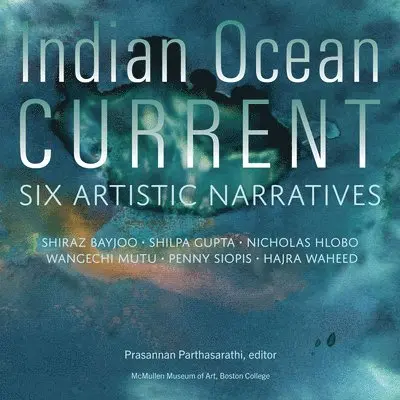
The rich history of the Indian Ocean has been much explored, though its present-day manifestations remain less studied. This catalog for an exhibition at the McMullen Museum of Art, curated by Prasannan Parthasarathi and Salim Currimjee, brings together essays that contextualize the work of six contemporary artists from the region. Through a variety of mediums and forms—including watercolors, videos, collages, sculptures, and photographs—Shiraz Bayjoo, Shilpa Gupta, Nicholas Hlobo, Wangechi Mutu, Penny Siopis, and Hajra Waheed grapple with the past, present, and future of the Indian Ocean.Indian Ocean Current provides interdisciplinary perspectives on the work of these six artists, with essays drawn from environmental studies, postcolonial studies, literature, and history. Contributors trace the connections that spanned the Indian Ocean, the movement of peoples, and the evolution of plural societies. From the mid-twentieth century, decolonization led to the creation of new nation-states, and hastily erected borders divided many. Today, the rising waters of the Indian Ocean, a consequence of climate change, strip these borders of their power. Indian Ocean Current opens up an artistic, historical, cultural, and political conversation about an area of the world famed for its cosmopolitanism but threatened by nationalism and global warming.