P.T. Durbin - Böcker
Visar alla böcker från författaren P.T. Durbin. Handla med fri frakt och snabb leverans.
10 produkter
10 produkter
Del 6 - Philosophy and Technology
Philosophy of Technology
Practical, Historical and Other Dimensions
Inbunden, Engelska, 1989
1 578 kr
Skickas inom 10-15 vardagar
The corps of philosophers who make up the Society for Philosophy & Technology has now been collaborating, in one fashion or another, for almost fifteen years. In addition, the number of philosophers, world-wide, who have begun to focus their analytical skills on technology and related social problems grows increasingly every year. {It would certainly swell the ranks if all of them joined the Society!) It seems more than ap propriate, in this context, to publish a miscellaneous volume that em phasizes the extraordinary range and diversity of contemporary contribu tions to the philosophical understanding of the exceedingly complex phenomenon that is modern technology. My thanks, once again, to the anonymous referees who do so much to maintain standards for the series. And thanks also to the secretaries - Mary Imperatore and Dorothy Milsom - in the Philosophy Department at the University of Delaware; their typing and retyping of the MSS, and especially notes and references, also contributes to keeping our standards high. PAUL T. DURBIN vii Paul T. Durbin (ed.), Philosophy ofT echnology, p. vii.
Broad and Narrow Interpretations of Philosophy of Technology
Broad and Narrow Interpretations
Inbunden, Engelska, 1990
1 064 kr
Skickas inom 10-15 vardagar
BACKGROUND: DEPARTMENTS, SPECIALIZATION, AND PROFESSIONALIZATION IN AMERICAN HIGHER EDUCATION For over half of its history, U.S. higher education turned out mostly cler gymen and lawyers. Looking back on that period, we might be tempted to think that this meant specialized training for the ministry or the practice of law. That, however, was not the case. What a college education in the U.S. prepared young men (almost exclusively) for, from the founding of Harvard College in 1636 through the founding of hundreds of denominational colleges in the first two-thirds of the nineteenth century, was leadership in the community. Professionalization and specialization only began to take root, and then became the dominant mode in U.S. higher education, in the period roughly from 1860--1920. In subsequent decades, that seemed to many critics to signal the end of what might be called "education in wisdom," the preparation of leaders for a broad range of responsibilities. Professionalization, specialization, and departmentalization of higher education in the U.S. began in the last quarter of the nineteenth century.
Del 8 - Philosophy and Technology
Europe, America, and Technology: Philosophical Perspectives
Inbunden, Engelska, 1991
1 578 kr
Skickas inom 10-15 vardagar
As Europe moves toward 1992 and full economic unity, and as Eastern Europe tries to find its way in the new economic order, the United States hesitates. Will the new European economic order be good for the U.S. or not? Such a question is exacerbated by world-wide changes in the technological order, most evident in Japan's new techno-economic power. As might be expected, philosophers have been slow to come to grips with such issues, and lack of interest is compounded by different philosophical styles in different parts of the world. What this volume addresses is more a matter of conflicting styles than a substantive confrontation with the real-world issues. But there is some attempt to be concrete. The symposium on Ivan Illich - with contributions from philosophers and social critics at the Penns- vania State University, where Illich has taught for several years - may suggest the old cliche of Old World vs. New World. Illich's fulminations against technology are often dismissed by Americans as old-world-style prophecy, while Illich seems largely unknown in his native Europe. But Albert Borgmann, born in Germany though now settled in the U.S., shows that this old dichotomy is difficult to maintain in our technological world. Borgmann's focus is on urgent technological problems that have become almost painfully evident in both Europe and America.
2 101 kr
Skickas inom 10-15 vardagar
Only recently has the phenomenon of technology become an object of in terest for philosophers. The first attempts at a philosophy of technology date back scarcely a hundred years - a span of time extremely short when com pared with the antiquity of philosophical reflections on nature, science, and society. Over that hundred-year span, speculative, critical, and empiricist approaches of various sorts have been put forward. Nevertheless, even now there remains a broad gap between the importance of technology in the real world and the sparse number of philosophical works dedicated to the under standing of modern technology. As a result of the complex structure of modern technology, it can be dealt with in very different ways. These range from metaphysical exposition to efforts aimed at political consensus. Quite naturally, within such a broad range, certain national accents can be discovered-; they are shaped by a com mon language, accepted philosophical traditions, and concrete problems requiring consideration. Even so, the worldwide impact of technology, its penetration into all spheres of individual, social, and cultural life, together with the urgency of the problems raised in this context - all these demand a joint philosophical discussion that transcends the barriers of language and cultural differences. The papers printed here are intended to exemplify such an effort at culture-transcending philosophical discussion.
1 064 kr
Skickas inom 10-15 vardagar
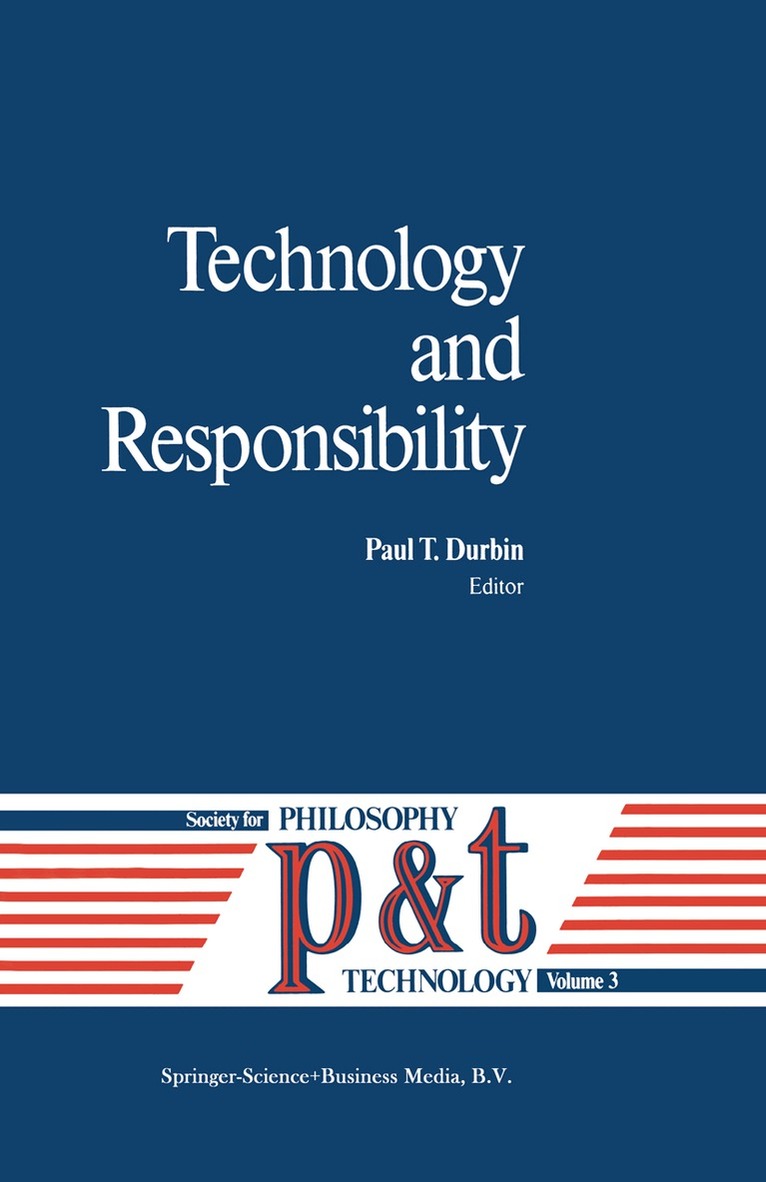
Since it may seem strange for a new series to begin with volume 3, a word of explanation is in order. The series, Philosophy and Technology, inaugurated in this form with this volume, is the official publication of the Society for Philosophy & Technology. Approximately one volume each year is tobe published, alternating between proceedings volumes - taken from contributions to biennial international conferences of the Society - and miscellaneous volumes, with roughly the character of a professional society journal. The forerunners of the series in its present form were two proceedings volumes: Philosophy and Technology (1983), edited by Paul T. Durbin and Friedrich Rapp, and Philosophy and Technology //: Information Technology and Computers in Theory and Practice (1986), edited by Carl Mitcham and Alois Huning - both published (as volumes 80 and 90, respectively) in the series, Boston Studies in the Philosophy of Science. The Society for Philosophy & Technology, now more than ten years old, is devoted to the promotion of philosophical schalarship that deals in one way or another with technology and technological society. "Philosophical scholarship" is interpreted broadly as including contribu tions from any and all perspectives; the one requirement is that the schalarship be sound, and all contributions to the series are subject to rigorous blind refereeing. "Technology," the other half of the philos ophy-and-technology pairing, is also construed broadly.
536 kr
Skickas inom 10-15 vardagar
Nearly everyone agrees that life has changed in our technological society, whether the contrast is with earlier stages in Western culture or with non-Western cultures. "Modernization" is just one of various terms that have been applied to the process by which we have arrived at the peculiar lifestyle typical of our age; whatever the term for the process, almost all analysts agree in finding technology to be one of its key ingredients. This is the judgment of critics of all sorts - anthropologists, historians, literary figures, sociologists, theologians. Volume 4 in the Philosophy and Technology series brings the perspectives of philosophers to bear on the issue of characterizing contemporary life, mainly in high-technology societies. Some of the philosophers look at the issue directly. Others focus on work life - or on the living arrangements that surround or condition or offer refuge from work life in technological society. Still others reflect on particular technologies, especially biotechnology and computer technology, that are increasingly affecting both work and family life. There is also a paper on the nature of thinking in technologi cal praxis, along with two papers on whether it is appropriate to export this sort of thinking to Third World countries, and another paper on the issue of responsibility in technology - which would have fit better in volume 3 of the series, entitled Technology and Responsibility (1987). Finally, volume 4 closes with a broad-ranging bibliography that takes work and technology as its focus.
Del 80 - Boston Studies in the Philosophy and History of Science
Philosophy and Technology
Häftad, Engelska, 2011
2 101 kr
Skickas inom 10-15 vardagar
Only recently has the phenomenon of technology become an object of in terest for philosophers. The first attempts at a philosophy of technology date back scarcely a hundred years - a span of time extremely short when com pared with the antiquity of philosophical reflections on nature, science, and society. Over that hundred-year span, speculative, critical, and empiricist approaches of various sorts have been put forward. Nevertheless, even now there remains a broad gap between the importance of technology in the real world and the sparse number of philosophical works dedicated to the under standing of modern technology. As a result of the complex structure of modern technology, it can be dealt with in very different ways. These range from metaphysical exposition to efforts aimed at political consensus. Quite naturally, within such a broad range, certain national accents can be discovered-; they are shaped by a com mon language, accepted philosophical traditions, and concrete problems requiring consideration. Even so, the worldwide impact of technology, its penetration into all spheres of individual, social, and cultural life, together with the urgency of the problems raised in this context - all these demand a joint philosophical discussion that transcends the barriers of language and cultural differences. The papers printed here are intended to exemplify such an effort at culture-transcending philosophical discussion.
1 578 kr
Skickas inom 10-15 vardagar
As Europe moves toward 1992 and full economic unity, and as Eastern Europe tries to find its way in the new economic order, the United States hesitates. Will the new European economic order be good for the U.S. or not? Such a question is exacerbated by world-wide changes in the technological order, most evident in Japan's new techno-economic power. As might be expected, philosophers have been slow to come to grips with such issues, and lack of interest is compounded by different philosophical styles in different parts of the world. What this volume addresses is more a matter of conflicting styles than a substantive confrontation with the real-world issues. But there is some attempt to be concrete. The symposium on Ivan Illich - with contributions from philosophers and social critics at the Penns- vania State University, where Illich has taught for several years - may suggest the old cliche of Old World vs. New World. Illich's fulminations against technology are often dismissed by Americans as old-world-style prophecy, while Illich seems largely unknown in his native Europe. But Albert Borgmann, born in Germany though now settled in the U.S., shows that this old dichotomy is difficult to maintain in our technological world. Borgmann's focus is on urgent technological problems that have become almost painfully evident in both Europe and America.
Broad and Narrow Interpretations of Philosophy of Technology
Broad and Narrow Interpretations
Häftad, Engelska, 2011
1 064 kr
Skickas inom 10-15 vardagar
BACKGROUND: DEPARTMENTS, SPECIALIZATION, AND PROFESSIONALIZATION IN AMERICAN HIGHER EDUCATION For over half of its history, U.S. higher education turned out mostly cler gymen and lawyers. Looking back on that period, we might be tempted to think that this meant specialized training for the ministry or the practice of law. That, however, was not the case. What a college education in the U.S. prepared young men (almost exclusively) for, from the founding of Harvard College in 1636 through the founding of hundreds of denominational colleges in the first two-thirds of the nineteenth century, was leadership in the community. Professionalization and specialization only began to take root, and then became the dominant mode in U.S. higher education, in the period roughly from 1860--1920. In subsequent decades, that seemed to many critics to signal the end of what might be called "education in wisdom," the preparation of leaders for a broad range of responsibilities. Professionalization, specialization, and departmentalization of higher education in the U.S. began in the last quarter of the nineteenth century.
1 578 kr
Skickas inom 10-15 vardagar
The corps of philosophers who make up the Society for Philosophy & Technology has now been collaborating, in one fashion or another, for almost fifteen years. In addition, the number of philosophers, world-wide, who have begun to focus their analytical skills on technology and related social problems grows increasingly every year. {It would certainly swell the ranks if all of them joined the Society!) It seems more than ap propriate, in this context, to publish a miscellaneous volume that em phasizes the extraordinary range and diversity of contemporary contribu tions to the philosophical understanding of the exceedingly complex phenomenon that is modern technology. My thanks, once again, to the anonymous referees who do so much to maintain standards for the series. And thanks also to the secretaries - Mary Imperatore and Dorothy Milsom - in the Philosophy Department at the University of Delaware; their typing and retyping of the MSS, and especially notes and references, also contributes to keeping our standards high. PAUL T. DURBIN vii Paul T. Durbin (ed.), Philosophy ofT echnology, p. vii.