Purnima Mankekar - Böcker
Visar alla böcker från författaren Purnima Mankekar. Handla med fri frakt och snabb leverans.
7 produkter
7 produkter
289 kr
Skickas inom 7-10 vardagar
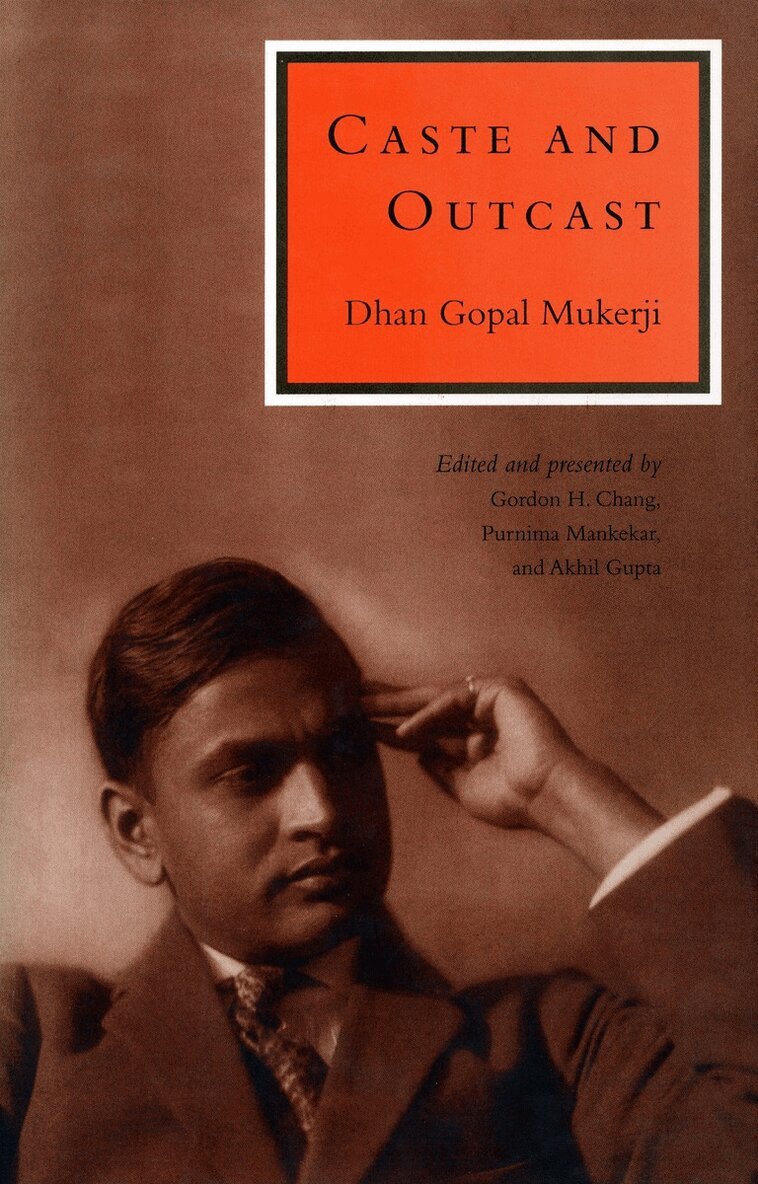
A person of rare talent and broad appeal, Dhan Gopal Mukerji (1890-1936) holds the distinction of being the first South Asian immigrant to have a successful career in the United States as a man of letters. As the author of two dozen published volumes of poetry, drama, fiction, social commentary, philosophy, translations, and children's stories, Mukerji was a pivotal figure in the transmission and interpretation of Indian traditions to Americans in the first several decades of the twentieth century. This reissue of his classic autobiography Caste and Outcast, with a new Introduction and Afterword, seeks to revitalize interest in Mukerji and his work and to contribute to the exploration of the South Asian experience in America.Originally published in 1923, this book is an exercise in both cultural translation and cultural critique. In the first half of the book, Mukerji draws upon his early experiences as a Bengali Brahmin in India, hoping to convey to readers "an intimate impression of eastern life"; the second half describes Mukerji's coming to America and his experiences as a student, worker, and activist in California. Mukerji's text, written in an engaging personal style, is the kind of ethnographic writing that seeks to render intelligible and familiar the unfamiliar and the exotic. Gordon H. Chang's substantial Introduction locates the story of Caste and Outcast within the larger context of Mukerji's life, tracing the author's personal history and his connections to such major figures as Jawaharlal Nehru, M. N. Roy, Van Wyck Brooks, Roger Baldwin, and Will Durant. The Afterword, by Purnima Mankekar and Akhil Gupta, examines the ways in which Mukerji stretches the limits of the autobiographical genre and provides a counternarrative to the dominant nationalist account of American society.
Screening Culture, Viewing Politics
An Ethnography of Television, Womanhood, and Nation in Postcolonial India
Häftad, Engelska, 1999
418 kr
Skickas inom 7-10 vardagar
In Screening Culture, Viewing Politics Purnima Mankekar presents a cutting-edge ethnography of television-viewing in India. With a focus on the responses of upwardly-mobile, yet lower-to-middle class urban women to state-sponsored entertainment serials, Mankekar demonstrates how television in India has profoundly shaped women’s place in the family, community, and nation, and the crucial role it has played in the realignment of class, caste, consumption, religion, and politics. Mankekar examines both “entertainment” narratives and advertisements designed to convey particular ideas about the nation. Organizing her study around the recurring themes in these shows-Indian womanhood, family, community, constructions of historical memory, development, integration, and sometimes violence-Mankekar dissects both the messages televised and her New Delhi subjects’ perceptions of and reactions to these messages. In the process, her ethnographic analysis reveals the texture of these women’s daily lives, social relationships, and everyday practices. Throughout her study, Mankekar remains attentive to the tumultuous historical and political context in the midst of which these programs’ integrationalist messages are transmitted, to the cultural diversity of the viewership, and to her own role as ethnographer. In an enlightening epilogue she describes the effect of satellite television and transnational programming to India in the 1990s. Through its ethnographic and theoretical richness, Screening Culture, Viewing Politics forces a reexamination of the relationship between mass media, social life, and identity and nation formation in non-Western contexts. As such, it represents a major contribution to a number of fields, including media and communication studies, feminist studies, anthropology, South Asian studies, and cultural studies.
589 kr
Skickas inom 3-6 vardagar
Drawing on methods and approaches from anthropology, media studies, film theory, and cultural studies, the contributors to Media, Erotics, and Transnational Asia examine how mediated eroticism and sexuality circulating across Asia and Asian diasporas both reflect and shape the social practices of their producers and consumers. The essays in this volume cover a wide geographic and thematic range, and combine rigorous textual analysis with empirical research into the production, circulation, and consumption of various forms of media. Judith Farquhar examines how health magazines serve as sources of both medical information and erotic titillation to readers in urban China. Tom Boellstorff analyzes how queer zines produced in Indonesia construct the relationship between same-sex desire and citizenship. Purnima Mankekar examines the rearticulation of commodity affect, erotics, and nation on Indian television. Louisa Schein describes how portrayals of Hmong women in videos shot in Laos create desires for the homeland among viewers in the diaspora. Taken together, the essays offer fresh insights into research on gender, erotics, media, and Asia transnationally conceived. Contributors. Anne Allison, Tom Boellstorff, Nicole Constable, Heather Dell, Judith Farquhar, Sarah L. Friedman, Martin F. Manalansan IV, Purnima Mankekar, Louisa Schein, Everett Yuehong Zhang
1 681 kr
Skickas inom 3-6 vardagar
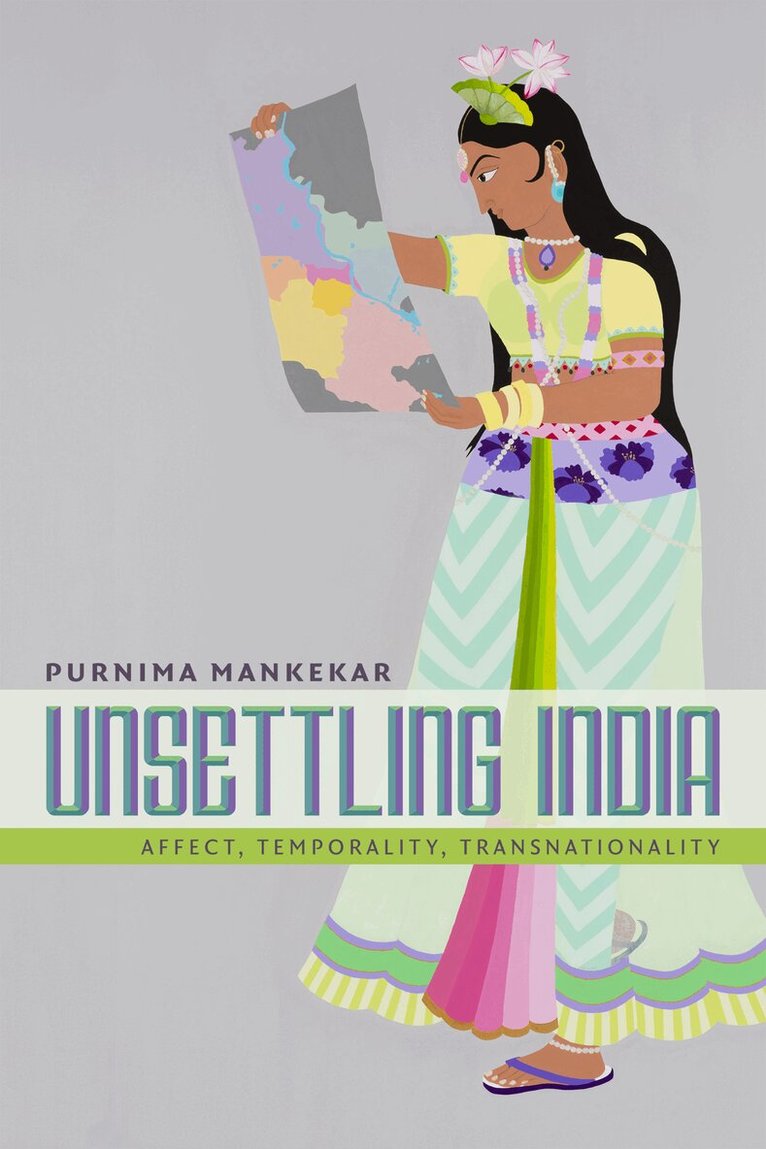
In Unsettling India, Purnima Mankekar offers a new understanding of the affective and temporal dimensions of how India and “Indianness,” as objects of knowledge production and mediation, circulate through transnational public cultures. Based on over a decade of ethnographic fieldwork in New Delhi and the San Francisco Bay Area, Mankekar tracks the sense of unsettlement experienced by her informants in both places, disrupting binary conceptions of homeland and diaspora, and the national and transnational. She examines Bollywood films, Hindi TV shows, advertisements, and such commodities as Indian groceries as interconnected nodes in the circulation of transnational public cultures that continually reconfigure affective connections to India and what it means to be Indian, both within the country and outside. Drawing on media and cultural studies, feminist anthropology, and Asian/Asian American studies, this book deploys unsettlement as an analytic to trace modes of belonging and not-belonging.
375 kr
Skickas inom 7-10 vardagar
In Unsettling India, Purnima Mankekar offers a new understanding of the affective and temporal dimensions of how India and “Indianness,” as objects of knowledge production and mediation, circulate through transnational public cultures. Based on over a decade of ethnographic fieldwork in New Delhi and the San Francisco Bay Area, Mankekar tracks the sense of unsettlement experienced by her informants in both places, disrupting binary conceptions of homeland and diaspora, and the national and transnational. She examines Bollywood films, Hindi TV shows, advertisements, and such commodities as Indian groceries as interconnected nodes in the circulation of transnational public cultures that continually reconfigure affective connections to India and what it means to be Indian, both within the country and outside. Drawing on media and cultural studies, feminist anthropology, and Asian/Asian American studies, this book deploys unsettlement as an analytic to trace modes of belonging and not-belonging.
1 173 kr
Skickas inom 7-10 vardagar
In The Future of Futurity, Purnima Mankekar and Akhil Gupta examine the lives and experiences of call center agents in India’s business process outsourcing (BPO) industry, who live in Bengaluru and work for customers in the Global North. Mankekar and Gupta show how futurity—an affective-temporal potentiality and mode of being that emphasizes the unfolding of time—enables BPO workers to strive for hopeful futures despite their experiences of growing inequality, volatility, and violence. Drawing on long-term fieldwork with managers, owners, and workers of BPO companies, the authors explore how workers find pathways for navigating a globalized world and for imagining their futures in it. They point to the heterogeneous lives, yearnings, and anxieties of BPO workers, foregrounding the disjunctions and conjunctions between labor, corporeality, intimacy, family life, and mobility. Mankekar and Gupta show how workers’ daily lives and imaginings of the future point to the relationships between futurity, capital, and technology as well as futurity’s imbrications with contemporary racial capitalism. In so doing, the authors insist on the transformative potential of futurity even in conditions of extreme precarity.
309 kr
Skickas
In The Future of Futurity, Purnima Mankekar and Akhil Gupta examine the lives and experiences of call center agents in India’s business process outsourcing (BPO) industry, who live in Bengaluru and work for customers in the Global North. Mankekar and Gupta show how futurity—an affective-temporal potentiality and mode of being that emphasizes the unfolding of time—enables BPO workers to strive for hopeful futures despite their experiences of growing inequality, volatility, and violence. Drawing on long-term fieldwork with managers, owners, and workers of BPO companies, the authors explore how workers find pathways for navigating a globalized world and for imagining their futures in it. They point to the heterogeneous lives, yearnings, and anxieties of BPO workers, foregrounding the disjunctions and conjunctions between labor, corporeality, intimacy, family life, and mobility. Mankekar and Gupta show how workers’ daily lives and imaginings of the future point to the relationships between futurity, capital, and technology as well as futurity’s imbrications with contemporary racial capitalism. In so doing, the authors insist on the transformative potential of futurity even in conditions of extreme precarity.