R. P. Dore - Böcker
Visar alla böcker från författaren R. P. Dore. Handla med fri frakt och snabb leverans.
8 produkter
8 produkter
2 159 kr
Skickas inom 10-15 vardagar
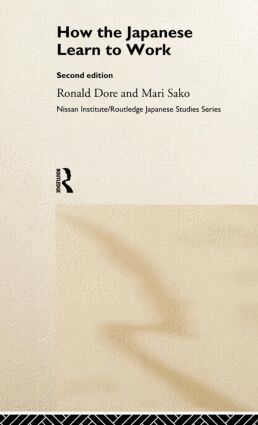
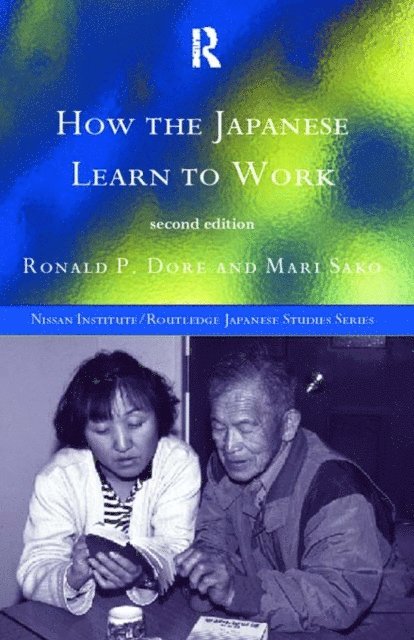
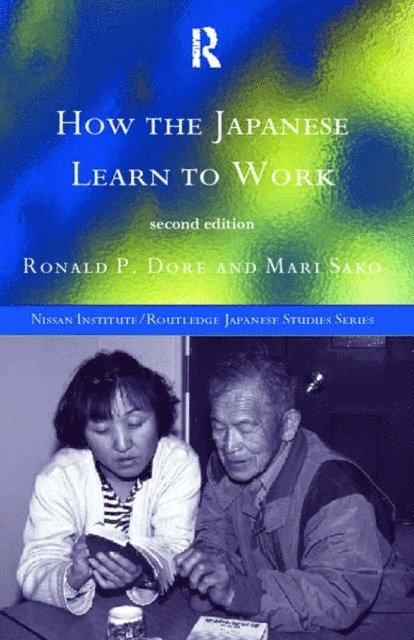
Japan is regarded as a world leader in the field of education and training for improved economic performance. Yet success in Japan is often achieved by going against what is regarded as ideal practice elsewhere. This book offers the most comprehensive review available in English of the many facets of Japanese vocational education and training. Covering the system from primary education through to in job-training offered by companies, this book provides a detailed study of current practice giving equal emphasis to formal training in explicitly vocational courses, and informal training in factories, shops and offices.The authors analyse the difference between substantive 'person-changing' training and mere 'ability-labelling.' They raise important questions, such as: To what extent does the need to package skills to provide convenient qualifications distort the actual training given? How efficient is it to rely on professional trainers to certify the acquisition of skills, rather than run separate testing systems?The authors reveal how, in Japanese companies, employees are strongly motivated by pride in the successful execution of their jobs, and that much company training is carried out by colleagues.
797 kr
Skickas inom 10-15 vardagar
Japan is regarded as a world leader in the field of education and training for improved economic performance. Yet success in Japan is often achieved by going against what is regarded as ideal practice elsewhere. This book offers the most comprehensive review available in English of the many facets of Japanese vocational education and training. Covering the system from primary education through to in job-training offered by companies, this book provides a detailed study of current practice giving equal emphasis to formal training in explicitly vocational courses, and informal training in factories, shops and offices.The authors analyse the difference between substantive 'person-changing' training and mere 'ability-labelling.' They raise important questions, such as: To what extent does the need to package skills to provide convenient qualifications distort the actual training given? How efficient is it to rely on professional trainers to certify the acquisition of skills, rather than run separate testing systems?The authors reveal how, in Japanese companies, employees are strongly motivated by pride in the successful execution of their jobs, and that much company training is carried out by colleagues.
2 155 kr
Skickas inom 10-15 vardagar
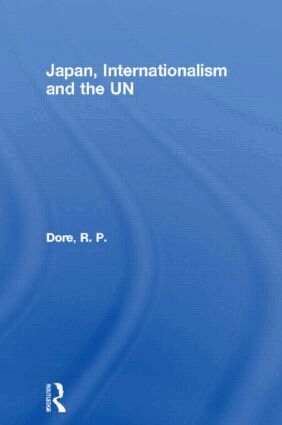
Japan has enormous economic power and yet is a minor player in international politics. In part this has been due to the partnership with US, but now with the end of cold war there is a fierce debate going on in Japan regarding the international political role for the nation. This book is a response to the issues raised and was originally published in Japanese for a Japanese audience. Ronald Dore provides a full analysis of Japan's post war international position and in particular its role within the UN, the use of armed force and constitution. Japan, Internationalism and the UN provides a unique insight into Japan's foreign policy and its related domestic politics. It is the product of nearly half a century of study and discussion with the Japanese themselves about their place in the world.
752 kr
Skickas inom 10-15 vardagar
Japan has enormous economic power and yet is a minor player in international politics. In part this has been due to the partnership with US, but now with the end of cold war there is a fierce debate going on in Japan regarding the international political role for the nation. This book is a response to the issues raised and was originally published in Japanese for a Japanese audience. Ronald Dore provides a full analysis of Japan's post war international position and in particular its role within the UN, the use of armed force and constitution. Japan, Internationalism and the UN provides a unique insight into Japan's foreign policy and its related domestic politics. It is the product of nearly half a century of study and discussion with the Japanese themselves about their place in the world.
811 kr
Skickas inom 3-6 vardagar
This book offers an in-depth exploration of life in Shitayama-cho, a diverse neighborhood in Tokyo, aiming to capture the daily experiences, cultural practices, and social dynamics of its residents. By examining how people earn a living, form relationships, and interact with their environment, the study seeks to provide a nuanced understanding of both individual lives and broader community patterns. While the neighborhood's heterogeneity presents challenges to generalization, it also reflects the complexity of Tokyo's urban fabric, making the findings relevant to understanding city life in Japan as a whole. The combination of direct observation and formal interviews allows for a rich, multi-dimensional portrait of life in Shitayama-cho, complemented by comparative insights drawn from national statistics and broader studies of urban Japan.The study also delves into the ongoing social transformations in Japanese society, contextualizing changes in family structures, community relationships, and cultural attitudes against a backdrop of industrialization and Western influence. By comparing traditional practices with emerging modern values, the research sheds light on how these shifts manifest in everyday life and how individuals navigate the resulting tensions. The book balances its focus on local, lived experiences with broader sociological inquiries, addressing both the unique cultural traits of Japanese society and the universal challenges posed by modernization. Through this approach, it provides valuable insights for understanding both the continuity and change in urban Japan.This title is part of UC Press's Voices Revived program, which commemorates University of California Press’s mission to seek out and cultivate the brightest minds and give them voice, reach, and impact. Drawing on a backlist dating to 1893, Voices Revived makes high-quality, peer-reviewed scholarship accessible once again using print-on-demand technology. This title was originally published in 1963.
811 kr
Skickas inom 3-6 vardagar
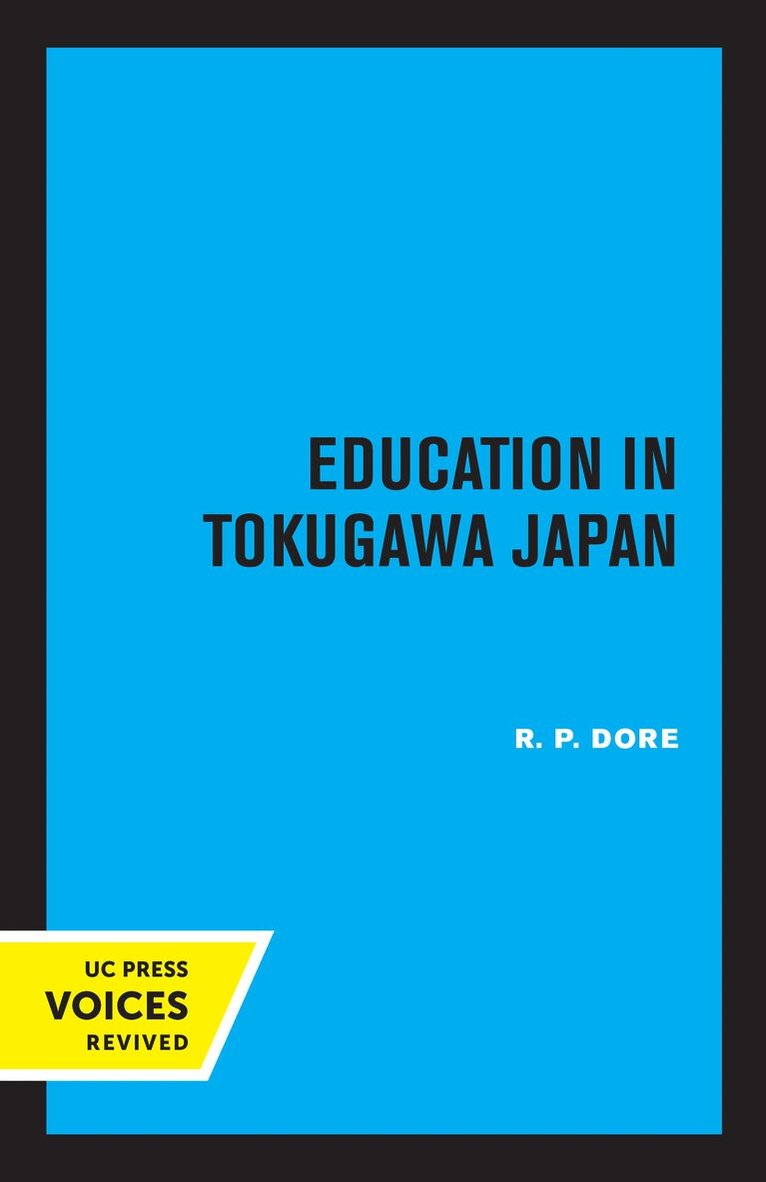
Education in Tokugawa Japan by R. P. Dore offers the first comprehensive English-language account of how a society often remembered for its rigid hierarchy laid the foundations of modern Japan’s remarkably high levels of literacy and learning. Drawing on fief records, school regulations, curricula, and popular texts, Dore reconstructs the educational institutions of the Tokugawa period—from the elite fief schools training samurai to the terakoya that brought reading, writing, and arithmetic to commoners. He shows how Confucian moral training, vocational imperatives of governance, and the spread of print culture combined to transform education from a priestly preserve into a broadly shared pursuit.Far from being static, Tokugawa education adapted to political reform, Western learning, and the growth of commerce. Dore details both the ideals that guided samurai education—moral rectitude, loyalty, and service—and the practicalities of school life: ceremonies, examinations, discipline, and finance. He also probes the limits of the system, from the uneven education of women to tensions between moral cultivation and administrative utility. With clarity and breadth, the book illuminates how early modern Japan’s scholastic traditions nurtured a society capable of rapid modernization after 1868, while offering a rich portrait of the interplay between social order, merit, and the pursuit of knowledge.This title is part of UC Press's Voices Revived program, which commemorates University of California Press’s mission to seek out and cultivate the brightest minds and give them voice, reach, and impact. Drawing on a backlist dating to 1893, Voices Revived makes high-quality, peer-reviewed scholarship accessible once again using print-on-demand technology. This title was originally published in 1965.
1 469 kr
Skickas inom 3-6 vardagar
This book offers an in-depth exploration of life in Shitayama-cho, a diverse neighborhood in Tokyo, aiming to capture the daily experiences, cultural practices, and social dynamics of its residents. By examining how people earn a living, form relationships, and interact with their environment, the study seeks to provide a nuanced understanding of both individual lives and broader community patterns. While the neighborhood's heterogeneity presents challenges to generalization, it also reflects the complexity of Tokyo's urban fabric, making the findings relevant to understanding city life in Japan as a whole. The combination of direct observation and formal interviews allows for a rich, multi-dimensional portrait of life in Shitayama-cho, complemented by comparative insights drawn from national statistics and broader studies of urban Japan.The study also delves into the ongoing social transformations in Japanese society, contextualizing changes in family structures, community relationships, and cultural attitudes against a backdrop of industrialization and Western influence. By comparing traditional practices with emerging modern values, the research sheds light on how these shifts manifest in everyday life and how individuals navigate the resulting tensions. The book balances its focus on local, lived experiences with broader sociological inquiries, addressing both the unique cultural traits of Japanese society and the universal challenges posed by modernization. Through this approach, it provides valuable insights for understanding both the continuity and change in urban Japan.This title is part of UC Press's Voices Revived program, which commemorates University of California Press’s mission to seek out and cultivate the brightest minds and give them voice, reach, and impact. Drawing on a backlist dating to 1893, Voices Revived makes high-quality, peer-reviewed scholarship accessible once again using print-on-demand technology. This title was originally published in 1963.
754 kr
Skickas inom 7-10 vardagar
Education in Tokugawa Japan by R. P. Dore offers the first comprehensive English-language account of how a society often remembered for its rigid hierarchy laid the foundations of modern Japan’s remarkably high levels of literacy and learning. Drawing on fief records, school regulations, curricula, and popular texts, Dore reconstructs the educational institutions of the Tokugawa period—from the elite fief schools training samurai to the terakoya that brought reading, writing, and arithmetic to commoners. He shows how Confucian moral training, vocational imperatives of governance, and the spread of print culture combined to transform education from a priestly preserve into a broadly shared pursuit.Far from being static, Tokugawa education adapted to political reform, Western learning, and the growth of commerce. Dore details both the ideals that guided samurai education—moral rectitude, loyalty, and service—and the practicalities of school life: ceremonies, examinations, discipline, and finance. He also probes the limits of the system, from the uneven education of women to tensions between moral cultivation and administrative utility. With clarity and breadth, the book illuminates how early modern Japan’s scholastic traditions nurtured a society capable of rapid modernization after 1868, while offering a rich portrait of the interplay between social order, merit, and the pursuit of knowledge.This title is part of UC Press's Voices Revived program, which commemorates University of California Press’s mission to seek out and cultivate the brightest minds and give them voice, reach, and impact. Drawing on a backlist dating to 1893, Voices Revived makes high-quality, peer-reviewed scholarship accessible once again using print-on-demand technology. This title was originally published in 1965.