R. S. Woolhouse - Böcker
Visar alla böcker från författaren R. S. Woolhouse. Handla med fri frakt och snabb leverans.
3 produkter
3 produkter
595 kr
Skickas inom 7-10 vardagar
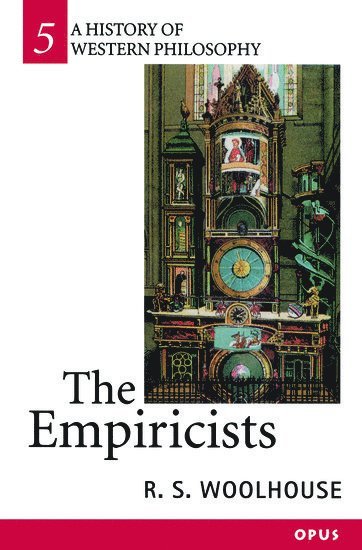
`One of the great historic controversies in philosophy' was how Bertrand Russell described the ideological conflict between rationalists and empiricists - the conflict between reason and experience as sources of knowledge and ideas. Yet in this study of the empiricists R.S. Woolhouse is not so much concerned to justify these conventional labels as to set forth the dominant philosophical ideas and let those ideas speak for themselves. Setting the empiricist philosophers in their contemporary cultural context, the author examines their various approaches to philosophy. He concentrates primarily on the major figures - Bacon, Hobbes, Locke, Berkeley and Hume - but also discusses the unjustly neglected French philosopher Pierre Gassendi and devotes a chapter to the Royal Society of London for the Improving of Natural Knowledge, which was founded in the 1660s. While focusing on their contribution to the new philosophy of the seventeenth century, which was primarily concerned with the nature of knowledge and science, he also highlights the moral and political aspects of their work and emphasises the significance of their ideas to twentieth-century thinking.
659 kr
Skickas inom 5-8 vardagar
One of the greatest of modern philosophers, on a par with his contemporary John Locke, Leibniz was born in Leipzig in 1646, died in Hanover in 1716. He was a leading figure in European intellectual circles, and the founder of the Academy of Berlin. His strange, complex metaphysical system established him as the third of the great 'Rationalists', after Descartes and Spinoza. Along with the 'New System', his most famous philosophical works are the Discourse of Metaphysics (1685) and Monadology (c.1713). He also made important contributions to logic, mathematics, theology, jurisprudence, and history.Gathered here for the first time are all the key texts in a crucial debate in modern philosophy, centred on Leibniz's famous 1695 essay, the `New System of the Nature of Substances and their Communication'. In this classic essay Leibniz introduced to a broad European readership the strikingly original metaphysical ideas he had come to a decade earlier. His 'system' became increasingly famous and drew him into discussion and development of these ideas, both in public and in private, with a variety of thinkers: Simon Foucher; Henri Basbage de Beauval; Francois Lamy; Isaac Jacquelot; the Englishwoman Damaris Masham; Pierre Desmaizeaux; René Joseph de Tournemine; and most notably the great French philosopher and scholar Pierre Bayle.
1 982 kr
Skickas inom 7-10 vardagar
One of the greatest of modern philosophers, on a par with his contemporary John Locke, Leibniz was born in Leipzig in 1646, died in Hanover in 1716. He was a leading figure in European intellectual circles, and the founder of the Academy of Berlin. His strange, complex mataphysical system established him as the third of the great `Rationalists', after Descartes and Spinoza. Along with the `New System', his most famous philosophical works are the Discourse of Metaphysics (1685) and Monadology (c.1713). He also made important contributions to logic, mathematics, theology, jurisprudence, and history.Gathered here for the first time are all the key texts in a crucial debate in modern philosophy, centred on Leibniz's famous 1695 essay, the `New System of the Nature of Substances and their Communication'. In this classic essay Leibniz introduced to a broad European readership the strikingly original metaphysical ideas he had come to a decade earlier. His `system' became increasingly famous and drew him into discussion and development of these ideas, both in public and in private, with a variety of thinkers: Simon Foucher; Henri Basbage de Beauval; Francois Lamy; Isaac Jacquelot; the Englishwoman Damaris Masham; Pierre Desmaizeaux; René Joseph de Tournemine; and most notably the great French philosopher and scholar Pierre Bayle.Woolhouse and Francks's new English edition gives the only full representation of this debate, and will therefore be essential reading for anyone who wishes to gain a proper understanding of Leibniz's philosophy and its intelletual context. As Leibniz himself said, "he who knows only what I have published does not know me." All the texts are newly translated and extensively annotated; many appear in English for the first time.