R. Wood - Böcker
Visar alla böcker från författaren R. Wood. Handla med fri frakt och snabb leverans.
8 produkter
8 produkter
1 064 kr
Skickas inom 10-15 vardagar
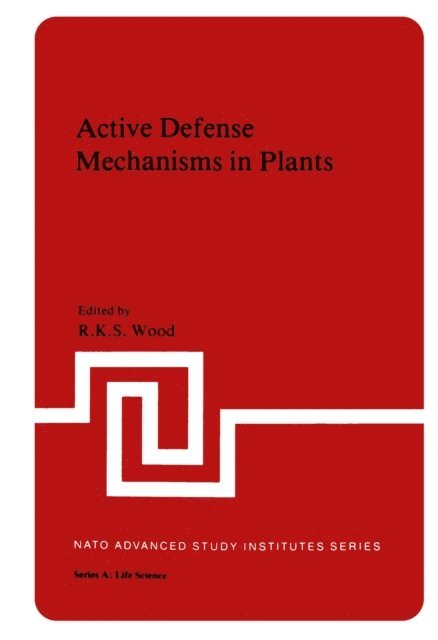
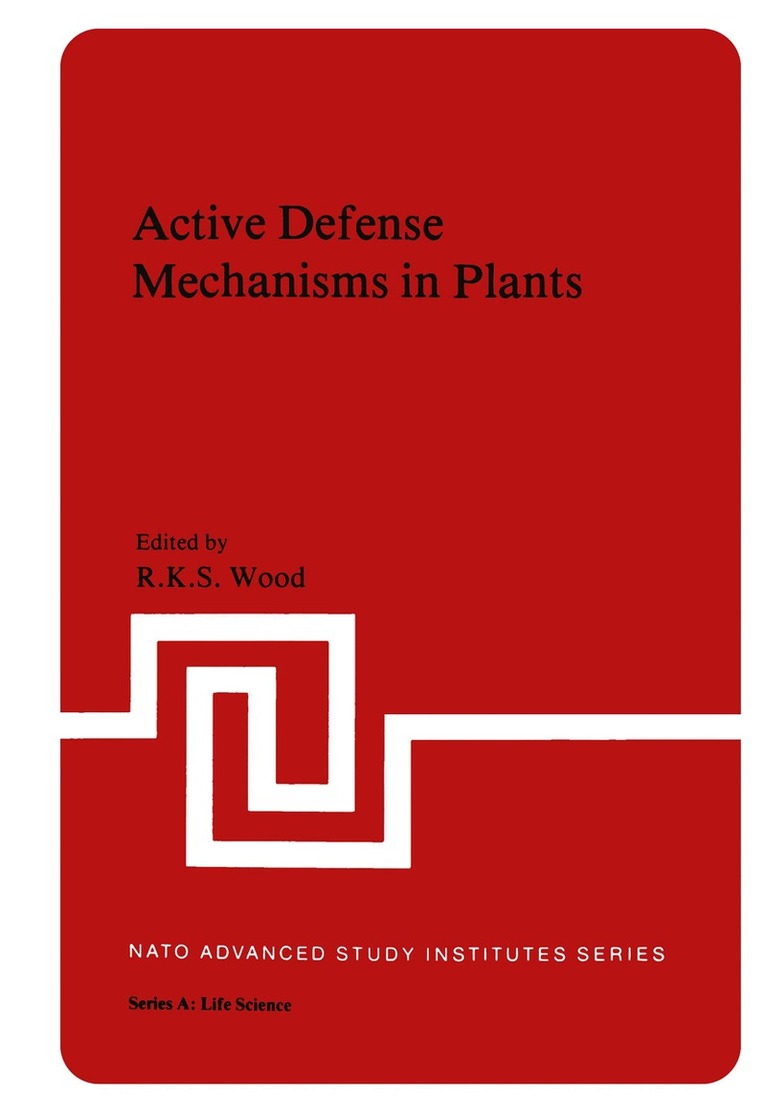
A NATO Advanced Study Institute on "Active Defence Mechanisms in Plants" was held at Cape Sounion, Greece, 21 April - 3 May 1981. It succeeded a similar Institute held at Porte Conte, Sardinia in 1975 on "Specificity in Plant Diseases. " What are active defence mechanisms in the context of plant disease in which a plant, the host, may be damaged by a pathogen? Defence mechanisms comprise properties of the host that decrease this damage. The mechanisms are passive when they are independent of the pathogen. They are active when they follow changes in the host caused by the pathogen. Thus for a fungal pathogen, cell walls of a higher plant which are lignified before infection would be a passive defence mechanism if they decreased damage by impeding growth of the fungus. Cell walls known to become lignified as a response to the pathogen would be an active defence mechanism if it were established that this response decreased damage. The papers and discussions at this Advanced Study Institute were about active defence mechanisms in higher plants, mainly econo mically important crop plants, against fungi, bacteria and viruses as pathogens. Taking the microorganisms first it is a truism but one that bears repeating that although plants almost always grow in close association with a wide variety of fungi and bacteria, often of types that can be pathogens, they rarely become diseased, at least not sufficiently so as to attract notice.
536 kr
Skickas inom 10-15 vardagar
A NATO Advanced Study Institute on "Phytotoxins in Plant Diseases" was held in Pugnochiuso (Italy) in June 1970. It was concerned mainly with the chemistry and mode of action of substances toxic to higher plants which are produced by pathogenic bacteria and fungi. The role of such substances in specificity was consider ed but largely in relation to host-specific toxins. In 1973, in light of the success of the 1970 Institute, we decided to plan for another in 1975 and after discussion with col leagues during the Second International Congress of Plant Pathology, we selected "Specificity in Plant Diseases" as the theme for the 1975 Institute. Our chief reasons for the choice were that specificity is un doubtedly the dominant problem in plant pathology and that with the rapid increase during the last decade or so in the diversity and sophistication of biochemical techniques, we should now expect during the next few years much more research on specificity and major ad vances in our understanding of the mechanisms that control it. It seemed to us that a residential meeting with the advantages and status of a NATO Advanced Study Institute would do much to stimulate interest and research in this most important field. The theme also had the merit of continuity with that of the 1970 Institute.
95 kr
Skickas inom 5-8 vardagar
110 kr
Skickas inom 5-8 vardagar
334 kr
Skickas inom 5-8 vardagar
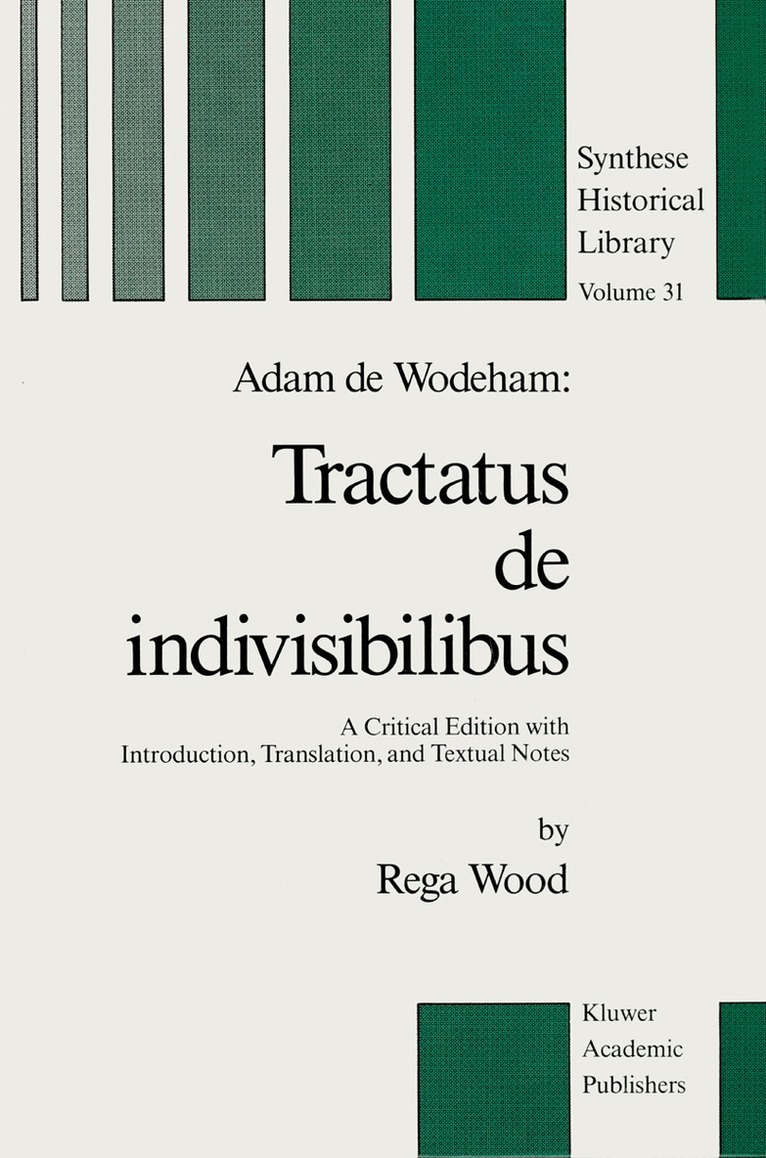
Adam de Wodeham: Tractatus de Indivisibilibus
A Critical Edition with Introduction, Translation, and Textual Notes
Inbunden, Engelska, 1988
2 101 kr
Skickas inom 10-15 vardagar
The English Franciscan philosopher and theologian, Adam of Wodeham (d. 1358), was a disciple and friend of William of Ockham; he was also a student of Walther Chatton. Nevertheless, he was an independent thinker who did not hesitate to criticize his former teachers - Ockham sporadically and benevolently, Chatton, frequently and aggressively. Since W odeham developed his own doctrinal position by a thorough critical examination of current opinions, the first part of this introduc tion briefly outlines the positions of the chief figures in the English controversy over indivisibles. The second part of the introduction pre sents a summary of Wodeham's views in the Tractatus de indivisibilibus, lists the contents of the treatise, and considers the question of its date and its chronological position in the context of Wodeham's other works. In the third part, the editorial procedures used here are set forth. 1. THE INDIVISIBILIST CONTROVERSY In the literature of the 13th and 14th centuries, the term 'indivisible' refers to a simple, un extended entity. Consequently, these indivisibles are not physical atoms but either mathematical points, temporal instants or indivisibles of motion, usually called mutata esse. I THOMAS BRADWARDINE (d. 1349), roughly contemporary with Wodeham, classified the positions it was possible to take regarding indivisibles. He described his own view as the common view, that of "Aristotle, A verroes, and most of the moderns," according to which a "continuum was not composed of atoms (athomis) but of parts divisible without end.
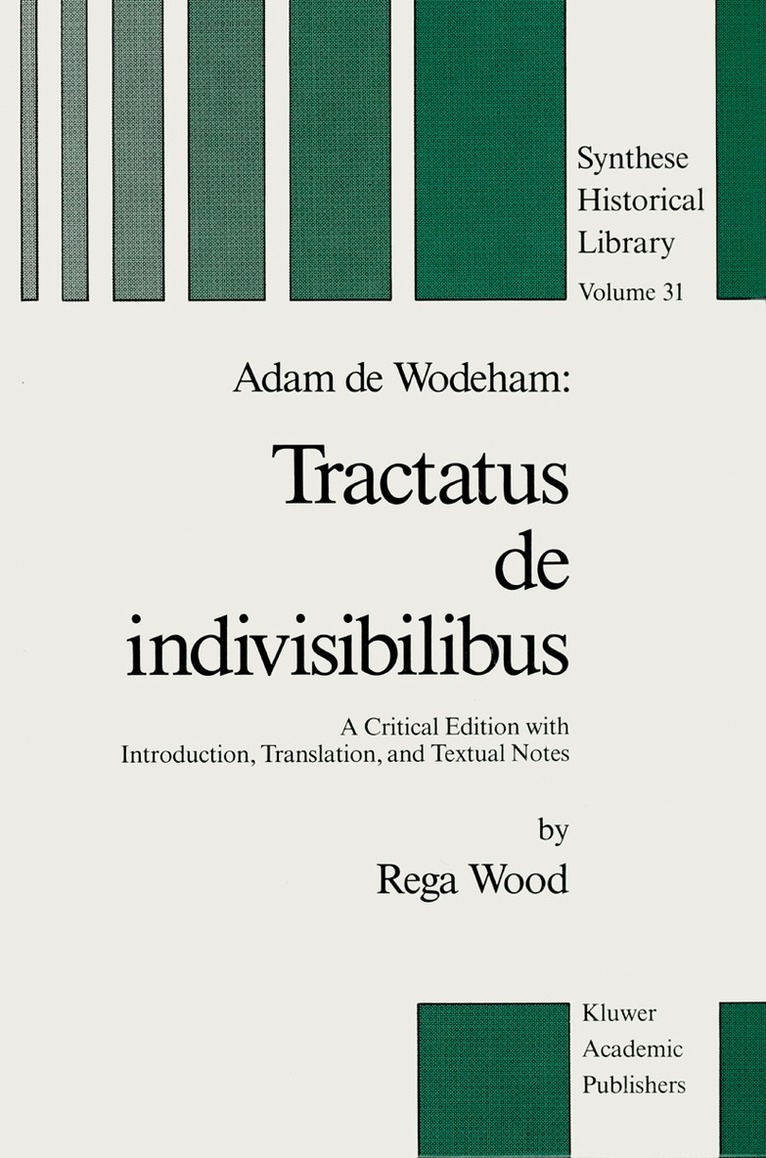
Adam de Wodeham: Tractatus de Indivisibilibus
A Critical Edition with Introduction, Translation, and Textual Notes
Häftad, Engelska, 2011
2 101 kr
Skickas inom 10-15 vardagar
The English Franciscan philosopher and theologian, Adam of Wodeham (d. 1358), was a disciple and friend of William of Ockham; he was also a student of Walther Chatton. Nevertheless, he was an independent thinker who did not hesitate to criticize his former teachers - Ockham sporadically and benevolently, Chatton, frequently and aggressively. Since W odeham developed his own doctrinal position by a thorough critical examination of current opinions, the first part of this introduc tion briefly outlines the positions of the chief figures in the English controversy over indivisibles. The second part of the introduction pre sents a summary of Wodeham's views in the Tractatus de indivisibilibus, lists the contents of the treatise, and considers the question of its date and its chronological position in the context of Wodeham's other works. In the third part, the editorial procedures used here are set forth. 1. THE INDIVISIBILIST CONTROVERSY In the literature of the 13th and 14th centuries, the term 'indivisible' refers to a simple, un extended entity. Consequently, these indivisibles are not physical atoms but either mathematical points, temporal instants or indivisibles of motion, usually called mutata esse. I THOMAS BRADWARDINE (d. 1349), roughly contemporary with Wodeham, classified the positions it was possible to take regarding indivisibles. He described his own view as the common view, that of "Aristotle, A verroes, and most of the moderns," according to which a "continuum was not composed of atoms (athomis) but of parts divisible without end.
258 kr
Skickas inom 5-8 vardagar