
Rachel Augustine Potter – författare
Visar alla böcker från författaren . Handla med fri frakt och snabb leverans.
3 produkter
3 produkter
Häftad, Engelska, 2019
276 kr
Skickas inom 5-8 vardagar
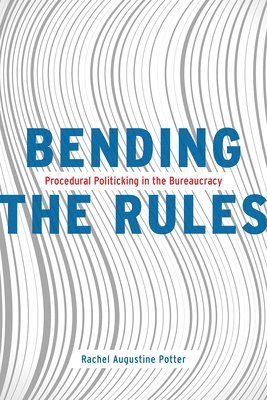
Who determines the fuel standards for our cars? What about whether Plan B, the morning-after pill, is sold at the local pharmacy? Many people assume such important and controversial policy decisions originate in the halls of Congress. But the choreographed actions of Congress and the president account for only a small portion of the laws created in the United States. By some estimates, more than ninety percent of law is created by administrative rules issued by federal agencies like the Environmental Protection Agency and the Department of Health and Human Services, where unelected bureaucrats with particular policy goals and preferences respond to the incentives created by a complex, procedure-bound rulemaking process. With Bending the Rules, Rachel Augustine Potter shows that rule making is not the rote administrative activity it is commonly imagined to be but rather an intensely political activity in its own right. Because rule making occurs in a separation of powers system, bureaucrats are not free to implement their preferred policies unimpeded: the president, Congress, and the courts can all get involved in the process, often at the bidding of affected interest groups. However, rather than capitulating to demands, bureaucrats routinely employ "procedural politicking," using their deep knowledge of the process to strategically insulate their proposals from political scrutiny and interference. Tracing the rulemaking process from when an agency first begins working on a rule to when it completes that regulatory action, Potter show how bureaucrats use procedures to resist interference from Congress, the President, and the courts at each stage of the process. This influence reveals that unelected bureaucrats wield considerable influence over the direction of public policy in the United States.

Inbunden, Engelska, 2026
1 277 kr
Kommande
Shows how the proliferation of contractors within the federal agencies is fundamentally reshaping American governance.Much of what the federal government does today is carried out by people the public rarely sees. While debates focus on bureaucrats and political appointees, agencies increasingly rely on a vast contractor workforce to perform functions ranging from tech support to policy analysis to regulatory drafting services. This quiet transformation has altered how the government functions while simultaneously preserving the public-facing image of a bureaucracy run by civil servants. The federal government does not keep reliable data on how many contractors it employs, but many estimates suggest that contractors outnumber career bureaucrats.In Going Private, Rachel Augustine Potter explains how this shift reshapes the everyday operation of the administrative state and coalesces power within the presidency. Easily hired and easily fired, contractors have strong incentives to please their clients, making them malleable to the president’s will. Presidents from both parties have leveraged these features and learned to rely on contractors to advance political priorities, bypass uncooperative bureaucrats, and gain increased control over agency work.Drawing on new data and interviews, Going Private argues that outsourcing is not merely an administrative convenience. Rather, it is a defining feature of contemporary governance—one that complicates accountability, blurs the boundaries of the administrative state, and alters the exercise of presidential power.

Häftad, Engelska, 2026
367 kr
Kommande
Shows how the proliferation of contractors within the federal agencies is fundamentally reshaping American governance.Much of what the federal government does today is carried out by people the public rarely sees. While debates focus on bureaucrats and political appointees, agencies increasingly rely on a vast contractor workforce to perform functions ranging from tech support to policy analysis to regulatory drafting services. This quiet transformation has altered how the government functions while simultaneously preserving the public-facing image of a bureaucracy run by civil servants. The federal government does not keep reliable data on how many contractors it employs, but many estimates suggest that contractors outnumber career bureaucrats.In Going Private, Rachel Augustine Potter explains how this shift reshapes the everyday operation of the administrative state and coalesces power within the presidency. Easily hired and easily fired, contractors have strong incentives to please their clients, making them malleable to the president’s will. Presidents from both parties have leveraged these features and learned to rely on contractors to advance political priorities, bypass uncooperative bureaucrats, and gain increased control over agency work.Drawing on new data and interviews, Going Private argues that outsourcing is not merely an administrative convenience. Rather, it is a defining feature of contemporary governance—one that complicates accountability, blurs the boundaries of the administrative state, and alters the exercise of presidential power.