Rachel Weber – författare
Visar alla böcker från författaren Rachel Weber. Handla med fri frakt och snabb leverans.
5 produkter
5 produkter
738 kr
Skickas inom 5-8 vardagar
The Oxford Handbook of Urban Planning is an authoritative volume on planning, a long-established professional social science discipline in the U.S. and throughout the world. Edited by Rachel Weber and Randall Crane, professors at two leading planning institutes in the United States, this handbook collects together over 45 noted field experts to discuss three key questions: Why plan? How and what do we plan? Who plans for whom? These three questions are then applied across three major topics in planning: States, Markets, and the Provision of Social Goods; The Methods and Substance of Planning; and Agency, Implementation, and Decision Making. Covering the key components of the discipline, this book is a comprehensive, discipline-defining text suited for students and seasoned planners alike.
387 kr
Skickas inom 7-10 vardagar
During the Great Recession, the housing bubble took much of the blame for bringing the American economy to its knees, but commercial real estate also experienced its own boom-and-bust in the same time period. In Chicago, for example, law firms and corporate headquarters abandoned their historic downtown office buildings for the millions of brand-new square feet that were built elsewhere in the central business district. What causes construction booms like this, and why do they so often leave a glut of vacant space and economic distress in their wake? In From Boom to Bubble, Rachel Weber debunks the idea that booms occur only when cities are growing and innovating. Instead, she argues, even in cities experiencing employment and population decline, developers rush to erect new office towers and apartment buildings when they have financial incentives to do so. Focusing on the main causes of overbuilding during the early 2000s, Weber documents the case of Chicago's "Millennial Boom," showing that the Loop's expansion was a response to global and local pressures to produce new assets.An influx of cheap cash, made available through the use of complex financial instruments, helped transform what started as a boom grounded in modest occupant demand into a speculative bubble, where pricing and supply had only tenuous connections to the market. Innovative and compelling, From Boom to Bubble is an unprecedented historical, sociological, and geographic look at how property markets change and fail-and how that affects cities.
308 kr
Skickas inom 7-10 vardagar
An unprecedented historical, sociological, and geographic look at how property markets change and fail—and how that affects cities.In From Boom to Bubble, Rachel Weber debunks the idea that booms occur only when cities are growing and innovating. Instead, she argues, even in cities experiencing employment and population decline, developers rush to erect new office towers and apartment buildings when they have financial incentives to do so. Focusing on the main causes of overbuilding during the early 2000s, Weber documents the case of Chicago’s “Millennial Boom,” showing that the Loop’s expansion was a response to global and local pressures to produce new assets. An influx of cheap cash, made available through the use of complex financial instruments, helped transform what started as a boom grounded in modest occupant demand into a speculative bubble, where pricing and supply had only tenuous connections to the market. From Boom to Bubble is an innovative look at how property markets change and fail—and how that affects cities.
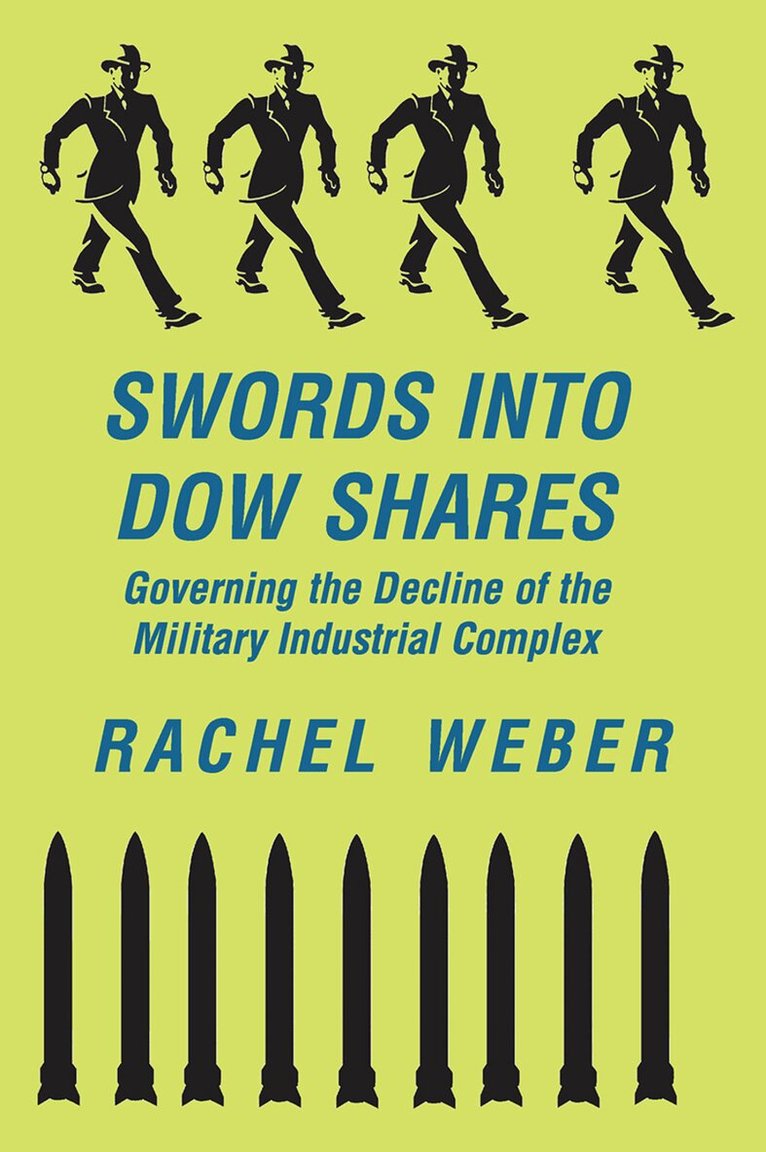
Swords Into Dow Shares
Governing The Decline Of The Military- Industrial Complex
Inbunden, Engelska, 2019
2 113 kr
Skickas inom 10-15 vardagar
Contemporary legal doctrine holds that corporate managers have obligations, first and foremost, to maximize profits for their shareholders. This doctrine is based on the assumption that shareholders alone bear the financial risks and contribute the equity necessary for production. But what if other groups contribute assets and also risk losing their investments? What if other groups actually shelter shareholders from financial risks? Such is the case with the nation's prime defense contractors. By examining the case of defense contracting, where the federal government and, indirectly, the taxpayers assume most of the risks and costs of producing weaponry, Rachel Weber critiques the assumptions underlying our system of corporate governance.The Department of Defense provides contracts for billions of dollars, specialized components and facilities, interest subsidies, tax breaks, and regulatory relief. These public contributions make the record shareholder returns and executive compensation packages of the early 1990s all the more problematic. This book follows the case of General Dynamics, the nation's largest military shipbuilder and considered a trendsetter in the industry for its explicit shareholder orientation. The behavior of contractors like General Dynamics in the post-Cold War period raises serious concerns about the private stewardship of public funds. How can the government make contractors accountable to other public interests? In Swords into Dow Shares Rachel Weber offers some original suggestions for redirecting defense resources to foster innovation, decrease the tax burden of military spending, and help to retain and create high-wage jobs in a civilian-industrial economy.
Swords Into Dow Shares
Governing The Decline Of The Military- Industrial Complex
Häftad, Engelska, 2001
754 kr
Skickas inom 10-15 vardagar
Contemporary legal doctrine holds that corporate managers have obligations, first and foremost, to maximize profits for their shareholders. This doctrine is based on the assumption that shareholders alone bear the financial risks and contribute the equity necessary for production. But what if other groups contribute assets and also risk losing their investments? What if other groups actually shelter shareholders from financial risks? Such is the case with the nation's prime defense contractors. By examining the case of defense contracting, where the federal government and, indirectly, the taxpayers assume most of the risks and costs of producing weaponry, Rachel Weber critiques the assumptions underlying our system of corporate governance.The Department of Defense provides contracts for billions of dollars, specialized components and facilities, interest subsidies, tax breaks, and regulatory relief. These public contributions make the record shareholder returns and executive compensation packages of the early 1990s all the more problematic. This book follows the case of General Dynamics, the nation's largest military shipbuilder and considered a trendsetter in the industry for its explicit shareholder orientation. The behavior of contractors like General Dynamics in the post-Cold War period raises serious concerns about the private stewardship of public funds. How can the government make contractors accountable to other public interests? In Swords into Dow Shares Rachel Weber offers some original suggestions for redirecting defense resources to foster innovation, decrease the tax burden of military spending, and help to retain and create high-wage jobs in a civilian-industrial economy.