
Raj Verma - Böcker
Visar alla böcker från författaren Raj Verma. Handla med fri frakt och snabb leverans.
11 produkter
11 produkter
690 kr
Skickas inom 10-15 vardagar
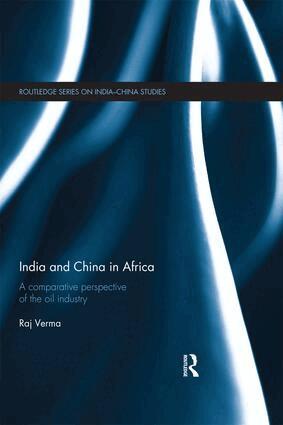
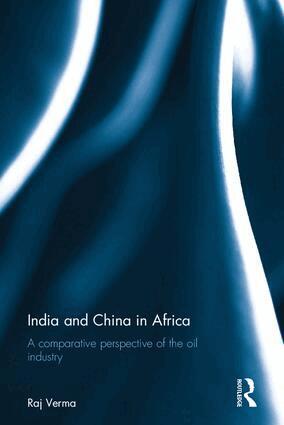
With their phenomenal growth rates, India and China are surging ahead as world economic powers. Due to increasing instability in the Middle East, they have turned to Africa to procure oil to fuel their industrialisation process. Africa’s economy stands to be impacted in various ways due to the increasing interaction with these ‘Asian Giants’. This book analyses the acquisition of oil blocks by Indian and Chinese oil corporations in eleven West African countries. It describes the differences in how India and China mobilise oil externally to meet their respective goals and objectives. The book examines the rate of return on capital, rate of interest on loans and the ease of availability of loans, the difference in the level of technology and ability to acquire technology, project management skills, risk aversion, valuation of the asset and the difference in the economic, political and diplomatic support received by the Chinese and Indian oil companies from their respective governments. It is argued that the difference in the relative economic and political power of India and China accounts for the ability of Chinese oil companies to outbid their Indian competitors and/or be preferred as partners by international oil companies. Containing interviews from Indian and Chinese oil company executives, government officials, industry officials, former diplomats and scholars and academics from India, China and the UK, this book makes a valuable contribution to existing literature on India, China and the oil industry in West Africa. It will be a valuable resource for academics in the field of International Relations, Foreign Policy Analysis, Asian Business and Economics.
2 103 kr
Skickas inom 10-15 vardagar
This book explores India-US relations and addresses the questions: Did India-US relations strengthen under Trump 1.0? Was there greater political, diplomatic, strategic, and defense cooperation between the two largest democracies in the world under the Trump administration? Was there increasing convergence or divergence at the bilateral and multilateral level, in relations with third countries, and in the realm of regional security and geopolitics?The contributors to this edited volume offer nuanced insights, highlighting that the answers are not straightforward. They highlight that bilateral ties flourished during the Modi-Trump era, fuelled by the camaraderie between the two leaders, and shared concerns over China’s rise. However, differences remained on issues such as democracy, trade, multilateralism, climate change, and regional security, especially within the Quadrilateral Security Dialogue. The Trump administration, particularly President Trump, played a key role in shaping these dynamics.This book is relevant reading for students, scholars, and researchers of international relations, political science, and South Asian studies, particularly those interested in US-India relations, geopolitics, global governance and international especially Asian security. Additionally, this volume will be of interest to practitioners and policymakers involved in South Asia, US foreign policy, the Indo-Pacific and international diplomacy.The chapters in this book were originally published as a special issue of India Review.
2 103 kr
Skickas inom 10-15 vardagar
This edited volume provides a holistic explanation for China’s incursions along the Line of Actual Control (LAC) in May 2020. It seeks to inform policy and build a bridge between policy and practice.Why did China intrude along the disputed border with India in May 2020? This question has baffled governments, policy makers, scholars and analysts across the globe. There is no clarity even in the Indian government regarding China’s intrusions at multiple points along the LAC in May 2020. Contributors examine factors such as China’s domestic politics, China’s foreign and security policies and strategies, China’s strategic culture, domestic factors and politics in India, India’s infrastructure development along the LAC, China’s rising material capabilities and the shift in the overall balance of power between India and China, India’s foreign policy especially India-US relations, Sino-Indian relations and Sino-Indian rivalry in the Indo-Pacific. Contributors to this edited volume seek to inform Indian policy makers by providing solutions to enhance India’s deterrence against China and prevent further land grab and also examine the possibility of a conflict or a wider border war between the two “Asian giants.” Thus, this edited volume seeks to inform policy and build a bridge between policy and practice.This book will be relevant for scholars and researchers specializing in international relations, Asian geopolitics, security studies and conflict resolution. This book will also appeal to policy makers, involved in foreign and security policies.The chapters in this book were originally published as a special issue of India Review.
1 968 kr
Skickas inom 10-15 vardagar
This book examines the sovereignty paradox in the Global South within the context of the Russia-Ukraine war. It illustrates the contradiction that countries which helped establish the post-World War II norm of "equal sovereignty"—entitling all nations to the same respect for sovereignty and territorial integrity as the West—are reluctant to publicly condemn Russia’s infringement on Ukraine’s sovereignty.The chapters in this volume further highlight the Global South’s duplicity because the Global South has been extremely critical of the US-led West for violating the United Nations Charter, international law and compromising on the sovereignty and territorial integrity of countries in the Global South. Through the analysis of nine countries, the contributions discuss each nation’s foreign policy tenets and how they have been violated in their stance on the Russia-Ukraine war and the justifications for such deviations. It also illustrates that “cherry picking” is the norm that states have adopted in employing the concept of sovereignty and this is likely to continue in the future.This book will be of interest to students, scholars, analysts, and policymakers in the fields of international relations, political science, geopolitics, and Global South studies.The chapters in this book were originally published as a special issue of Contemporary Security Policy.
2 236 kr
Skickas inom 10-15 vardagar
With their phenomenal growth rates, India and China are surging ahead as world economic powers. Due to increasing instability in the Middle East, they have turned to Africa to procure oil to fuel their industrialisation process. Africa’s economy stands to be impacted in various ways due to the increasing interaction with these ‘Asian Giants’. This book analyses the acquisition of oil blocks by Indian and Chinese oil corporations in eleven West African countries. It describes the differences in how India and China mobilise oil externally to meet their respective goals and objectives. The book examines the rate of return on capital, rate of interest on loans and the ease of availability of loans, the difference in the level of technology and ability to acquire technology, project management skills, risk aversion, valuation of the asset and the difference in the economic, political and diplomatic support received by the Chinese and Indian oil companies from their respective governments. It is argued that the difference in the relative economic and political power of India and China accounts for the ability of Chinese oil companies to outbid their Indian competitors and/or be preferred as partners by international oil companies. Containing interviews from Indian and Chinese oil company executives, government officials, industry officials, former diplomats and scholars and academics from India, China and the UK, this book makes a valuable contribution to existing literature on India, China and the oil industry in West Africa. It will be a valuable resource for academics in the field of International Relations, Foreign Policy Analysis, Asian Business and Economics.

781 kr
Skickas inom 5-8 vardagar

755 kr
Skickas inom 5-8 vardagar

781 kr
Skickas inom 5-8 vardagar
781 kr
Skickas inom 5-8 vardagar

781 kr
Skickas inom 5-8 vardagar
288 kr
Skickas inom 5-8 vardagar
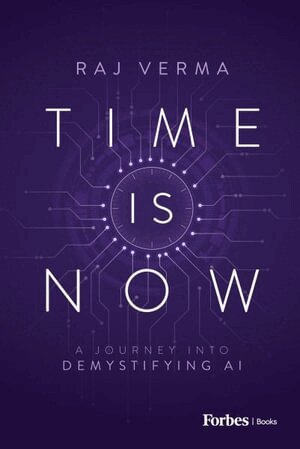
How can leaders adapt to the rapid change of technology’s impact on business? How can AI be leveraged for more intelligent decision making? Can our choices be simultaneously good for business and the world? This book provides leaders with the first steps to answer these important questions.For over thirty years, technology has become more interwoven with both our professional and personal lives. In the future, the integration of tech, business, and life will become even more seamless. With the current exponential growth of artificial intelligence and other emerging technologies, business leaders must learn how to adapt their decision making to look beyond short-term profits and create insight for long-term impact and growth.In Time is Now: A Journey into Demystifying AI, Raj Verma, CEO of SingleStore, takes readers on an insightful journey to not only demystify emerging tech like AI but to demystify how today’s leader must make decisions. Through engaging storytelling and relevant examples, Verma shares the lessons from his personal and professional life to glean timeless and universal lessons.At the crux of this journey, is the power of Now, which Verma defines as a convergence of Information, Context, and Choice:Information is data, the collection of memory which shapes our identity.Context is the analysis of all information in the present.Choice is focused on the future, approached with courage and conscience.From these three pillars of Now, we write our future—for better or worse. As the speed of Real Time increases, so will the consequences of our decisions. In the explosion of AI, leaders have a responsibility to learn before they act. We must wield the tools available with the insight that our decisions will impact the world for generations to come. Doing so will require both great courage and conscience. It cannot wait. The time is Now.