Randolph L. Braham - Böcker
Visar alla böcker från författaren Randolph L. Braham. Handla med fri frakt och snabb leverans.
3 produkter
3 produkter
254 kr
Skickas inom 10-15 vardagar
The Politics of Genocide: The Holocaust in Hungary, Condensed Edition is an abbreviated version of the classic work first published in 1981 and revised and expanded in 1994. It includes a new historical overview, and retains and sharpens its focus on the persecution of the Jews. Through a meticulous use of Hungarian and many other sources, the book explains in a rational and empirical context the historical, political, communal, and socioeconomic factors that contributed to the unfolding of this tragedy at a time when the leaders of the world, including the national and Jewish leaders of Hungary, were already familiar with the secrets of Auschwitz.The Politics of Genocide is the most eloquent and comprehensive study ever produced of the Holocaust in Hungary. In this condensed edition, Randolph L. Braham includes the most important revisions of the 1994 second edition as well as new material published since then. Scholars of Holocaust, Slavic, and East-Central European studies will find this volume indispensable.
296 kr
Skickas inom 10-15 vardagar
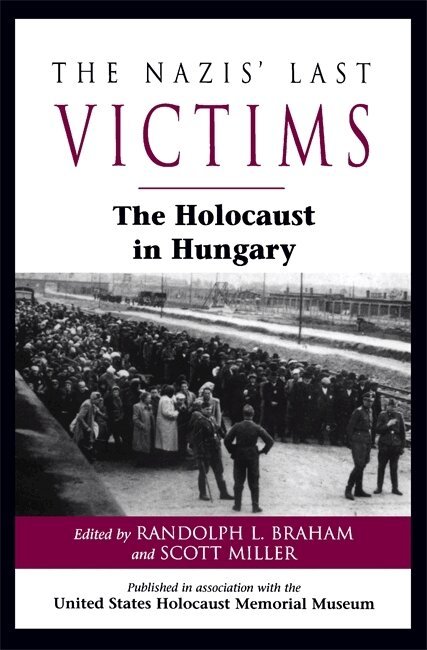
The Nazis' Last Victims articulates and historically scrutinizes both the uniqueness and the universality of the Holocaust in Hungary, a topic often minimalized in general works on the Holocaust. The result of the 1994 conference at the United States Holocaust Memorial Museum on the 50th anniversary of the deportation of Hungarian Jewry, this anthology examines the effects on Hungary as the last country to be invaded by the Germans. The Jewish community in Hungary remained relatively intact throughout most of the Holocaust period until just months before the end of World War II. ""The Nazis' Last Victims"" questions what Hungarians knew of their impending fate and examines the heightened sense of tension and haunting drama in Hungary, where the largest single killing process of the Holocaust period occurred in the shortest amount of time. The text covers the experiences of victims, perpetrators, collaborators, rescuers, resisters, and bystanders, as well as memorializers and historiographers of the Holocaust. While providing a basic historical overview of the Holocaust, this collection applies to Hungary the general themes of Holocaust historiography, analysing traditional anti-Semitism, anti-Jewish legislation, local collaboration, Jewish responses, ghettoization, deportations, the killing process, and Allied responses. Reflecting scholarship from a number of different disciplines in Hungary, Israel, and the United States, the contributors present a variety of - and often conflicting - analyses and insights, demonstrating an open and animated exchange of ideas. The contributors utilized archives from Hungary, Israel, and Germany, and some, as survivors of the Holocaust in Hungary, have included their own personal testimony. Through the combination of two vital components of history writing - the analytical and the recollective - the book probes the destruction of the last remnant of European Jewry in the Holocaust.
1 777 kr
Skickas inom 10-15 vardagar
According to most historians, the Holocaust in Hungary represented a unique chapter in the singular history of what the Nazis termed as the “Final Solution” of the “Jewish question” in Europe. More than seventy years after the Shoah, the origins and prehistory as well as the implementation and aftermath of the genocide still provide ample ground for scholarship. In fact, Hungarian historians began to seriously deal with these questions only after the 1980s. Since then, however, a consistently active and productive debate has been waged about the history and interpretation of the Holocaust in Hungary and with the passage of time, more and more questions have been raised in connection with its memorialization. This volume includes twelve selected scholarly papers thematically organized under four headings: 1. The newest trends in the study of the Holocaust in Hungary. 2. The anti-Jewish policies of Hungary during the interwar period 3. The Holocaust era in Hungary 4. National and international aspects of Holocaust remembrance. The studies reflect on the anti-Jewish atmosphere in Hungary during the interwar period; analyze the decision-making process that led to the deportations, and the options left open to the Hungarian government. They also provide a detailed presentation of the Holocaust in Transylvania and describe the experience of Hungarian Jewish refugees in Austria after the end of the war.