
Raymond B. Cowles – författare
Visar alla böcker från författaren Raymond B. Cowles. Handla med fri frakt och snabb leverans.
4 produkter
4 produkter
473 kr
Skickas inom 5-8 vardagar
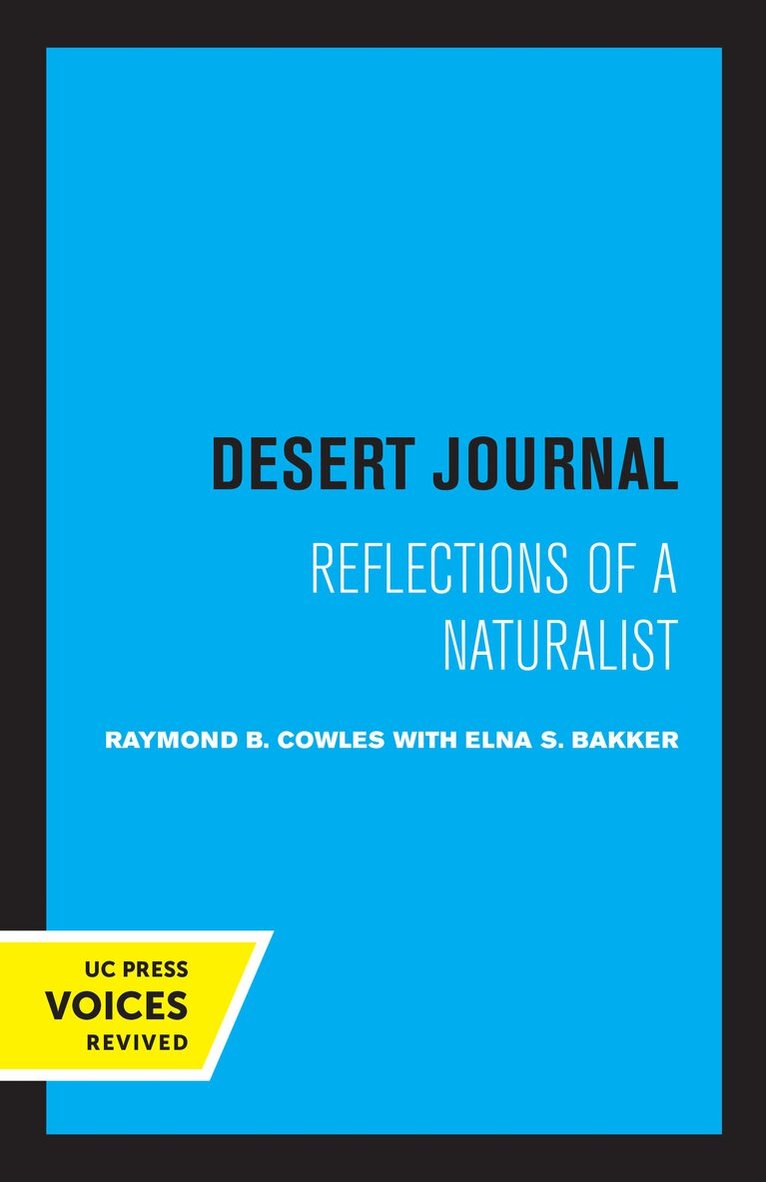
Desert Journal: A Naturalist Reflects on Arid California is both a tribute to the life and work of Raymond B. Cowles and a call to reflect on humanity's relationship with nature. Born in 1896 in South Africa, Cowles developed a lifelong fascination with wildlife during his boyhood, which shaped his pioneering work in reptilian thermoregulation—a field he helped establish. His research extended far beyond academia, influencing generations of students and laying the foundation for ecological awareness in California and beyond.Cowles was a visionary, deeply concerned about the impact of human population growth on biodiversity. Long before these ideas gained mainstream attention, he identified the intrinsic link between overpopulation and environmental degradation. Though his book on the subject was never published, the themes resonate throughout his writings, particularly in Chapter 23 of this volume. Cowles’ holistic perspective embraced the biosphere as an interconnected entity, and his ethical framework extended to all life forms. He was not only a scientist but also a humanist, reveling in the sensory experiences of nature and mourning their loss in an increasingly mechanized world. His poetic reflections, like a letter written shortly before his death, reveal his enduring love for the natural world and his plea for others to preserve its beauty. His life was one of dedication and insight, as exemplified in his final public discussions about overpopulation and resource scarcity. Even in his later years, he demonstrated vitality, intellectual sharpness, and a profound ability to connect with people. His legacy, captured in this book and in the memories of those he inspired, underscores the urgency of harmonizing human aspirations with the needs of the planet.This title is part of UC Press's Voices Revived program, which commemorates University of California Press’s mission to seek out and cultivate the brightest minds and give them voice, reach, and impact. Drawing on a backlist dating to 1893, Voices Revived makes high-quality, peer-reviewed scholarship accessible once again using print-on-demand technology. This title was originally published in 1977.
581 kr
Skickas inom 5-8 vardagar
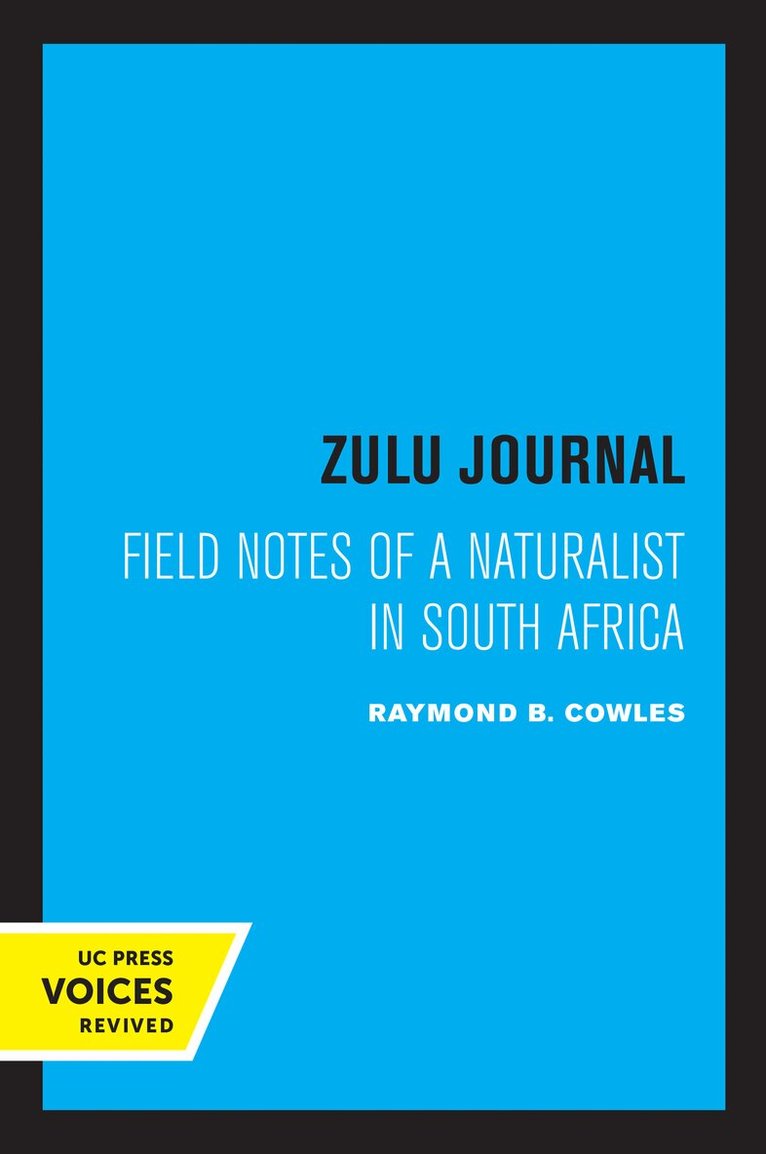
Zulu Journal: Field Notes of a Naturalist in South Africa by Raymond B. Cowles is a lyrical mosaic of memory and field observation, charting a lifetime’s engagement with the landscapes of Natal and Zululand. Drawing on two major research trips (1925–27, 1953) and recollections of a missionary childhood at Adams and Umzumbe stations, Cowles weaves together natural history, ethnographic encounters, and personal narrative. Rather than a strict diary, the book offers “winnowings” from field notes and recollections, crafted to capture the moods of season and place. The steep gradient from Drakensberg peaks to the Indian Ocean provides the ecological framework, where sharp shifts in climate and fauna occur over just a few miles. From kraal-scattered reserves to crown lands, farms, and game preserves, Cowles situates his apprenticeship as a naturalist—moving from slingshot to rifle to camera—within a South African environment both abundant and already under pressure.What distinguishes the work is Cowles’s attention to small vertebrates, reptiles, and amphibians rather than the big game that dominated colonial writing. A childhood discovery of Nile monitor lizard eggs incubating in termite mounds, later developed into a Ph.D. note, becomes emblematic of Africa’s capacity for everyday scientific surprise. Alongside such moments, he recounts family missionary history, the hazards of Durban’s early harbor, and the decline of elephants, crocodiles, and other species, as new threats such as schistosomiasis spread. The narrative consistently balances affectionate evocation of Zulu landscapes with the colonial vantage point of its author, producing a text that is both immersive and reflective. By its conclusion, Zulu Journal moves from memory to warning: population surges, medical advances, and industrial extraction are accelerating the depletion of renewable and nonrenewable resources alike. Cowles frames his conservation ethic bluntly—better the quick death by predator or hunter than slow starvation—while acknowledging the shrinking window for studying “unspoiled nature.” At once personal record and ecological meditation, the book invites readers to consider natural history not only as science but as lived, sensory engagement with a rapidly changing world.This title is part of UC Press's Voices Revived program, which commemorates University of California Press’s mission to seek out and cultivate the brightest minds and give them voice, reach, and impact. Drawing on a backlist dating to 1893, Voices Revived makes high-quality, peer-reviewed scholarship accessible once again using print-on-demand technology. This title was originally published in 1959.

1 093 kr
Skickas inom 5-8 vardagar
Desert Journal: A Naturalist Reflects on Arid California is both a tribute to the life and work of Raymond B. Cowles and a call to reflect on humanity's relationship with nature. Born in 1896 in South Africa, Cowles developed a lifelong fascination with wildlife during his boyhood, which shaped his pioneering work in reptilian thermoregulation—a field he helped establish. His research extended far beyond academia, influencing generations of students and laying the foundation for ecological awareness in California and beyond.Cowles was a visionary, deeply concerned about the impact of human population growth on biodiversity. Long before these ideas gained mainstream attention, he identified the intrinsic link between overpopulation and environmental degradation. Though his book on the subject was never published, the themes resonate throughout his writings, particularly in Chapter 23 of this volume. Cowles’ holistic perspective embraced the biosphere as an interconnected entity, and his ethical framework extended to all life forms. He was not only a scientist but also a humanist, reveling in the sensory experiences of nature and mourning their loss in an increasingly mechanized world. His poetic reflections, like a letter written shortly before his death, reveal his enduring love for the natural world and his plea for others to preserve its beauty. His life was one of dedication and insight, as exemplified in his final public discussions about overpopulation and resource scarcity. Even in his later years, he demonstrated vitality, intellectual sharpness, and a profound ability to connect with people. His legacy, captured in this book and in the memories of those he inspired, underscores the urgency of harmonizing human aspirations with the needs of the planet.This title is part of UC Press's Voices Revived program, which commemorates University of California Press’s mission to seek out and cultivate the brightest minds and give them voice, reach, and impact. Drawing on a backlist dating to 1893, Voices Revived makes high-quality, peer-reviewed scholarship accessible once again using print-on-demand technology. This title was originally published in 1977.

1 093 kr
Skickas inom 5-8 vardagar
Zulu Journal: Field Notes of a Naturalist in South Africa by Raymond B. Cowles is a lyrical mosaic of memory and field observation, charting a lifetime’s engagement with the landscapes of Natal and Zululand. Drawing on two major research trips (1925–27, 1953) and recollections of a missionary childhood at Adams and Umzumbe stations, Cowles weaves together natural history, ethnographic encounters, and personal narrative. Rather than a strict diary, the book offers “winnowings” from field notes and recollections, crafted to capture the moods of season and place. The steep gradient from Drakensberg peaks to the Indian Ocean provides the ecological framework, where sharp shifts in climate and fauna occur over just a few miles. From kraal-scattered reserves to crown lands, farms, and game preserves, Cowles situates his apprenticeship as a naturalist—moving from slingshot to rifle to camera—within a South African environment both abundant and already under pressure.What distinguishes the work is Cowles’s attention to small vertebrates, reptiles, and amphibians rather than the big game that dominated colonial writing. A childhood discovery of Nile monitor lizard eggs incubating in termite mounds, later developed into a Ph.D. note, becomes emblematic of Africa’s capacity for everyday scientific surprise. Alongside such moments, he recounts family missionary history, the hazards of Durban’s early harbor, and the decline of elephants, crocodiles, and other species, as new threats such as schistosomiasis spread. The narrative consistently balances affectionate evocation of Zulu landscapes with the colonial vantage point of its author, producing a text that is both immersive and reflective. By its conclusion, Zulu Journal moves from memory to warning: population surges, medical advances, and industrial extraction are accelerating the depletion of renewable and nonrenewable resources alike. Cowles frames his conservation ethic bluntly—better the quick death by predator or hunter than slow starvation—while acknowledging the shrinking window for studying “unspoiled nature.” At once personal record and ecological meditation, the book invites readers to consider natural history not only as science but as lived, sensory engagement with a rapidly changing world.This title is part of UC Press's Voices Revived program, which commemorates University of California Press’s mission to seek out and cultivate the brightest minds and give them voice, reach, and impact. Drawing on a backlist dating to 1893, Voices Revived makes high-quality, peer-reviewed scholarship accessible once again using print-on-demand technology. This title was originally published in 1959.