
Inbunden, Engelska, 1998
450 kr
Tillfälligt slut
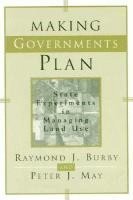
"The message of this book is one of cautious optimism. New challenges to planning are coming forth...These have caused some state legislatures to be reluctant to create or strengthen comprehensive-planning requirements. We do not think that such challenges necessitate a dismantling of these requirements. Instead, they require stronger justification for governmental actions and more (rather than less) attention to the details of the design of state mandates."-from Making Governments Plan In the past fifty years the American landscape-urban, rural, and wild-has undergone significant change. Searching for ways of coping with this change, policy makers at the state and local levels have attempted to capture the benefits of development while avoiding the congestion, housing shortages, and environmental degradation that often accompany rapid changes in land use. Uncounted new methods-growth boundaries, subdivision exactions, impact fees-have been tried.At the forefront of the growth management movement, a handful of states have forged new systems of governance to link local policy more closely to state goals and to cajole (and sometimes coerce) cooperation among neighboring localities. In this path-breaking book, a team of scholars from five universities show how new experiments in growth management can reinvigorate land use planning and help local governments find new solutions to the problems caused by growth and change. Drawing on evidence from five states and scores of cities and counties, the authors show why the benefits of growth are not automatic. Much depends on how well states craft growth management legislation, how amply programs are funded, and how dedicated state officials are to working with localities. By building on these findings, they conclude, states and localities can improve their chances for coping successfully with land use change. Beyond these policy lessons, Making Governments Plan offers important theoretical insights on how to design intergovernmental programs more effectively and how to use local comprehensive plans to further policy objectives.This knowledge can, in turn, provide the foundation for further theoretical work and for extending the lessons of this book to other policy arenas. Published in cooperation with the Center for American Places, Harrisonburg, Virginia.