Raymond Kapral - Böcker
Visar alla böcker från författaren Raymond Kapral. Handla med fri frakt och snabb leverans.
3 produkter
3 produkter
1 034 kr
Skickas inom 7-10 vardagar
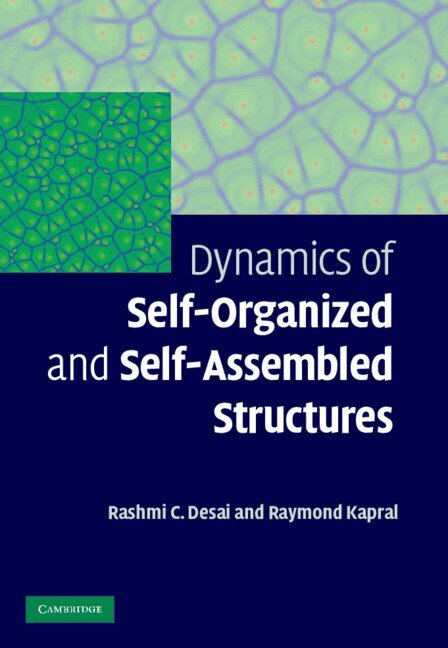
Physical and biological systems driven out of equilibrium may spontaneously evolve to form spatial structures. In some systems molecular constituents may self-assemble to produce complex ordered structures. This book describes how such pattern formation processes occur and how they can be modeled. Experimental observations are used to introduce the diverse systems and phenomena leading to pattern formation. The physical origins of various spatial structures are discussed, and models for their formation are constructed. In contrast to many treatments, pattern-forming processes in nonequilibrium systems are treated in a coherent fashion. The book shows how near-equilibrium and far-from-equilibrium modeling concepts are often combined to describe physical systems. This inter-disciplinary book can form the basis of graduate courses in pattern formation and self-assembly. It is a useful reference for graduate students and researchers in a number of disciplines, including condensed matter science, nonequilibrium statistical mechanics, nonlinear dynamics, chemical biophysics, materials science, and engineering.
2 121 kr
Skickas inom 10-15 vardagar
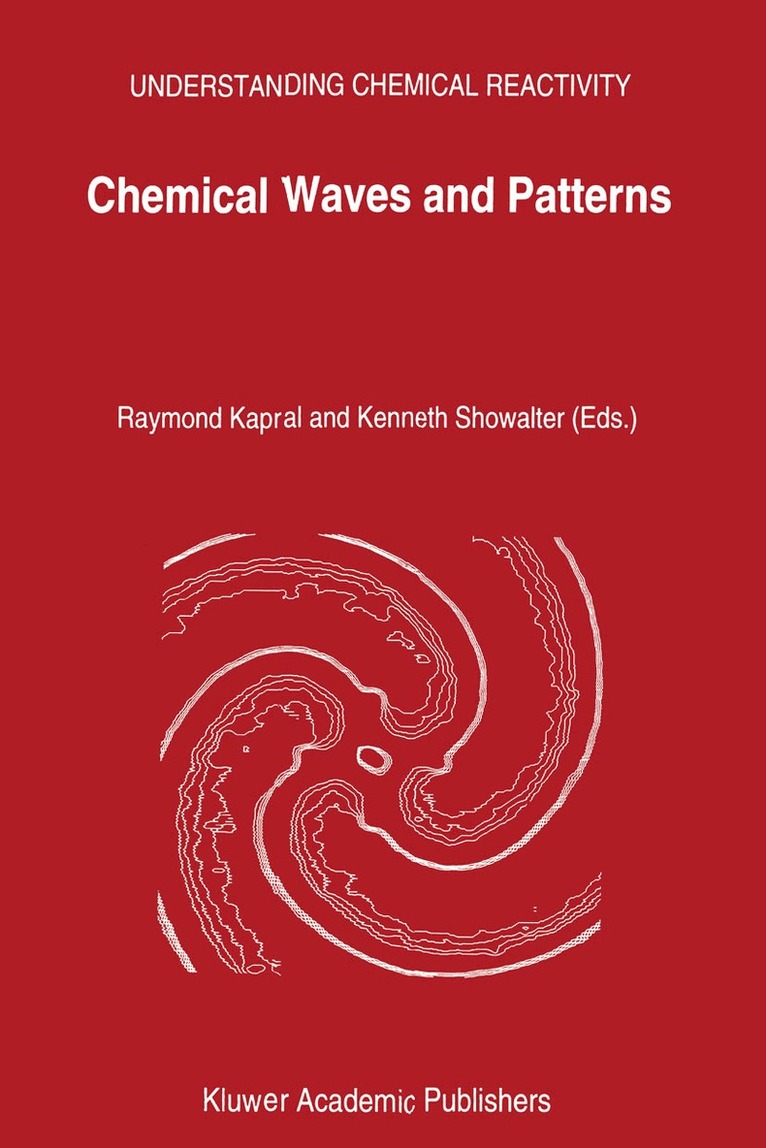
This work focuses on the recent developments that have taken place in the experimental and theoretical study of pattern formation in chemically reacting systems. The major developments have centred around the study of spiral waves in excitable and oscillatory media, chemical-wave propagation processes and Turing patterns. On the experimental side, the use of continuously-fed unstirred reactors and reactors involving gels or porous media have opened up the possibility of controlled studies of spiral-wave dynamics and the discovery of new types of dynamics and interactions. The use of digital-imaging methods has allowed both visualization and quantitative study of such chemical waves. The experimental observation of Turing and Turing-like patterns in chemical systems has led to a rapid development of work in this area. This volume, containing contributions by leading researchers in the field, aims to put recent advances into perspective and to set the stage for future developments. It should be of interest for researchers and postgraduates in chemistry, physics, mathematics, biology and chemical engineering, plus departmental and central libraries.
2 121 kr
Skickas inom 10-15 vardagar
The concept of macroscopic waves and patterns developing from chemical reaction coupling with diffusion was presented, apparently for the first time, at the Main Meeting of the Deutsche Bunsengesellschaft fur Angewandte Physikalische Chemie, held in Dresden, Germany from May 21 to 24, 1906. Robert Luther, Director of the Physical Chemistry Laboratory in Leipzig, read his paper on the discovery and analysis of propagating reaction-diffusion fronts in autocatalytic chemical reactions [1, 2]. He presented an equation for the velocity of these new waves, V = a(KDC)1/2, and asserted that they might have features in common with propagating action potentials in nerve cell axons. During the discussion period, a skeptic in the audience voiced his objections to this notion. It was none other than the great physical chemist Walther Nernst, who believed that nerve impulse propagation was far too rapid to be akin to the propagating fronts. He was also not willing to accept Luther's wave velocity equation without a derivation. Luther stood his ground, saying his equation was "a simple consequence of the corresponding differential equation. " He described several different autocatalytic reactions that exhibit propagating fronts (recommending gelling the solution to prevent convection) and even presented a demonstration: the autocatalytic permanganate oxidation of oxalate was carried out in a test tube with the image of the front projected onto a screen for the audience.