Raymond T. Smith - Böcker
Visar alla böcker från författaren Raymond T. Smith. Handla med fri frakt och snabb leverans.
5 produkter
5 produkter
Negro Family in British Guiana
Family Structure and Social Status in the Villages
Inbunden, Engelska, 1998
3 163 kr
Skickas inom 10-15 vardagar
This is Volume IX of eighteen in a collection on the Sociology of Development. Originally published in 1956 and using language of the time, this monologue looks at the family system in Guianese families.
Negro Family in British Guiana
Family Structure and Social Status in the Villages
Häftad, Engelska, 2013
671 kr
Skickas inom 10-15 vardagar
This is Volume IX of eighteen in a collection on the Sociology of Development. Originally published in 1956 and using language of the time, this monologue looks at the family system in Guianese families.
414 kr
Skickas inom 10-15 vardagar
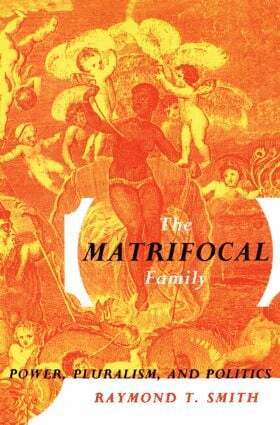
The essays in this collection focus attention on the enormous contribution made by women in maintaining family relations in situations of both racial and gender domination.
Del 65 - Cambridge Studies in Social and Cultural Anthropology
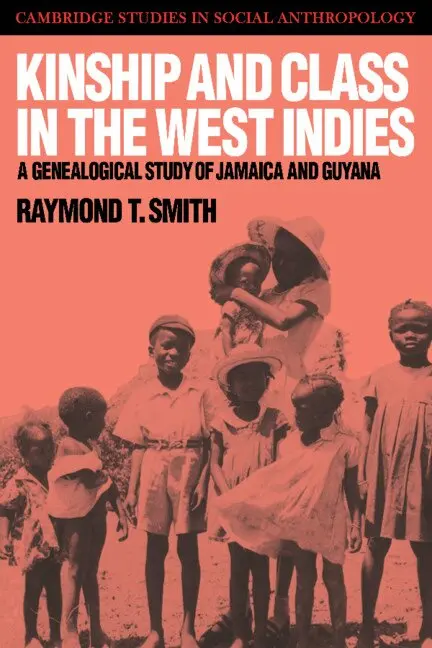
Kinship and Class in the West Indies
A Genealogical Study of Jamaica and Guyana
Häftad, Engelska, 1990
428 kr
Skickas inom 7-10 vardagar
Is a family system that permits freedom to enter, dissolve, and re-enter sexual unions, that tolerates high illegitimacy rates, and allows a large proportion of households to be headed by women, viable, natural and healthy? This is an appropriate question to ask of many modern industrial societies in the 1980s. Yet a system with just those factors has been in place in the West Indies for 150 years. In this book, Raymond T. Smith explores the extensive family and kinship ties of West Indians in Jamaica and Guyana, and in so doing dispels many of the myths that exist about West Indian family life.
639 kr
Skickas inom 10-15 vardagar
In this volume an international group of anthropologists and historians examines the complex relationships between family life, culture, and economic change in Latin America and the Caribbean. Dissatisfied with interpretations based on European experience, these scholars incorporate the particular histories, ideologies, and aspirations of New World peoples into analyses informed by general theory.The study of kinship in Latin America has been in the past dominated by anthropologists concerned with primitive Indian groups. The few scholars who have investigated family life in urban or more developed rural groups have focused on what they believe to be the impact of modernization on traditional systems brought from Europe or carried forward from an Indian past. In Kinship Ideology and Practice in Latin America, the contributors show that, contrary to the belief that urbanization and economic development lead to individualism, social atomization, and the dissolution of the family, the rich as well as the poor of Latin America are sustained by, and use, extensive kinship ties.The essays include analyses of kinship and godparenthood among slaves in the West Indies and Brazil; studies of Andean kinship from Incan times to the present; and descriptions of kinship and marriage among Brazilian slum dwellers and plantation workers, Mexican millionaires, cowboys, and peasants, and the Jamaican middle class. One essay uses translations of original documents to follow the changing meanings of such concepts as love, ""heart,"" concupiscence, and carnality during the economic changes that affected colonial New Mexico. Each contribution focuses on a particular aspect of the four major areas covered: the definition and dynamics of kinship, familial ties originating in nuclear relations and their extensions, the meaning and institutionalization of ""compadrazgo"" (ritual kinship), and the organization of marriage.In his introduction, Raymond Smith discusses the present state of kinship theory with special reference to the issues illuminated by these essays. He notes that contributors from varied backgrounds in history, anthropology, and sociology meet on common ground because ""given a theoretical approach that views society as a process in time, structures by principles that are historically reconstituted, reproduced, and transformed, it is evident that history and social science cease to be distinguishable."" With this premise, Kinship Ideology and Practice in Latin America should appeal to scholars from a number of disciplines.A UNC Press Enduring Edition -- UNC Press Enduring Editions use the latest in digital technology to make available again books from our distinguished backlist that were previously out of print. These editions are published unaltered from the original, and are presented in affordable paperback formats, bringing readers both historical and cultural value.