R.B. Heimann – författare
Visar alla böcker från författaren R.B. Heimann. Handla med fri frakt och snabb leverans.
5 produkter
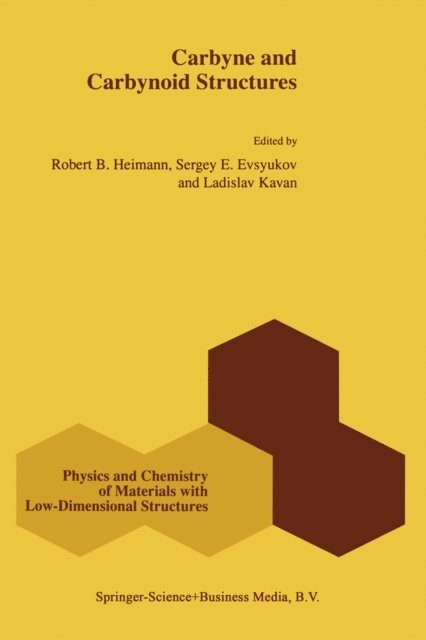
Carbyne and Carbynoid Structures
Av R.B. Heimann, S.E. Evsyukov m. fl.
Inbunden, 1999
2189 kr
Lägg i varukorg
A collection of topical and mostly critical reviews written by professionals who are working or have been working in this and related fields, this book intends to provide a complete, ordered and concise summary of what is known (or not known) about carbyne at this date. The authors have tried to be …
Auflösung von Kristallen
Theorie und technische Anwendung
Av R.B. Heimann
E-bok, 2013
782 kr
Lägg i varukorg
Auflösung von Kristallen
Theorie und technische Anwendung
Av R.B. Heimann
Häftad, 2012
772 kr
Lägg i varukorg
Carbyne and Carbynoid Structures
Av R.B. Heimann, S.E. Evsyukov m. fl.
Häftad, 2012
2189 kr
Lägg i varukorg
1.1. THE DISCOVERY OF CARBYNE Yu.P. KUDRYA VTSEV A.N. Nesmeyanov Institute ofOrganoelement Compounds, Russian Academy of Sciences, 117813 Moscow, Russia Abstract - The history of the discovery of carbyne is briefly recalled. The existence of carbyne was first disclosed by Russian researchers in …
Carbyne and Carbynoid Structures
Av Ladislav Kavan, S.E. Evsyukov m. fl.
E-bok, 2012
2925 kr
Lägg i varukorg
1.1. THE DISCOVERY OF CARBYNE Yu.P. KUDRYA VTSEV A.N. Nesmeyanov Institute ofOrganoelement Compounds, Russian Academy of Sciences, 117813 Moscow, Russia Abstract - The history of the discovery of carbyne is briefly recalled. The existence of carbyne was first disclosed by Russian researchers in …