R.D. Rosenkrantz - Böcker
Visar alla böcker från författaren R.D. Rosenkrantz. Handla med fri frakt och snabb leverans.
3 produkter
3 produkter
Del 158 - Synthese Library
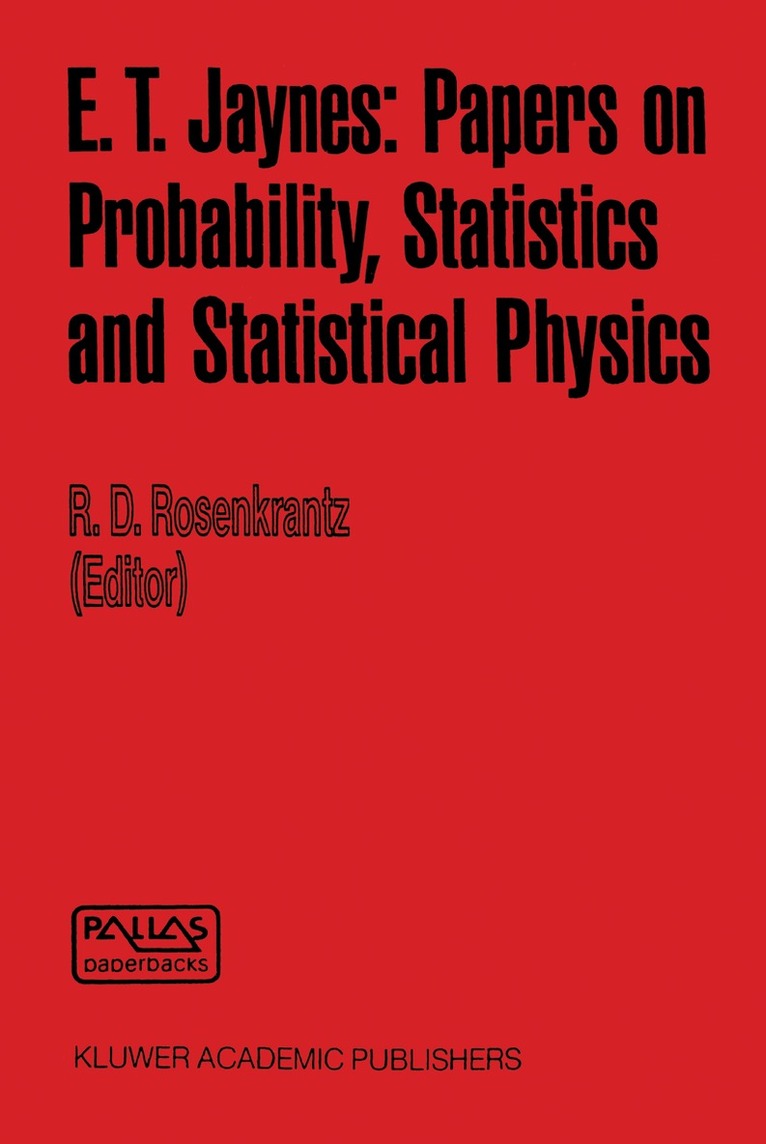
E. T. Jaynes: Papers on Probability, Statistics and Statistical Physics
Häftad, Engelska, 1989
1 900 kr
Skickas inom 10-15 vardagar
The first six chapters of this volume present the author's 'predictive' or information theoretic' approach to statistical mechanics, in which the basic probability distributions over microstates are obtained as distributions of maximum entropy (Le. , as distributions that are most non-committal with regard to missing information among all those satisfying the macroscopically given constraints). There is then no need to make additional assumptions of ergodicity or metric transitivity; the theory proceeds entirely by inference from macroscopic measurements and the underlying dynamical assumptions. Moreover, the method of maximizing the entropy is completely general and applies, in particular, to irreversible processes as well as to reversible ones. The next three chapters provide a broader framework - at once Bayesian and objective - for maximum entropy inference. The basic principles of inference, including the usual axioms of probability, are seen to rest on nothing more than requirements of consistency, above all, the requirement that in two problems where we have the same information we must assign the same probabilities. Thus, statistical mechanics is viewed as a branch of a general theory of inference, and the latter as an extension of the ordinary logic of consistency. Those who are familiar with the literature of statistics and statistical mechanics will recognize in both of these steps a genuine 'scientific revolution' - a complete reversal of earlier conceptions - and one of no small significance.
1 064 kr
Skickas inom 10-15 vardagar
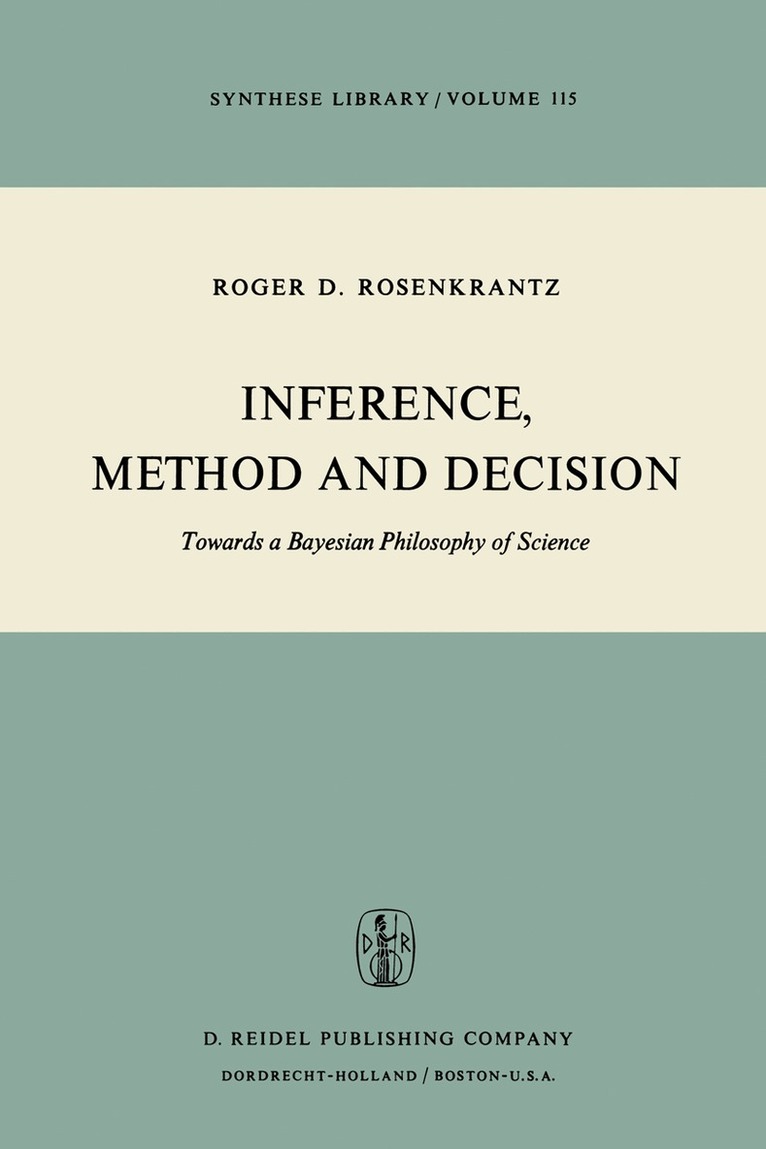
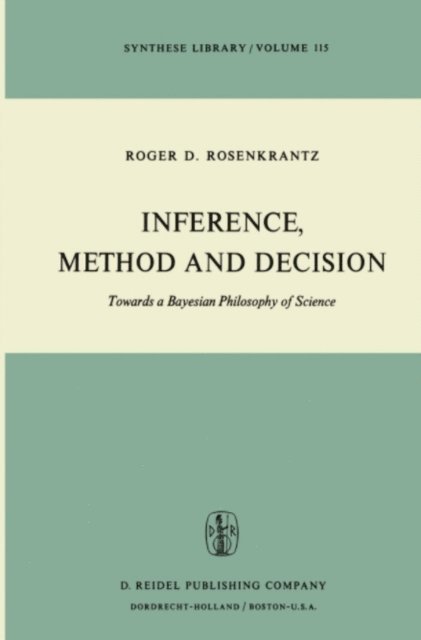
This book grew out of previously published papers of mine composed over a period of years; they have been reworked (sometimes beyond recognition) so as to form a reasonably coherent whole. Part One treats of informative inference. I argue (Chapter 2) that the traditional principle of induction in its clearest formulation (that laws are confirmed by their positive cases) is clearly false. Other formulations in terms of the 'uniformity of nature' or the 'resemblance of the future to the past' seem to me hopelessly unclear. From a Bayesian point of view, 'learning from experience' goes by conditionalization (Bayes' rule). The traditional stum bling block for Bayesians has been to fmd objective probability inputs to conditionalize upon. Subjective Bayesians allow any probability inputs that do not violate the usual axioms of probability. Many subjectivists grant that this liberality seems prodigal but own themselves unable to think of additional constraints that might plausibly be imposed. To be sure, if we could agree on the correct probabilistic representation of 'ignorance' (or absence of pertinent data), then all probabilities obtained by applying Bayes' rule to an 'informationless' prior would be objective. But familiar contra dictions, like the Bertrand paradox, are thought to vitiate all attempts to objectify 'ignorance'. BuUding on the earlier work of Sir Harold Jeffreys, E. T. Jaynes, and the more recent work ofG. E. P. Box and G. E. Tiao, I have elected to bite this bullet. In Chapter 3, I develop and defend an objectivist Bayesian approach.
1 064 kr
Skickas inom 10-15 vardagar
This book grew out of previously published papers of mine composed over a period of years; they have been reworked (sometimes beyond recognition) so as to form a reasonably coherent whole. Part One treats of informative inference. I argue (Chapter 2) that the traditional principle of induction in its clearest formulation (that laws are confirmed by their positive cases) is clearly false. Other formulations in terms of the 'uniformity of nature' or the 'resemblance of the future to the past' seem to me hopelessly unclear. From a Bayesian point of view, 'learning from experience' goes by conditionalization (Bayes' rule). The traditional stum bling block for Bayesians has been to fmd objective probability inputs to conditionalize upon. Subjective Bayesians allow any probability inputs that do not violate the usual axioms of probability. Many subjectivists grant that this liberality seems prodigal but own themselves unable to think of additional constraints that might plausibly be imposed. To be sure, if we could agree on the correct probabilistic representation of 'ignorance' (or absence of pertinent data), then all probabilities obtained by applying Bayes' rule to an 'informationless' prior would be objective. But familiar contra dictions, like the Bertrand paradox, are thought to vitiate all attempts to objectify 'ignorance'. BuUding on the earlier work of Sir Harold Jeffreys, E. T. Jaynes, and the more recent work ofG. E. P. Box and G. E. Tiao, I have elected to bite this bullet. In Chapter 3, I develop and defend an objectivist Bayesian approach.