Rebecca West Burns – författare
343 kr
Skickas inom 3-6 vardagar
601 kr
Skickas inom 5-8 vardagar
1 063 kr
Skickas inom 5-8 vardagar
563 kr
Läs direkt efter köp
601 kr
Skickas inom 5-8 vardagar
1 063 kr
Skickas inom 5-8 vardagar
543 kr
Läs direkt efter köp
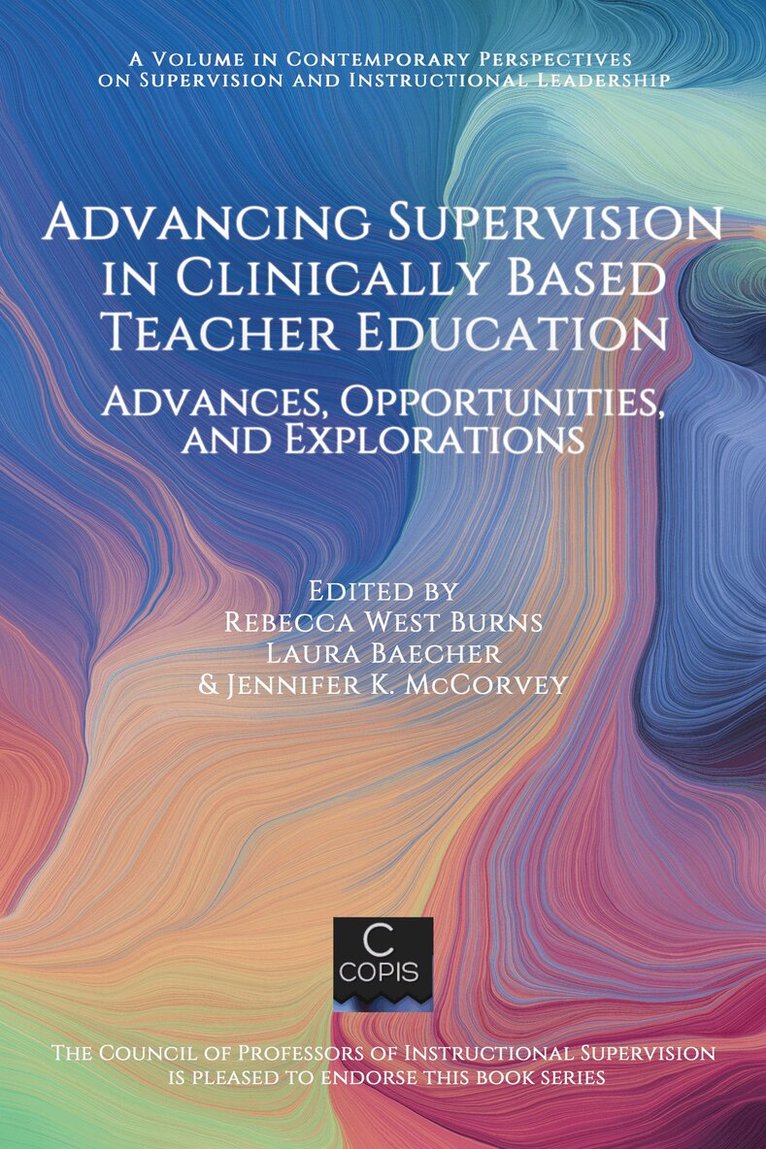
Advancing Supervision in Clinically Based Teacher Education
Advances, Opportunities, and Explorations
535 kr
Skickas inom 5-8 vardagar
Advancing Supervision in Clinically Based Teacher Education
Advances, Opportunities, and Explorations
997 kr
Skickas inom 5-8 vardagar
Advancing Supervision in Clinically Based Teacher Education
Advances, Opportunities, and Explorations
499 kr
Läs direkt efter köp
Supervision in teacher education is entering an exciting time. In the last decade, national reports calling for the transformation of teacher preparation have advocated for greater school-university collaboration and increased clinical preparation of teachers (AACTE, 2018; NCATE, 2010). Thus, institutions with teacher preparation should be increasingly concerned with the clinical component of their teacher certification programs (AACTE, 2010; 2018; NCATE, 2001; NEA, 2014). However, supervision in teacher preparation has historically been held in low regard, (Beck & Kosnik, 2002; Feiman-Nemser, 2001; The Holmes Group, 1986; Hoover, O’Shea, & Carroll, 1988; Soder & Sirotnik, 1990) even though research has shown that high-quality supervision promotes teacher candidate learning (Bates, Drits, & Ramirez, 2011; Burns, Jacobs, & Yendol-Hoppey, 2016; Darling-Hammond, 2014; Gimbert & Nolan, 2003; Lee, 2011). In fact, university supervisors “may be the most undervalued actors in the entire teacher preparation equation when one considers the knowledge, skills, and dispositions they must have to teach about teaching in the field” (Burns & Badiali, 2016, p. 156). Despite this research, the function of supervision has often been relegated to adjunct faculty or even removed the university-based supervisor altogether in some colleges/schools of education (McIntyre & McIntyre, 2020; NCATE, 2010; Slick, 1998; Zeichner, 1992, 2005). These practices are incredibly problematic for actualizing clinically based teacher education. Thus, the road to transforming teacher education must involve addressing such long standing misperceptions about what supervision is, what purpose it serves, and how it can be renewed from an afterthought to become the driving engine of high quality teacher preparation.
Advancing Supervision in Clinically Based Teacher Education: Advances, Opportunities, and Explorations aims to elevate supervision and supervisors, as undervalued actors, by disseminating high-quality manuscripts on this critical area of study. The chapters in this book tackle the persistent issue of devaluing and marginalizing supervision in some institutions of higher education by sharing current research, illuminating challenges of supervising in the current high stakes accountability climate, and offering innovative ideas that can improve supervision in clinically based teacher education.
Advancing Supervision in Clinically Based Teacher Education
Advances, Opportunities, and Explorations
577 kr
Läs direkt efter köp
649 kr
Läs direkt efter köp
649 kr
Läs direkt efter köp
1 226 kr
Läs direkt efter köp
Teacher education is rapidly changing, pushing the field to reposition clinical practice as the central feature of teacher preparation programs, increasing the role that schools play in teacher preparation, and advocating for greater collaboration between schools/school districts and universities/colleges of education (see American Association of Colleges for Teacher Education, 2018; National Council for the Accreditation of Teacher Education, 2010). As the field evolves so does the meaning and understanding of the work of teacher educators.
The Association of Teacher Educators (ATE) has a long history of supporting and advocating for teacher education and teacher educators. The quest to understand who is a teacher educator and what a teacher educator does began in the early 1990s. Through the work of various commissions, ATE developed, refined, and published a set of standards for teacher educators in 2008. Since that time, countless institutions and individuals have used these standards to guide their work and understanding of what it means to be a teacher educator.
The challenge of being a teacher educator in today''s shifting context and accountability climate is real. The Complex Work of Teacher Educators: Cases that Illustrate Teacher Educator Standards in Action provides concrete, contemporary examples of the ATE Standards from practicing teacher educators. These cases make transparent the complex work of teacher education and highlight the need for preparing high quality teacher educators who can meet tomorrow’s demands for preparing the next generation of teachers. Each chapter closely examines one of the ATE Teacher Educator Standards and then provides several cases from teacher educators across the United States that target that standard. Each chapter also includes discussion questions and an activity designed to promote reflection and change. Readers can use this book as a resource guide to improve their practice, innovate within their local contexts, and advance the work of teacher education.
667 kr
Skickas inom 5-8 vardagar
1 129 kr
Skickas inom 5-8 vardagar
1 226 kr
Läs direkt efter köp
Teacher education is rapidly changing, pushing the field to reposition clinical practice as the central feature of teacher preparation programs, increasing the role that schools play in teacher preparation, and advocating for greater collaboration between schools/school districts and universities/colleges of education (see American Association of Colleges for Teacher Education, 2018; National Council for the Accreditation of Teacher Education, 2010). As the field evolves so does the meaning and understanding of the work of teacher educators.
The Association of Teacher Educators (ATE) has a long history of supporting and advocating for teacher education and teacher educators. The quest to understand who is a teacher educator and what a teacher educator does began in the early 1990s. Through the work of various commissions, ATE developed, refined, and published a set of standards for teacher educators in 2008. Since that time, countless institutions and individuals have used these standards to guide their work and understanding of what it means to be a teacher educator.
The challenge of being a teacher educator in today''s shifting context and accountability climate is real. The Complex Work of Teacher Educators: Cases that Illustrate Teacher Educator Standards in Action provides concrete, contemporary examples of the ATE Standards from practicing teacher educators. These cases make transparent the complex work of teacher education and highlight the need for preparing high quality teacher educators who can meet tomorrow’s demands for preparing the next generation of teachers. Each chapter closely examines one of the ATE Teacher Educator Standards and then provides several cases from teacher educators across the United States that target that standard. Each chapter also includes discussion questions and an activity designed to promote reflection and change. Readers can use this book as a resource guide to improve their practice, innovate within their local contexts, and advance the work of teacher education.