Rebekah J. Kowal - Böcker
Visar alla böcker från författaren Rebekah J. Kowal. Handla med fri frakt och snabb leverans.
3 produkter
3 produkter
1 289 kr
Skickas inom 5-8 vardagar
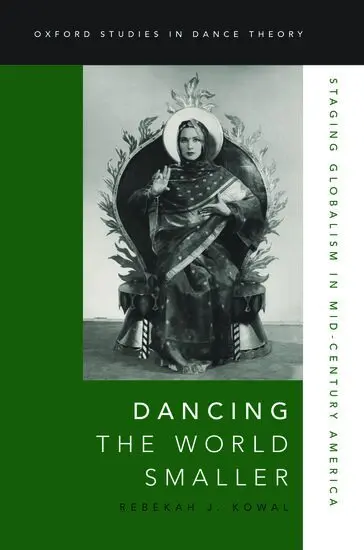
This is an open access title. It is available to read and download as a free PDF on the Oxford Academic platform. It is made available under a CC BY-NC-ND 4.0 International licence. Dancing the World Smaller examines international dance performances in New York City in the 1940s as sites in which dance artists and audiences contested what it meant to practice globalism in mid-twentieth-century America. During and after the Second World War, modern dance and ballet thrived in New York City, a fertile cosmopolitan environment in which dance was celebrated as an emblem of American artistic and cultural dominance. In the ensuing Cold War years, American choreographers and companies were among those the U.S. government sent abroad to serve as ambassadors of American cultural values and to extend the nation's geo-political reach. Less-known is that international dance performance, or what was then-called "ethnic" or "ethnologic" dance, enjoyed strong support among audiences in the city and across the nation as well. Produced in non-traditional dance venues, such as the American Museum of Natural History, the Ethnologic Dance Center, and Carnegie Hall, these performances elevated dance as an intercultural bridge across human differences and dance artists as transcultural interlocutors. Dancing the World Smaller draws on extensive archival resources, as well as critical and historical studies of race and ethnicity in the U.S., to uncover a hidden history of globalism in American dance and to see artists such as La Meri, Ruth St. Denis, Asadata Dafora, Pearl Primus, José Limón, Ram Gopal, and Charles Weidman in new light. Debates about how to practice globalism in dance proxied larger cultural struggles over how to reconcile the nation's new role as a global superpower. In dance as in cultural politics, Americans labored over how to realize diversity while honoring difference and manage dueling impulses toward globalism, on the one hand, and isolationism, on the other.
428 kr
Skickas inom 5-8 vardagar
This is an open access title. It is available to read and download as a free PDF on the Oxford Academic platform. It is made available under a CC BY-NC-ND 4.0 International licence. Dancing the World Smaller examines international dance performances in New York City in the 1940s as sites in which dance artists and audiences contested what it meant to practice globalism in mid-twentieth-century America. During and after the Second World War, modern dance and ballet thrived in New York City, a fertile cosmopolitan environment in which dance was celebrated as an emblem of American artistic and cultural dominance. In the ensuing Cold War years, American choreographers and companies were among those the U.S. government sent abroad to serve as ambassadors of American cultural values and to extend the nation's geo-political reach. Less-known is that international dance performance, or what was then-called "ethnic" or "ethnologic" dance, enjoyed strong support among audiences in the city and across the nation as well. Produced in non-traditional dance venues, such as the American Museum of Natural History, the Ethnologic Dance Center, and Carnegie Hall, these performances elevated dance as an intercultural bridge across human differences and dance artists as transcultural interlocutors. Dancing the World Smaller draws on extensive archival resources, as well as critical and historical studies of race and ethnicity in the U.S., to uncover a hidden history of globalism in American dance and to see artists such as La Meri, Ruth St. Denis, Asadata Dafora, Pearl Primus, José Limón, Ram Gopal, and Charles Weidman in new light. Debates about how to practice globalism in dance proxied larger cultural struggles over how to reconcile the nation's new role as a global superpower. In dance as in cultural politics, Americans labored over how to realize diversity while honoring difference and manage dueling impulses toward globalism, on the one hand, and isolationism, on the other.
2 034 kr
Skickas inom 5-8 vardagar
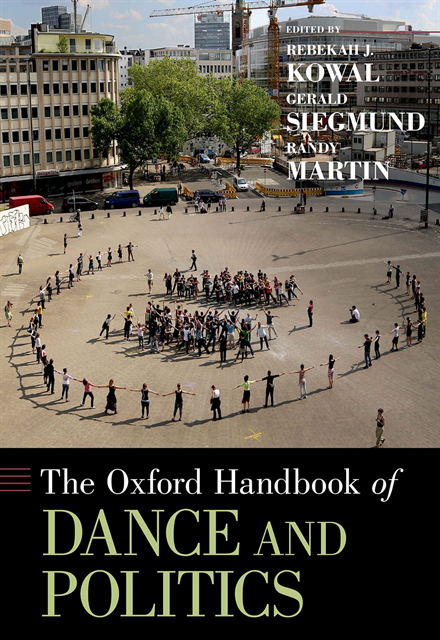
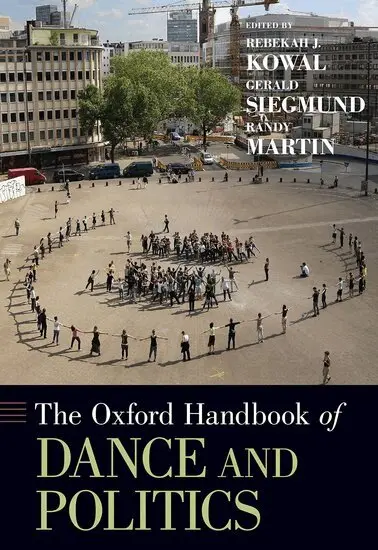
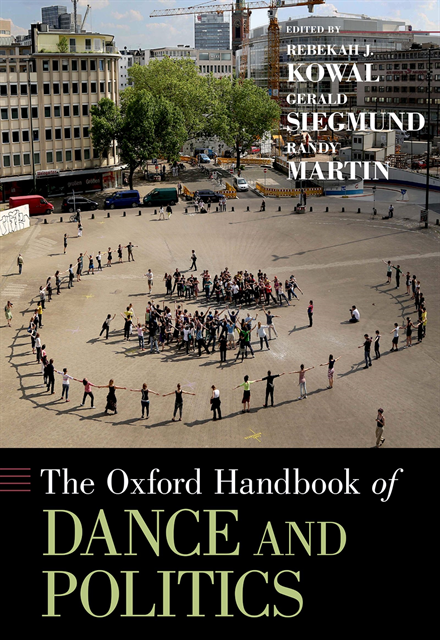
In recent decades, dance has become a vehicle for querying assumptions about what it means to be embodied, in turn illuminating intersections among the political, the social, the aesthetical, and the phenomenological. The Oxford Handbook of Dance and Politics edited by internationally lauded scholars Rebekah Kowal, Gerald Siegmund, and the late Randy Martin presents a compendium of newly-commissioned chapters that address the interdisciplinary and global scope of dance theory - its political philosophy, social movements, and approaches to bodily difference such as disability, postcolonial, and critical race and queer studies. In six sections 30 of the most prestigious dance scholars in the US and Europe track the political economy of dance and analyze the political dimensions of choreography, of writing history, and of embodied phenomena in general. Employing years of intimate knowledge of dance and its cultural phenomenology, scholars urge readers to re-think dominant cultural codes, their usages, and the meaning they produce and theorize ways dance may help to re-signify and to re-negotiate established cultural practices and their inherent power relations. This handbook poses ever-present questions about dance politics-which aspects or effects of a dance can be considered political? What possibilities and understandings of politics are disclosed through dance? How does a particular dance articulate or undermine forces of authority? How might dance relate to emancipation or bondage of the body? Where and how can dance articulate social movements, represent or challenge political institutions, or offer insight into habits of labor and leisure? The handbook opens its critical terms in two directions. First, it offers an elaborated understanding of how dance achieves its politics. Second, it illustrates how notions of the political are themselves expanded when viewed from the perspective of dance, thus addressing both the relationship between the politics in dance and the politics of dance. Using the most sophisticated theoretical frameworks and engaging with the problematics that come from philosophy, social science, history, and the humanities, chapters explore the affinities, affiliations, concepts, and critiques that are inherent in the act of dance, and questions about matters political that dance makes legible.