Reshmi Dutt-Ballerstadt - Böcker
Visar alla böcker från författaren Reshmi Dutt-Ballerstadt. Handla med fri frakt och snabb leverans.
3 produkter
3 produkter
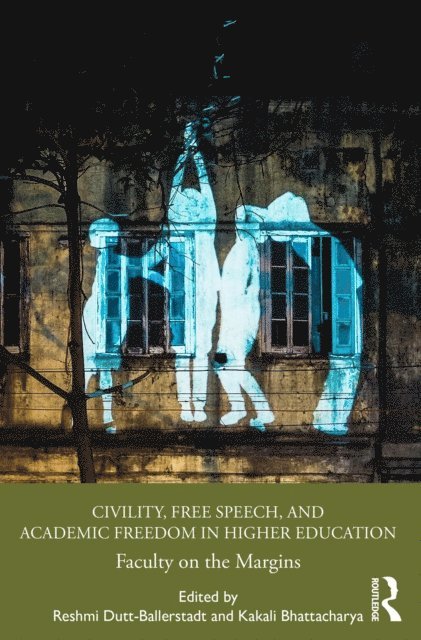
Civility, Free Speech, and Academic Freedom in Higher Education
Faculty on the Margins
Inbunden, Engelska, 2021
2 044 kr
Skickas inom 10-15 vardagar
Civility, Free Speech, and Academic Freedom in Higher Education: Faculty on the Margins represents a multidisciplinary approach, deploying different theoretical, methodological, sociological, political, and creative perspectives to articulate the stakes of civility for marginalized faculty within the landscape of higher education.How has the discourse on civility and free speech within academia become a systemic and oppressive form of silencing, suppressing, or eradicating marginal voices? What are some overt and covert ways in which institutions are using the logic of civility to control faculty uprising against the increasingly corporate-controlled landscape of higher education? This collection of essays examines the continuum between the post-9/11 and the post-Trump era backlashes. It details the organized retaliations against those in academia whose views and scholarships articulate their discontents against the U.S.-led "War on Terror." It contests the rise of White supremacy, Trump’s Muslim ban, anti-immigrant and racist government policies and rhetoric, and those who support the Boycott and Divestment Sanctions movements within the corporatized universities.All of these new and original essays shed light and further the debate on the various modes of civility that have become politicized within the U.S. academy. It will have a broad appeal to a cross section of national and international academics, activist scholars, social justice educators and researchers in the field of higher education.
Civility, Free Speech, and Academic Freedom in Higher Education
Faculty on the Margins
Häftad, Engelska, 2021
611 kr
Skickas inom 10-15 vardagar
Civility, Free Speech, and Academic Freedom in Higher Education: Faculty on the Margins represents a multidisciplinary approach, deploying different theoretical, methodological, sociological, political, and creative perspectives to articulate the stakes of civility for marginalized faculty within the landscape of higher education.How has the discourse on civility and free speech within academia become a systemic and oppressive form of silencing, suppressing, or eradicating marginal voices? What are some overt and covert ways in which institutions are using the logic of civility to control faculty uprising against the increasingly corporate-controlled landscape of higher education? This collection of essays examines the continuum between the post-9/11 and the post-Trump era backlashes. It details the organized retaliations against those in academia whose views and scholarships articulate their discontents against the U.S.-led "War on Terror." It contests the rise of White supremacy, Trump’s Muslim ban, anti-immigrant and racist government policies and rhetoric, and those who support the Boycott and Divestment Sanctions movements within the corporatized universities.All of these new and original essays shed light and further the debate on the various modes of civility that have become politicized within the U.S. academy. It will have a broad appeal to a cross section of national and international academics, activist scholars, social justice educators and researchers in the field of higher education.
866 kr
Skickas inom 5-8 vardagar
The twentieth century has witnessed the rise of a large population of postcolonial intellectual migrants «willingly» arriving from formerly colonized countries into the United Kingdom, the United States, and Canada to pursue intellectual goals. Embedded in this movement from the formerly colonized spaces into the West is the vexed question of dislocation and displacement for these intellectual subjects. The Postcolonial Citizen traces how such modes of (un)belonging are represented within literary and cultural space and how migrancy, and in particular the postcolonial «intellectual» migrant, is symbolically and philosophically understood as a cultural icon of displacement in the West. Using literary texts, autobiographical narrative of displacement, and cultural criticism, this book treats the cultural reception of intellectual migrancy (particularly within America) as both an uneasy and ambiguous condition. What is timely about this book’s treatment of migrancy is the current threat imposed on postcolonial writers and scholars in the United States post-9/11. The book examines and exposes the consequences of intellectually intervening into democratic ideals after the rise of the «national security state» – giving the migrant sensibility of dislocation a socio-political dimension. Thus, in dealing with the cultural reception of migrancy, The Postcolonial Citizen clearly marks the shift between pre- and post-9/11 migrant subjectivity and particularly addresses how the «third world» intellectual migrant has become synonymous with the voice of dissent and threat to the established democratic order in the United States.