R.G. Davies – författare
Visar alla böcker från författaren R.G. Davies. Handla med fri frakt och snabb leverans.
8 produkter
Computer Programming in Quantitative Biology
Av R.G. Davies
E-bok, 2012
717 kr
Lägg i varukorg
Computer Programming in Quantitative Biology covers the general background of Fortran coding and the more sophisticated computer programs likely to be encountered in quantitative biology. It discusses the application of over 40 appropriate and easily adaptable programming techniques to problems of …
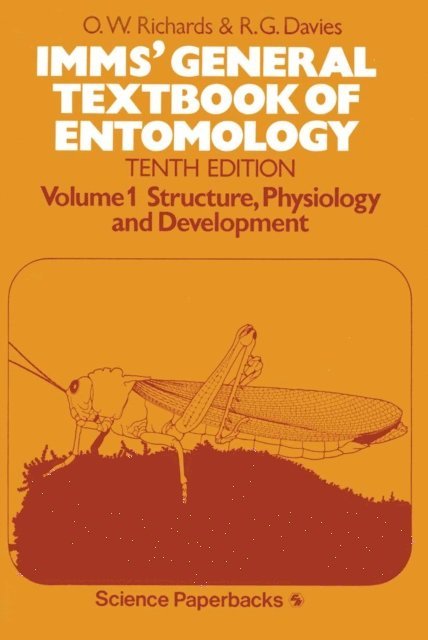
IMMS’ General Textbook of Entomology
Volume I: Structure, Physiology and Development
Av A.D. Imms, O.W. Richards m. fl.
Häftad, 1977
1853 kr
Lägg i varukorg
seem as appropriate now as the original balance was when Dr A. D. Imms' textbook was first published over fifty years ago. There are 35 new figures, all based on published illustrations, the sources of which are acknowledged in the captions. We are grateful to the authors concerned and also to Miss …
Imms’ General Textbook of Entomology
Volume 2: Classification and Biology
Av A.D. Imms, O.W. Richards m. fl.
Häftad, 1977
1093 kr
Lägg i varukorg
seem as appropriate now as the original balance was when Dr A. D. Imms' textbook was first published over fifty years ago. There are 35 new figures, all based on published illustrations, the sources of which are acknowledged in the captions. We are grateful to the authors concerned and also to Miss …
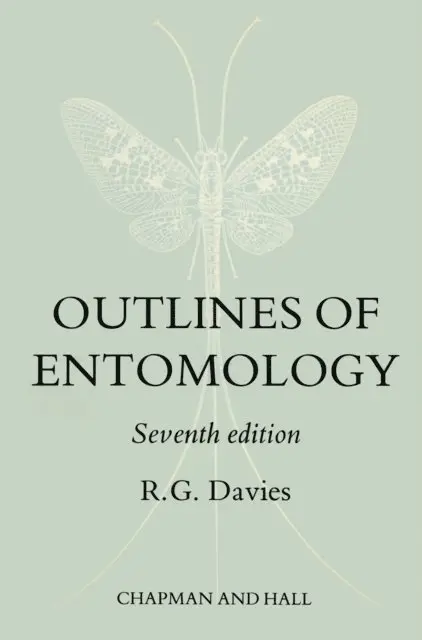
Outlines of Entomology
Häftad, 1988
1093 kr
Lägg i varukorg
The present edition may be regarded as a descendant, much changed and greatly enlarged, of the late Dr A. D. Imms' Outlines of Entomology, first published in 1942. This went through three further editions without much change, but after the death of the original author a fifth, revised edition by …
Outlines of Entomology
Av R.G. Davies
E-bok, 2012
1459 kr
Lägg i varukorg
The present edition may be regarded as a descendant, much changed and greatly enlarged, of the late Dr A. D. Imms'' Outlines of Entomology, first published in 1942. This went through three further editions without much change, but after the death of the original author a fifth, revised edition by …
IMMS' General Textbook of Entomology
Volume I: Structure, Physiology and Development
Av R.G. Davies, O.W. Richards m. fl.
E-bok, 2012
2428 kr
Lägg i varukorg
seem as appropriate now as the original balance was when Dr A. D. Imms'' textbook was first published over fifty years ago. There are 35 new figures, all based on published illustrations, the sources of which are acknowledged in the captions. We are grateful to the authors concerned and also to …
Imms' General Textbook of Entomology
Volume 2: Classification and Biology
E-bok, 2013
1459 kr
Lägg i varukorg
seem as appropriate now as the original balance was when Dr A. D. Imms'' textbook was first published over fifty years ago. There are 35 new figures, all based on published illustrations, the sources of which are acknowledged in the captions. We are grateful to the authors concerned and also to …
Imms’ General Textbook of Entomology
Volume 2: Classification and Biology
Häftad, 2014
1093 kr
Lägg i varukorg
seem as appropriate now as the original balance was when Dr A. D. Imms' textbook was first published over fifty years ago. There are 35 new figures, all based on published illustrations, the sources of which are acknowledged in the captions. We are grateful to the authors concerned and also to Miss …