R.H. Karlson - Böcker
Visar alla böcker från författaren R.H. Karlson. Handla med fri frakt och snabb leverans.
2 produkter
2 produkter
Del 23 - Population and Community Biology Series
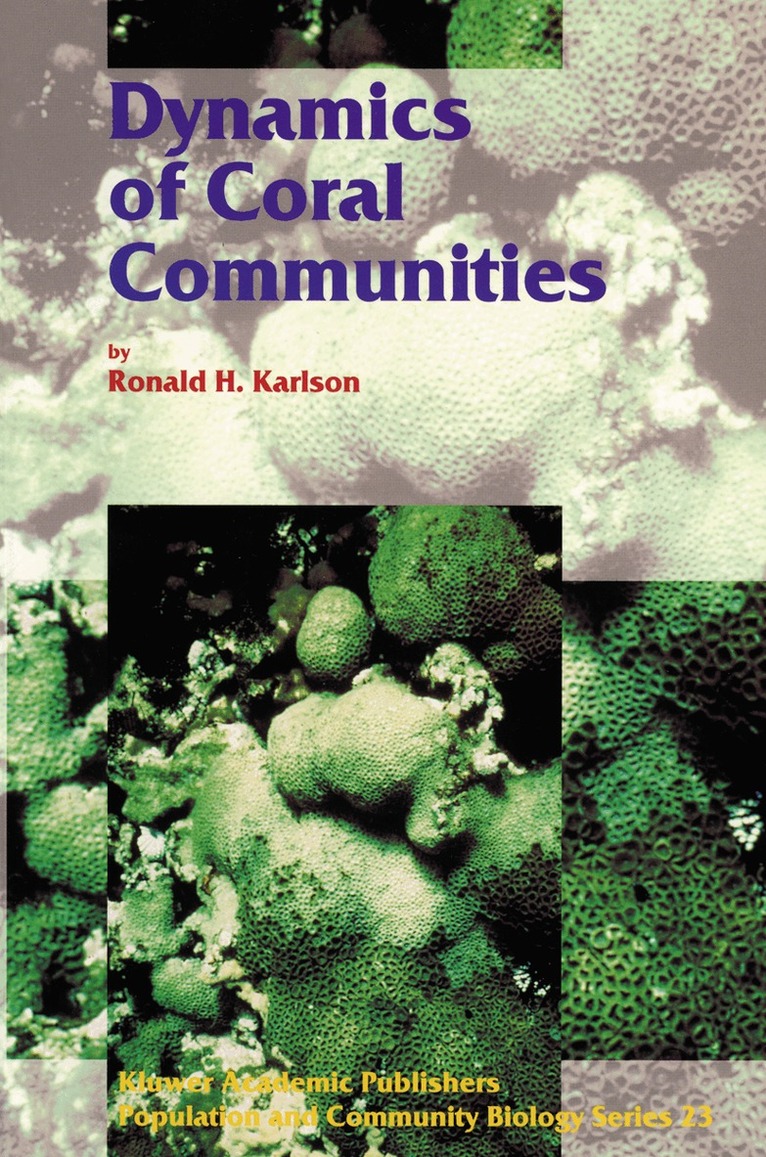
Dynamics of Coral Communities
Inbunden, Engelska, 1999
1 062 kr
Skickas inom 10-15 vardagar
This is a study of the dynamical processes influencing the structure of coral communities, some of the most biologically diverse communities on earth. A variety of biological and physical processes operating across an enormous range of spatiotemporal scales are highlighted (eg niche partitioning, biological interactions, disturbance phenomena, large-scale tectonic, eustatic, climatic and oceanographic processes). The focus on the community provides a framework for presenting some examples from the literature using multiple taxonomic groups (eg corals, fishes, encrusting invertebrates). The theoretical background and relevant evidence are provided for several important processes: the influence of keystone species on community stability; ecological succession; interspecific competition; consumer-resource interactions; disturbance-mediated species coexistence; saturation; limited membership; and regional enrichment. The merits of integrating the local perspective, emphasizing niche theory and biological interactions, with a larger historical-geographical perspective are discussed for coral communities in a biogeographical context.
1 062 kr
Skickas inom 10-15 vardagar
Coral communities are among the most fascinating of all biotic assemblages on earth. It is their rich diversity and the strong biological interactions which characterize these communities that provides the focus for this book. Here I describe patterns of diversity, species interactions, and community organization as well as the processes which influence these structural attributes. Although this treatment of the subject will to some degree blend evolutionary and ecological phenomena, I am primarily interested in the dynamic properties of living coral communities. Hence, such processes as succession, competition, predation, herbivory, and disturbances will be emphasized in ecological terms, but not to the exclusion of evolutionary considerations. The former influence the maintenance of diversity in coral communities and local distribution and abundance patterns. The latter deal primarily with the origins of diversity, adaptations to the local environment, biogeographic distributions, and longevity in the fossil record. With the recent resurgence of interest in historical and large-scale geographical effects on the local diversity of ecological communities, ecological and evolutionary perspectives are beginning to be integrated into our understanding of community organization and dynamics. Hence, a synthesis of these perspectives is attempted in the final chapter of this book. This effort emerges as a consequence of academic experiences, research interests, and the strong influence of several individuals. My first exposure to ecology occurred at Pomona College where three faculty members guided my early explorations into this subject.