Ricardo Zavala-Yoé – författare
Visar alla böcker från författaren Ricardo Zavala-Yoé. Handla med fri frakt och snabb leverans.
7 produkter
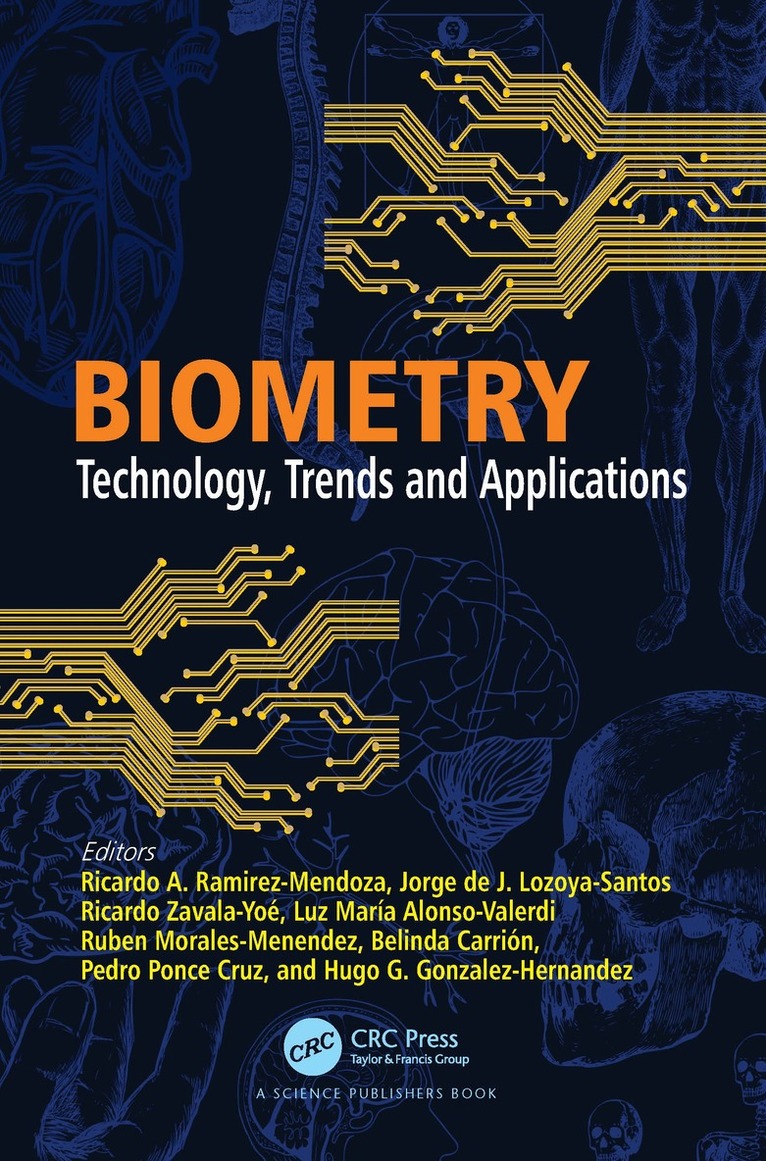
Biometry
Technology, Trends and Applications
Av Ricardo A. Ramirez-Mendoza, Jorge de J. Lozoya-Santos m. fl.
Inbunden, 2022
2578 kr
Lägg i varukorg
Biometrics provide quantitative representations of human features, physiological and behavioral. This book is a compilation of biometric technologies developed by various research groups in Tecnologico de Monterrey, Mexico. It provides a summary of biometric systems as a whole, explaining the …
Biometry
Technology, Trends and Applications
Av Ricardo A. Ramirez-Mendoza, Jorge de J. Lozoya-Santos m. fl.
Häftad, 2024
814 kr
Lägg i varukorg
Biometrics provide quantitative representations of human features, physiological and behavioral. This book is a compilation of biometric technologies developed by various research groups in Tecnologico de Monterrey, Mexico. It provides a summary of biometric systems as a whole, explaining the …
Biometry
Technology, Trends and Applications
Av Hugo G. Gonzalez-Hernandez, Pedro Ponce Cruz m. fl.
E-bok, 2022
963 kr
Lägg i varukorg
Biometrics provide quantitative representations of human features, physiological and behavioral. This book is a compilation of biometric technologies developed by various research groups in Tecnologico de Monterrey, Mexico. It provides a summary of biometric systems as a whole, explaining the …
Biometry
Technology, Trends and Applications
Av Hugo G. Gonzalez-Hernandez, Pedro Ponce Cruz m. fl.
E-bok, 2022
933 kr
Lägg i varukorg
Biometrics provide quantitative representations of human features, physiological and behavioral. This book is a compilation of biometric technologies developed by various research groups in Tecnologico de Monterrey, Mexico. It provides a summary of biometric systems as a whole, explaining the …
Modelling and Control of Dynamical Systems: Numerical Implementation in a Behavioral Framework
Inbunden, 2008
1128 kr
Lägg i varukorg
El que sabe que sabe es un sabio. S' ?guelo. El que no sabe que sabe esta dormido. Despi' ertalo. El que sabe que no sabe es sencillo. Instruyelo. ' El que no sabe que no sabe es un necio. Ap' artate de ' el (He who knows and knows he knows, he is wise. Follow him. He who knows and knows not he …
Modelling and Control of Dynamical Systems: Numerical Implementation in a Behavioral Framework
E-bok, 2008
1459 kr
Lägg i varukorg
Modelling and Control of Dynamical Systems: Numerical Implementation in a Behavioral Framework
Häftad, 2010
1095 kr
Lägg i varukorg
El que sabe que sabe es un sabio. S' ?guelo. El que no sabe que sabe esta dormido. Despi' ertalo. El que sabe que no sabe es sencillo. Instruyelo. ' El que no sabe que no sabe es un necio. Ap' artate de ' el (He who knows and knows he knows, he is wise. Follow him. He who knows and knows not he …