Richard Ambrosini - Böcker
Visar alla böcker från författaren Richard Ambrosini. Handla med fri frakt och snabb leverans.
3 produkter
3 produkter
299 kr
Skickas inom 10-15 vardagar
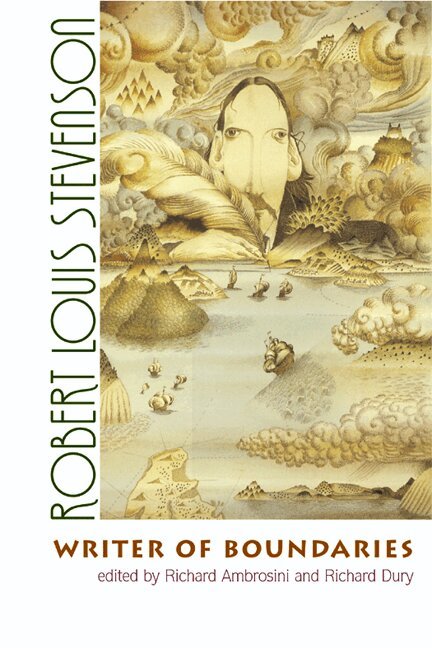
Robert Louis Stevenson: Writer of Boundaries reinstates Stevenson at the center of critical debate and demonstrates the sophistication of his writings and the present relevance of his kaleidoscopic achievements. While most young readers know Robert Louis Stevenson (1850 - 1894) as the author of ""Treasure Island"", few people outside of academia are aware of the breadth of his literary output. The contributors to ""Robert Louis Stevenson: Writer of Boundaries"" look, with varied critical approaches, at the whole range of his literary production and unite to confer scholarly legitimacy on this enormously influential writer who has been neglected by critics. As the editors point out in their Introduction, Stevenson reinvented the ""personal essay"" and the ""walking tour essay,"" in texts of ironic stylistic brilliance that broke completely with Victorian moralism. His first full-length work of fiction, ""Treasure Island"", provocatively combined a popular genre (subverting its imperialist ideology) with a self-conscious literary approach. Stevenson, one of Scotland's most prolific writers, was very effectively excluded from the canon by his twentieth-century successors, and rejected by Anglo-American Modernist writers and critics for his play with popular genres and for his non-serious metaliterary brilliance. While Stevenson's critical recognition has been slowly increasing, there have been far fewer published single-volume studies of his works than those of his contemporaries, Henry James and Joseph Conrad. ""The Robert Louis Stevenson Colloquium"", held at Gargnano, Italy, on Lake Garda in the summer of 2002, was attended by many of the world's leading Stevenson scholars.
493 kr
Skickas inom 7-10 vardagar
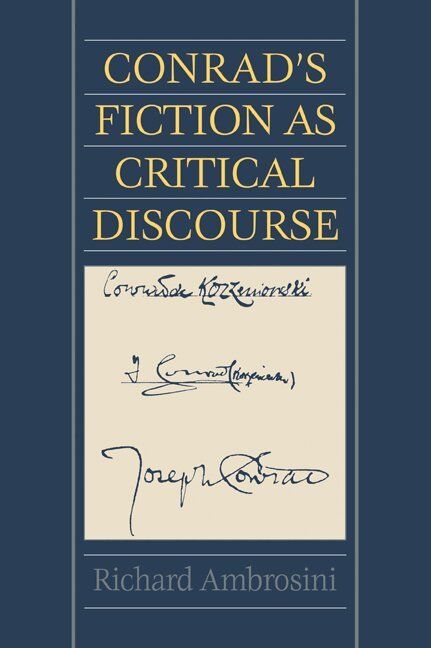
Joseph Conrad's comments about his works have commonly been dismissed as theoretically unsophisticated, while the critical notions of James, Woolf and Joyce have come to shape our understanding of the modern novel. Richard Ambrosini's study of Conrad's Fiction as Critical Discourse makes an original claim for the importance of his theoretical ideas as they are formed, tested, and eventually redefined in Heart of Darkness and Lord Jim. Setting the narrator's discourse in these tales in the context of the dynamic interplay of Conrad's fictional with his non-fictional writings, and of the transformations in his narrative forms, Ambrosini defines Conrad's view of fiction and the artistic ideal underlying his commitment as a writer in a new and challenging way. Conrad's innovatory techniques as a novelist are shown in the continuity of his theoretical enterprise, from the early search for an artistic prose and a personal novel form, to the later dislocations of perspective achieved by manipulation of conventions drawn from popular fiction. This reassessment of Conrad's critical thought offers a new perspective on the transition from the Victorian novel to contemporary fiction.
1 371 kr
Skickas inom 7-10 vardagar
Joseph Conrad's comments about his works have commonly been dismissed as theoretically unsophisticated, while the critical notions of James, Woolf and Joyce have come to shape our understanding of the modern novel. Richard Ambrosini's study of Conrad's Fiction as Critical Discourse makes an original claim for the importance of his theoretical ideas as they are formed, tested, and eventually redefined in Heart of Darkness and Lord Jim. Setting the narrator's discourse in these tales in the context of the dynamic interplay of Conrad's fictional with his non-fictional writings, and of the transformations in his narrative forms, Ambrosini defines Conrad's view of fiction and the artistic ideal underlying his commitment as a writer in a new and challenging way. Conrad's innovatory techniques as a novelist are shown in the continuity of his theoretical enterprise, from the early search for an artistic prose and a personal novel form, to the later dislocations of perspective achieved by manipulation of conventions drawn from popular fiction. This reassessment of Conrad's critical thought offers a new perspective on the transition from the Victorian novel to contemporary fiction.