Richard B. Bernstein - Böcker
Visar alla böcker från författaren Richard B. Bernstein. Handla med fri frakt och snabb leverans.
2 produkter
2 produkter
284 kr
Skickas inom 5-8 vardagar
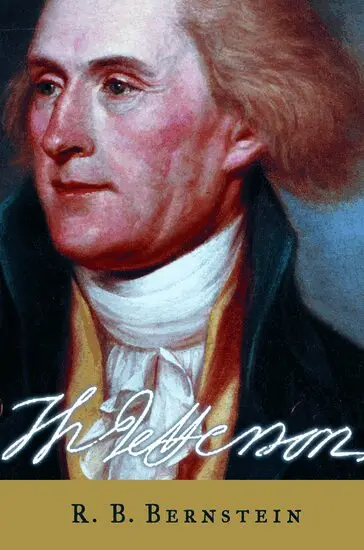
Thomas Jefferson designed his own tombstone, describing himself simply as "Author of the Declaration of Independence and of the Virginia Statute for Religious Freedom, and Father of the University of Virginia." It is in this simple epitaph that R.B. Bernstein finds the key to this enigmatic Founder--not as a great political figure, but as leader of "a revolution of ideas that would make the world over again."In Thomas Jefferson, Bernstein offers the definitive short biography of this revered American--the first concise life in six decades. Bernstein deftly synthesizes the massive scholarship on his subject into a swift, insightful, evenhanded account. Here are all of Jefferson's triumphs, contradictions, and failings, from his luxurious (and debt-burdened) life as a Virginia gentleman to his passionate belief in democracy, from his tortured defense of slavery to his relationship with Sally Hemings. Jefferson was indeed multifaceted--an architect, inventor, writer, diplomat, propagandist, planter, party leader--and Bernstein explores all these roles even as he illuminates Jefferson's central place in the American enlightenment, that "revolution of ideas" that did so much to create the nation we know today. Together with the less well-remembered points in Jefferson's thinking--the nature of the Union, his vision of who was entitled to citizenship, his dread of debt (both personal and national)--they form the heart of this lively biography. In this marvel of compression and comprehension, we see Jefferson more clearly than in the massive studies of earlier generations. More important, we see, in Jefferson's visionary ideas, the birth of the nation's grand sense of purpose.
1 832 kr
Skickas inom 7-10 vardagar
The Constitution of the United States is the product of a revolution in political thought as momentous as the winning of American independence. This profusely illustrated volume is a magnificent tribute to the oldest surviving charter of a federal republic. In a felicitous blend of words and pictures, Richard B. Bernstein retells the entire story of this revolution: the problems under the Articles of Confederation; the intense, often vituperative debate between Americans and Europeans over the brave new republican experiment; the arguing, reasoning, and reconciliation of interests before, during, and after the Federal Convention in 1787; the often bitter struggle for ratification in the thirteen states and the critical importance of The Federalist in the accompanying propaganda war; the beginnings of government under the Constitution; and the states' adoption of the Bill of Rights.The delegates to the Federal Convention were the foremost men of their states and regions—bookish but not reclusive, activist but not undisciplined, principled but not rigid. Bernstein's colorful description of the intellectual and political ferment they first created and then controlled brings to life their heroic effort. Along with these lost chapters of our history, he shows how experiments in government were a critical part of Americans' attempts to define their identity as a nation and a people.The Constitution was the result of no miracle; the outcome was never foreordained. A blend of theory and practicality, it was to be understood by all, not just by experts, and was no talisman against evils or unyielding to new experiences. As it bound up the founding generation, it was to be a guide to their successors. Illuminating his discussion—and our understanding—of the Constitution is a huge array of rare, in some cases unique, documents assembled by The New York Public Library for its exhibition commemorating the bicentennial of the Constitution.