Richard Everson - Böcker
Visar alla böcker från författaren Richard Everson. Handla med fri frakt och snabb leverans.
3 produkter
3 produkter
1 574 kr
Skickas inom 7-10 vardagar
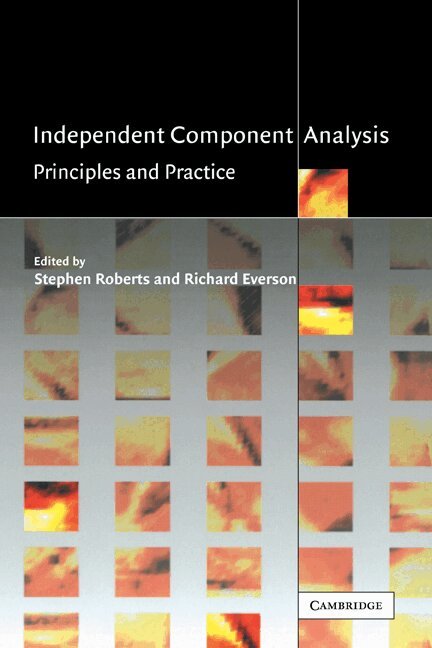
Independent Component Analysis (ICA) has recently become an important tool for modelling and understanding empirical datasets. It is a method of separating out independent sources from linearly mixed data, and belongs to the class of general linear models. ICA provides a better decomposition than other well-known models such as principal component analysis. This self-contained book contains a structured series of edited papers by leading researchers in the field, including an extensive introduction to ICA. The major theoretical bases are reviewed from a modern perspective, current developments are surveyed and many case studies of applications are described in detail. The latter include biomedical examples, signal and image denoising and mobile communications. ICA is discussed in the framework of general linear models, but also in comparison with other paradigms such as neural network and graphical modelling methods. The book is ideal for researchers and graduate students in the field.
Intelligent Data Engineering and Automated Learning - IDEAL 2004
5th International Conference, Exeter, UK, August 25-27, 2004, Proceedings
Häftad, Engelska, 2004
1 105 kr
Skickas inom 10-15 vardagar
The Intelligent Data Engineering and Automated Learning (IDEAL) conf- ence series began in 1998 in Hong Kong, when the world started to experience information and data explosion and to demand for better, intelligent meth- ologies and techniques. It has since developed, enjoyed success in recent years, and become a unique annual international forum dedicated to emerging topics and technologies in intelligent data analysis and mining, knowledge discovery, automated learning and agent technology, as well as interdisciplinary appli- tions, especially bioinformatics. These techniques are common and applicable to many ?elds. The multidisciplinary nature of research nowadays is pushing the boundaries and one of the principal aims of the IDEAL conference is to p- mote interactions and collaborations between disciplines, which are bene?cial and bringing fruitful solutions. This volume of Lecture Notes in Computer Science contains accepted papers presented at IDEAL 2004, held in Exeter, UK, August 25-27, 2004. The conf- ence received 272 submissions from all over the world, which were subsequently refereed by the ProgramCommittee.Among them 124 high-quality papers were accepted and included in the proceedings. IDEAL 2004 enjoyed outstanding keynote talks by distinguished guest speakers,Jim Austin, Mark Girolami, Ross King, Lei Xu and Robert Esnouf. This year IDEAL also teamed up with three international journals, namely the International Journal of Neural Systems,the Journal of Mathematical M- elling and Algorithms,and Neural Computing & Applications. Three special issues on Bioinformatics, Learning Algorithms,and Neural Networks & Data Mining, respectively, have been scheduled for selected papers from IDEAL 2004.
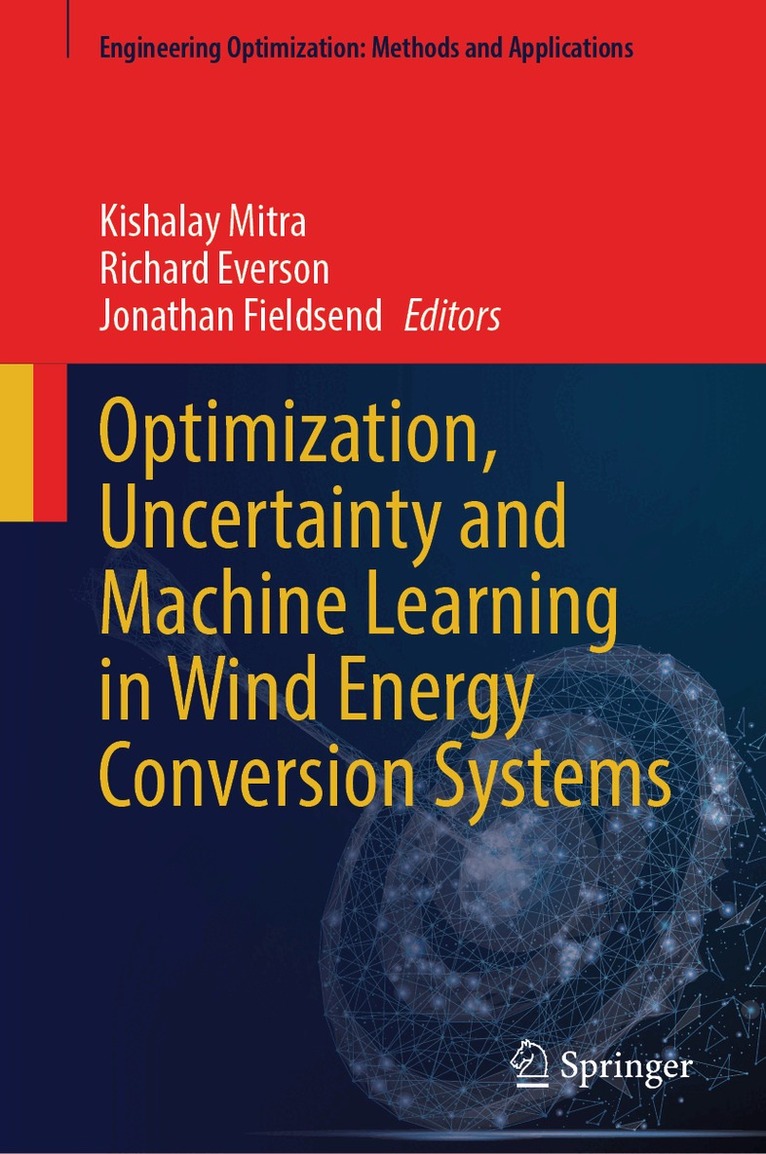
Optimization, Uncertainty and Machine Learning in Wind Energy Conversion Systems
Inbunden, Engelska, 2025
1 696 kr
Skickas inom 10-15 vardagar
This book presents state-of-the-art technologies in wind farm layout optimization and control to improve the current industry/research practice. The contents take readers towards a different kind of uncertainty handling through the discussion on several techniques enabling maximum energy harnessing out of uncertain situations. The book aims to give a detailed overview of such concepts in the first part, where the recent advancements in the fields of (i) Wind farm layout optimization, (ii) Multi-objective Optimization and Uncertainty handling in optimization methods, (iii) Development of Machine Learning-based surrogate models in optimization, and (iv) Different types of wake models for wind farms will be discussed. The second part will cover the application of the aforementioned techniques on the wind farm layout optimization and control through several chapters such as (i) Wind farm performance assessment using Computational Fluid Dynamics (CFD) tools, (ii) Artificial Neural Network (ANN) based hybrid wake models, (iii) Long Short-term Memory (LSTM) & Support Vector Regression (SVR) based forecasting and micro-siting, (iv) windfarm micro-siting using data-driven Robust Optimization (RO) as well as Generative Adversarial Networks (GANs), (v) Reinforcement learning (RL) based wind farm control and (vi) Application of eXplainable AI (XAI) tools for interpreting wind time-series data. In this manner, the book provides state-of-the-art techniques in the fields of multi-objective optimization, Evolutionary Algorithms, Machine Learning surrogate models, Bayesian Optimization, Data Analysis, and Optimization under Uncertainty and their applications in the field of wind energy generation that can be extremely generic and can be applied to many other engineering fields. This volume will be of interest to those in academia and industry.